Time Bomb – A policeman’s true story
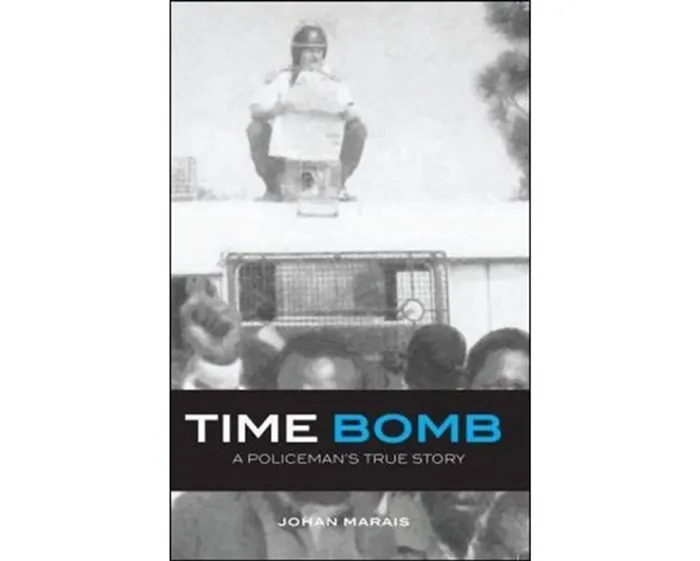
by Johan Marais (Tafelberg, R180)
These writings form the memoirs of a man advised by his doctor, who had apparently never encountered such a severe case of post-traumatic stress as his, to document his life story.
While it may be difficult for many readers to empathise with a person who comes across as corrupt and brutal as this man does, the author has clearly had innumerable experiences which go some way towards explaining his attitudes and actions.
I suspect that Marais may be correct in assuming that many policemen and women, as well as those who have served in the army, might relate to his story and the events which shape and mould this broken individual.
Many will probably recognise themselves and their own behaviour mirrored in this story, since it must be difficult for anyone to live with violence and not be affected.
The events of the writer’s childhood are sketched out for us and it seems his complicated relationship with alcoholic parents, an aunt and a mystery man who may or may not be his biological father, as well as other disturbing incidents which no child should be privy to, may be the seminal stage of his psychological troubles.
It comes as little surprise that Marais leaves school at 16 to follow his brother into the police, where he ends up working in a riot squad on the East Rand during the ’80s, a time when factional violence is at its peak.
He also joins up and fights as a member of the Rhodesian Light Infantry in that country’s war, and chooses to operate as a member of the reconnaissance unit Koevoet in Namibia, where he is further exposed to man’s inhumanity.
His resulting psychological degeneration is accompanied by alcohol abuse, a broken marriage and debilitating gout.
The book draws one in despite its less than eloquent turn of phrase. I found myself repulsed and yet wanting to know more.
I even wondered if similar circumstances would have had such a tragic effect on me.
Although he is clearly a victim of his circumstances, it seems Marais has chosen to hide little, if anything, and that he sometimes seems almost proud of his gruesome exploits, leaving the reader unsettled at his depravity. – Janine Magree