Rhumba
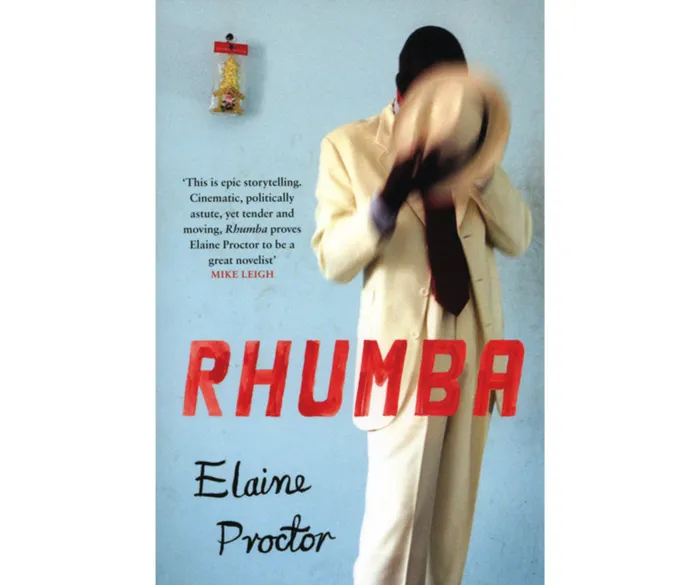
by Elaine Proctor (Quercus, R194.95)
Growing up in South Africa, Elaine Proctor developed an obsession with the Congo which, as a South African, she wasn’t allowed to visit at the time.
But she read about it, mostly in novels written by Westerners rather than Africans.
She became aware of the extremities of the place and a deep curiosity developed.
When she first arrived in London after her studies back home, she decided to write a film about the Congo. At the time, a strong Congolese community was establishing itself in London after Congolese immigrants were no longer welcomed in places like Belgium and France.
But what started out as a film script developed into her first novel many, many years later. First, she made contact with the Congolese community and even tried to dance the rhumba, which is also the title of her novel because it so beautifully captures the rhythms of the people and the place.
No research in the world, though, could give you the heartbeat of the people the way Elaine has managed to pin it down. Her African roots have heightened her consciousness and allowed her to reach into this world.
What she has found surprising, spending most of her life working on film, was the way writing allowed her a certain freedom.
“It was amazing to write the language the characters were going to speak in,” she says, “without the fear of anyone changing that.”
It is the control of the final product that makes her happy.
Her leap from film to books also allowed her to exercise the same muscles.
That made it easier to go much more deeply into the story and the characters. “I loved that,” she says.
Elaine says she was surprised by the joy of writing. She revelled in the craft. It was as if she were free of the imperatives of the market so part of the movie world, which is almost totally cost-driven.
Rhumba is the encounter of three souls – all different, and yet, there’s a coming together as each one unlocks some power for the other.
It is an unusual friendship, almost a collision: a young Congolese boy, Flambeau; a slick operator and older compatriot, Knight, who takes the young one under his wing; and his unlikely girlfriend Eleanor, a pale Scottish beauty who has more than lost her heart to this African warrior.
It’s a story of heartache and revelation as the young Flambeau, who has just landed in London, is in search of his mother.
No one seems to believe that she will appear. He latches on to the young Scottish lass and her gangster man, aptly called Knight, almost as if he can’t be all bad.
With Elaine’s strong attachment to film, the emphatic visual slant of the book makes sense.
It is written with colours, textures and flavours popping up all over the show, almost as if you are in the process of shaping your own movie.
“Word of Flambeau’s infraction seemed to have spread like pollen in the wind and once-friendly faces now regarded him with hooded eyes.”
Or perhaps: “Feather floated in the sky in deep and perfect silence.”
It seeps into your soul. She writes in a language that lies comfortably on the ear, and is accessible and artistic at the same time.
Perhaps it is because Elaine didn’t stray too far from her comfort zone. It is a story she has been carrying in her head and heart for many, many years which has had time to evolve and to knit its own fabric.
Writing about Africa and its people, especially about those sometimes lost souls operating away from the continent, the author can be sure that she will be exposing many of her readers to a new world.
These are people who seldom stray from their communities or share their lives. That’s what makes the story, the people and who they are so gripping.
In the real world, someone like Eleanor is a rarity, but the way she opens her life to those she feels touched by is what makes this an enchanting tale. Even if we are dealing with tough people and circumstances and the issue of illegal immigrants.
More and more, it is becoming part of everyone’s life and getting much harder to ignore.
How do you operate in that world? What if there’s nowhere else to go?
It’s all of that which opens new avenues to explore as this adventurous author taps into an almost Bonnie and Clyde-type story for the new millennium.
Confessing that her whole life is coloured by the fact that she came of age in South Africa’s darkest hour, Elaine also admits to a fascination with people who know how bad things can be.
This is where she takes us as she tells a story of voices that get lost in the clamour of the modern world. – Diane de Beer