

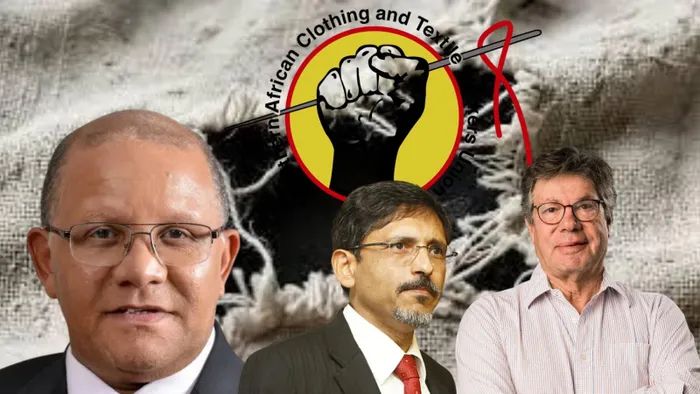
The Sactwo deal was facilitated at high political levels, with the involvement of union general secretary André Kriel, then-minister Ebrahim Patel and figures linked to Hosken Consolidated Investments (HCI), including veteran businessman Johnny Copelyn.
Image: IOL graphic
The claim that the Independent Media Consortium (IMC) owes the Southern African Clothing and Textile Workers’ Union (Sactwu) hundreds of millions is beginning to unravel under closer scrutiny.
At the centre of the case deliberated by the Supreme Court of Appeal (SCA) last week is a R150 million contribution by Sactwu’s investment arm, SIG, to the special purpose vehicle (SPV), Independent Media Consortium (IMC).
In a statement issued on Wednesday, Sekunjalo Investment Holdings said that it was important to clarify that the funds in question were not loaned to Sekunjalo Investment Holdings or any of its operating entities. Instead, the R150 million was advanced to the SPV— nominally referred to as Sekunjalo Independent Media (SIM), but in substance and in structure the Independent Media Consortium (IMC) — established specifically to acquire Independent Media. The SPV was a multi-shareholder consortium, and not synonymous with Sekunjalo.
Sekunjalo was one of approximately twenty shareholders in the consortium and did not receive the funds directly. The consortium included Sekunjalo Investment Holdings, led by Dr Iqbal Survé, the Public Investment Corporation, and a wide variety of other shareholders. However, contrary to circulated claims, Sekunjalo maintains that not a cent of this money was ever paid to the investment group or any of its entities. According to Sekunjalo, Sactwu did not enter the Independent Media deal as a conventional investor. Instead, the union allegedly approached the consortium for political reasons, seeking influence, publicity, and the prospect of a union-aligned newspaper.
The broader transaction — which saw Sekunjalo invest R1.3 billion and the Public Investment Corporation inject R850 million — returned ownership of Independent Media to South African hands after decades of foreign control. The deal itself was facilitated at high political levels, with the involvement of then-minister Ebrahim Patel and Blade Nzimande, and executed by union general secretary André Kriel alongside figures linked to Hosken Consolidated Investments (HCI), including Kevin Govender and veteran businessman Johnny Copelyn.
Central to the dispute is the flow of Sactwu’s R150 million. According to Sekunjalo, the money was channelled through the law firm ENSafrica (ENS), which then directed the funds to the PIC. A portion was retained by ENS for legal and advisory fees linked to the special purpose vehicle (SPV), the Independent Media Consortium (IMC). So if Sekunjalo never received the funds, on what basis is repayment being pursued?
Sekunjalo confirmed that ENS has been reported to the Legal Practice Council for conflicts of interest, including allegations that it converted what was originally an equity investment into a loan — a move that would materially benefit Sactwu’s position. So is it an investment or a loan — and who changed it? Sekunjalo maintains that Sactwu’s R150 million was initially an 8% equity investment in the SPV, not a loan. The distinction is crucial. If the funds were equity, Sactwu assumed investment risk. If they were a loan, repayment would be expected regardless of performance.
Who should Sactwu be pursuing? Sekunjalo’s statement suggests that Sactwu may be targeting the wrong entity entirely. Instead, it argues, the union should be seeking recovery from:
• Its own investment vehicle, SIG, which received the funds
• ENS, which structured and processed the transaction
• The PIC, which ultimately received the money
• And even its own historical investments, including about R400m lost in the highly publicised Trilinear fraud debacle that implicated senior politicians and union executives.
Sekunjalo further alleges that Sactwu and associated individuals benefited extensively from the relationship, including:
• Shares worth more than R1 billion in JSE-listed companies
• Dividends amounting to tens of millions of rand.
Despite this, the union is now seeking repayment while refusing to return shares or dividends, according to the statement.
The water is also muddied by Sactwu’s decision to convert its stake in the SPV into shares in Sagarmatha, an IT venture that ultimately did not list on the JSE. Now, Sekunjalo claims, the union is attempting to reverse that decision after the fact — effectively seeking to unwind an investment that did not yield the expected returns. In a dramatic twist, Sekunjalo has issued summons against Sactwu, claiming the union itself owes more than R500 million linked to funding provided for the union-backed newspaper World of Work (WOW). The union, it is alleged, has refused to repay these funds.
Who really funded Independent Media? Sekunjalo insists that it alone has carried the financial burden of sustaining Independent Media since 2013, contributing:
• R700 million directly
• R600 million indirectly
This, it says, ensured the business's survival and protected hundreds of journalism jobs — benefiting all shareholders, including Sactwu. As more information comes to light, more questions begin to emerge about Sactwu’s claims - right now, it’s just not adding up.
This story will be updated when a comment from Sactwu is received.
*Senekal de Wet is the Editor-in-Chief of Independent Media