

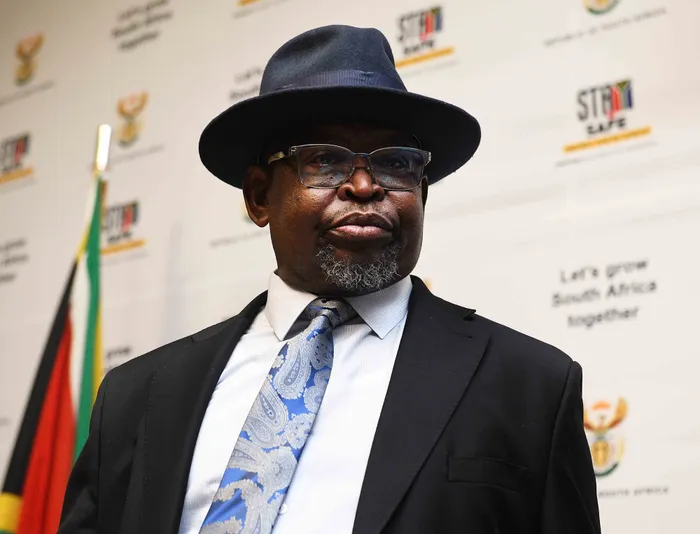
As South Africans wait for Godongwana’s address, the key question remains whether this National Budget delivers relief, restraint, or another year of careful balancing in an economy still searching for stronger momentum.
Image: Independent Newspapers
South Africa heads into the 2026 National Budget against a backdrop of fragile optimism, stubborn economic pressures and familiar anxiety about what Finance Minister Enoch Godongwana may unveil.
While markets have steadied and inflation has cooled from previous highs, the fiscal landscape remains tight.
Government faces rising expenditure demands, limited revenue flexibility and growing pressure to show that policy promises are translating into tangible outcomes.
Wednesday’s National Budget Speech is shaping up less as a moment of dramatic policy shifts and more as a test of how National Treasury balances competing priorities in a constrained environment.
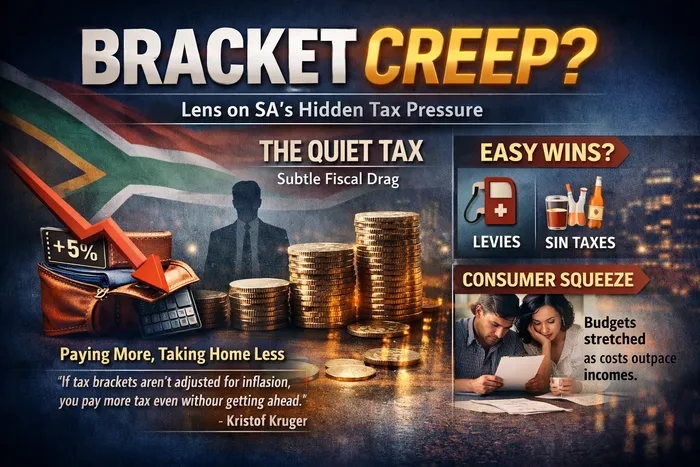
Much of the pre-Budget talk is around the tax thresholds and whether they will be adjusted.
Image: ChatGPT
One of the central tensions lies between political commitments and fiscal discipline.
President Cyril Ramaphosa’s recent pledges on strengthening healthcare, improving infrastructure and accelerating service delivery have raised expectations. But delivering on those ambitions requires money – and that money must come from either higher revenue, increased borrowing, or spending cuts elsewhere.
Ramaphosa’s health commitments are now facing their budget test, with funding allocations expected to reveal how much fiscal space National Treasury is willing, or able, to provide.
Economists say this National Budget will reveal the extent to which government can realistically fund those commitments without destabilising debt levels.
At the same time, ordinary taxpayers are bracing for the quieter risk of bracket creep.
Bracket creep, often described as a “silent tax”, occurs when income tax brackets are not fully adjusted for inflation. Salaries may rise on paper, but if tax thresholds lag price increases, more income is taxed at higher rates.
The result is a gradual erosion of take-home pay without any official announcement of tax hikes.
Tax specialists have warned that, if National Treasury opts for only partial inflation adjustments, millions of salaried South Africans could effectively pay more tax this year despite already strained household budgets.
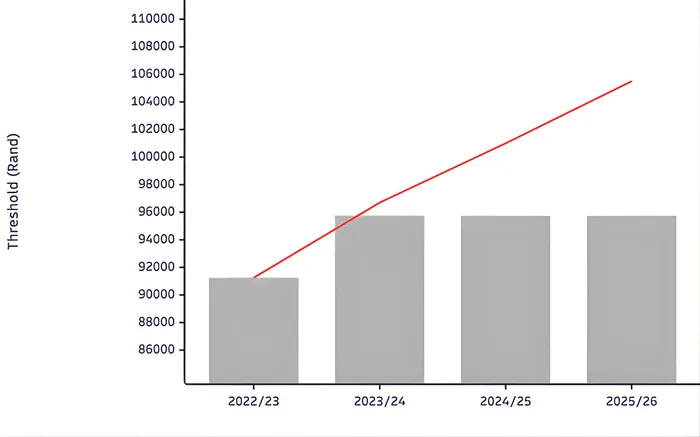
What happens when tax brackets aren't adjusted.
Image: Lance Collop CA(SA), CTA
For consumers already dealing with elevated food, transport and electricity costs, even small reductions in disposable income can have noticeable consequences.
Yet National Treasury does have at least one potential cushion.
A sustained rally in the gold price has bolstered mining sector profitability, lifting corporate tax receipts and royalties. The gold rally has emerged as an unexpected wild card for markets and the fiscus, potentially easing pressure on National Treasury’s revenue side.
However, analysts noted that commodity-linked windfalls are cyclical rather than structural.
Beyond personal income tax, attention is also turning to indirect taxes and levies.
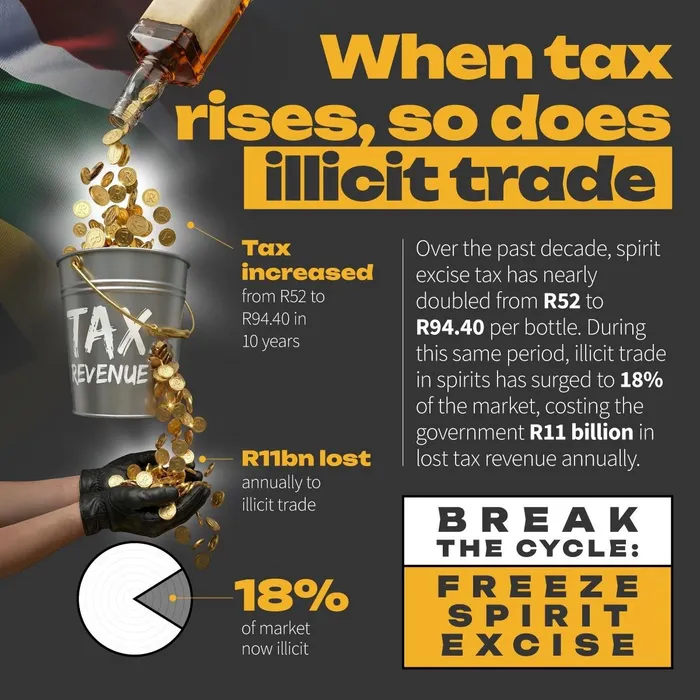
Tax on 750ml bottles of booze could go over R100 a bottle.
Image: Diageo
Excise duties are widely expected to rise again. IOL previously reported that spirits taxes could breach the R100 per bottle threshold, highlighting how sin tax increases continue to place upward pressure on consumer prices.
Industry bodies warned that steep hikes risk driving consumers toward illicit alternatives, undermining both legitimate businesses and tax collection.
Another tax instrument quietly hovering over the National Budget is Value-Added Tax (VAT).
VAT remains one of the state’s most reliable sources of revenue, yet also one of its most politically sensitive levers.
Last year’s National Budget demonstrated just how combustible VAT policy can be. A proposed increase triggered political divisions within the government of national unity and legal challenges before government ultimately backed down.
Godongwana confirmed VAT would lift to 15.5%, a reversal on a 17% proposal that avoided an immediate cost-of-living shock but left National Treasury managing a sizeable revenue shortfall.
The VAT noise led to the first time in South Africa’s democratic history that a National Budget was not passed last February, and it then had to be presented three times.
Against that backdrop, analysts told IOL it is highly unlikely National Treasury will revisit a VAT hike in this cycle.
However, debate around VAT may not disappear entirely.
Calls to expand the list of zero-rated goods could resurface as households continue grappling with rising living costs. Smaller technical adjustments, including potential tweaks to exemptions, also remain possible.
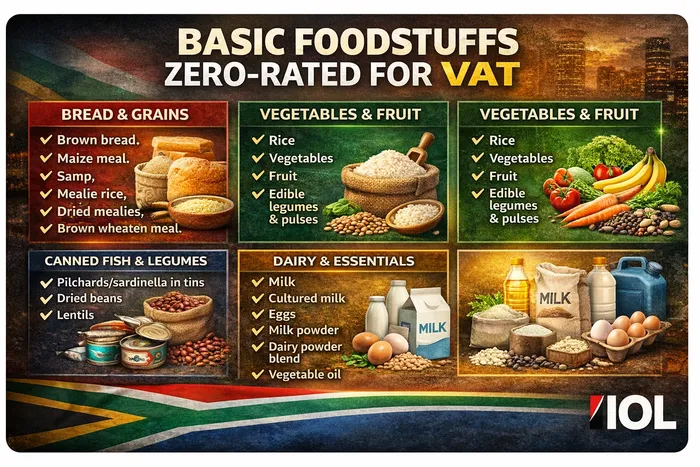
19 food items are zero-rated.
Image: ChatGPT
Even without VAT changes, indirect pressures persist.
Duties on alcohol and sugary drinks, along with various levies, may appear modest individually but accumulate over time, steadily stretching household budgets. In fact, the tax on spirits may go past R100 as alcohol taxes are again expected to be hiked.
There is also consensus that sin taxes will be increased – again – and that there may be higher fuel levies in aid of the Road Accident Fund.
Meanwhile, government’s broader fiscal credibility remains under scrutiny.
Debt stabilisation, expenditure control and growth-supportive reforms remain key themes for investors and ratings agencies.
Any signals that spending is accelerating without corresponding revenue certainty could unsettle markets.
The National Budget will also be judged on whether it signals meaningful support for economic growth.
For households, businesses and investors alike, National Budget 2026 may ultimately be defined not by headline shocks but by subtler shifts.
Individually modest, collectively significant.
As South Africans wait for Godongwana’s address, the key question remains whether this National Budget delivers relief, restraint, or another year of careful balancing in an economy still searching for stronger momentum.
IOL BUSINESS
As South Africans wait for Godongwana’s address, the key question remains whether this National Budget delivers relief, restraint, or another year of careful balancing in an economy still searching for stronger momentum.
Image: Independent Newspapers