

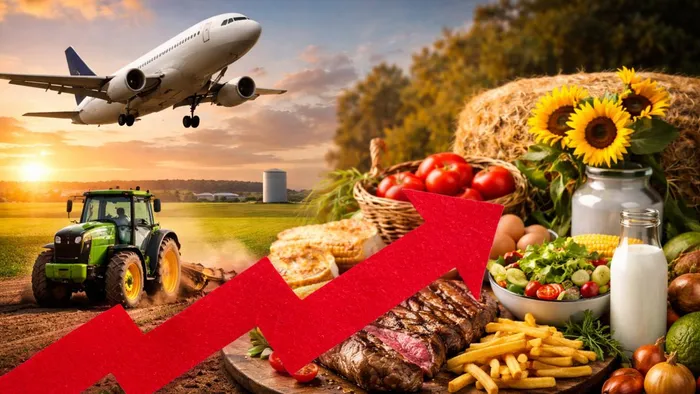
South Africans are facing a sharp rise in everyday costs as global fuel shocks ripple through the economy, pushing up the price of food, travel and borrowing.
Image: Graphic: Nicola Mawson | Freepik & ChatGPT
South Africans are facing a sharp rise in everyday costs as global fuel shocks ripple through the economy, pushing up the price of food, travel and borrowing.
What began as a surge in oil prices is now being felt directly in household budgets, with increases filtering through multiple layers of spending.
The increases are not isolated.
Fuel sits at the centre of the economy, meaning a rise at the pump feeds through into transport, production and logistics, and ultimately into the price of goods, services and borrowing.
The impact is already showing in inflation expectations.
Lesetja Kganyago, governor of the South African Reserve Bank (SARB), said recently that the bank was watching inflation. It modelled two scenarios:
“Given the oil price shock, we now project inflation to reach around 4% in the second quarter, with fuel inflation over 18%,” said Kganyago.
Nolan Wapenaar, head of fixed income and co-chief investment officer at Anchor Capital, said the SARB has revised its headline inflation forecast for 2026 upward to 3.7% from January’s 3.3% forecast.
Ahead of the most recent Monetary Policy Committee meeting, Independent economist Elize Kruger said: “The expected spike in fuel prices in early April will likely derail the moderate inflation outcome previously envisaged”.
At the centre of the increase is fuel.
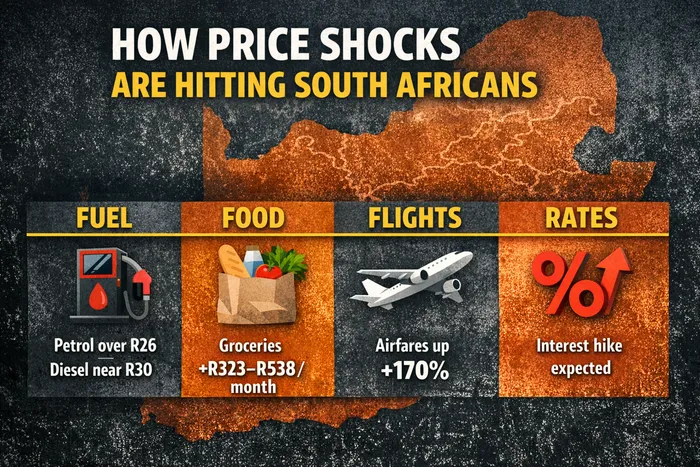
Petrol prices will rise by R3.06 per litre in April, while diesel will increase by between R7.37 and R7.51 per litre, following the latest adjustment. This comes as government is reducing the levy by around R3, taking the tax down to approximately R1 per l of fuel.
Prior to the announcement this afternoon, petrol seemed set for a price increase of between R5.31 for 93 Unleaded and R5.82 for 95 Unleaded.
Diesel looked like it could increase by between R10.13 in the case of 500ppm and R10.27 for the cleaner 50ppm based on projections from the Central Energy Fund.
Those figures were derived from the latest data and did not take account of government's proposed plan, announced on Tuesday, to temporarily cushion the blow with a R3 tax reprieve for April.
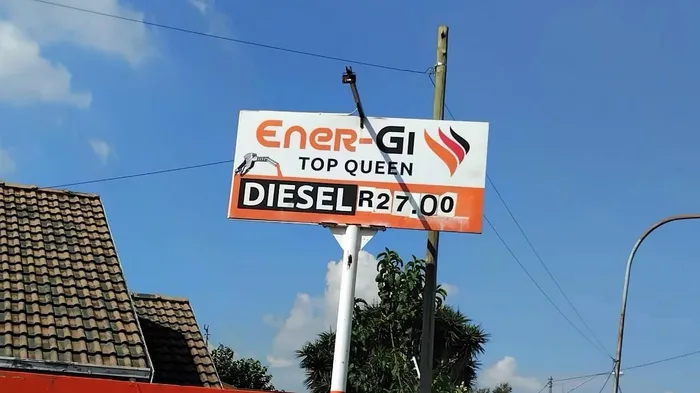
A Johannesburg petrol station had already increased the cost of diesel by early afternoon the day before prices were set to go up. Diesel was typically between R21.20 and R21.80 at this stage.
Image: Nicola Mawson | IOL
In the 2026 National Budget in February, predating the war, Finance Minister Enoch Godongwana announced a combined increase of 21 cents per litre in fuel levies, which will also take effect on 1 April 2026.
However, the fuel prices still translate into an increase of 15% for petrol and 40% for diesel month-on-month.
Apart from the massive spike in oil, which Trading Economics said this morning was back down to $107, it also noted that the “rand is on track for a nearly 8% decline in March, weighed down by heightened global uncertainty that spurred a shift toward dollar-denominated assets," which adversely affects fuel prices.
South Africans brace for the single biggest fuel hike in a month.
Image: Freepik
While the increase is lower than earlier projections, it is still expected to push inflation higher in the coming months.
Previous estimations had tomorrow's hike set to be the single biggest monthly increase on record, with this fuel shock rapidly feeding into the broader economy. While now more moderated, it is one of the sharpest monthly increases in recent years.
“Given the extent of these increases, the probability that these could trigger a widespread upward adjustment in prices across the economy is very high,” said Elize Kruger well ahead of the announcement.
Based on a fuel consumption of 15km per l (or a generous 6.7l per hundred km) consumers will pay between R300 and R460 more a month, depending on the actual hike and type of fuel.
Investec chief economist Annabel Bishop that businesses are unlikely to absorb higher fuel costs, meaning the increase will be passed through to consumers. The Competition Commission has already warned about price gouging on the back of pending fuel hikes.
The clearest spillover is in food – starting at the farm.
Higher diesel prices are raising the cost of planting, irrigation, harvesting and transport, while fertiliser prices, a major input cost, remain elevated due to global supply disruptions.
Transport alone can account for up to 10% to 15% of the final price of food, depending on distance and product type.
Based on the worst case fuel scenario, estimates suggested food inflation could rise between 6% and 10%, with households paying an additional R323 to R538 per month for basic groceries as the increases work through the system.
This is based on data from the Pietermaritzburg Economic Justice & Dignity Group’s Household Affordability Index, which showed the average household food basket cost R5,383.81 in February 2026.
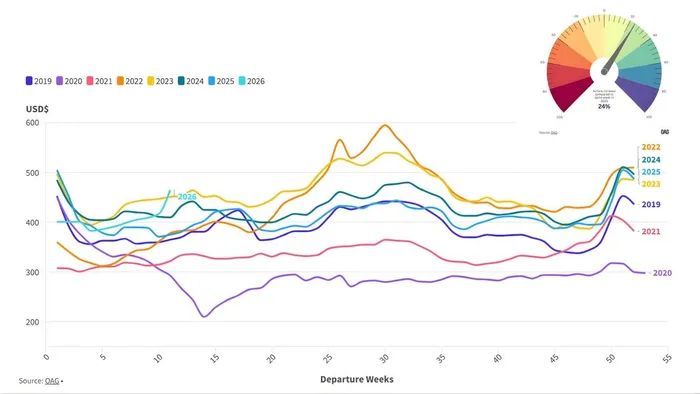
Historic price increases with data showing a 24% increase year-on-year.
Image: OAG
However, constrained fertiliser supply and elevated prices mean there is unlikely to be meaningful relief at the till point in the near term.
“South Africa’s agricultural sector is uniquely exposed to global shocks,” says Sanele Nkosi, Head of Agriculture at BDO South Africa. “Farmers rely heavily on imported inputs such as fertilisers, fuel and machinery, while selling into globally priced markets.”
Nkosi added that fertiliser can account for up to 50% of input costs in grain production. “If supply becomes unstable, farmers may reduce application, switch crops or plant less,” he added.
Fertiliser remains one of the most significant cost drivers in agriculture, with South Africa importing roughly 80% of its annual requirements, Wandile Sihlobo has said.
“The worsening inflation scenario will hit the purchasing power of salary earners,” said Kruger.
Travel costs have also been rising sharply.
Airfares on some routes have surged by as much as 170% in recent weeks, before coming down somewhat. This is based on pricing data across major routes between Europe and South Africa, as higher jet fuel costs combine with disrupted flight paths and reduced capacity.
One traveller said flights booked from Cyprus to Cape Town for R36,000 in December would now cost between R57,000 and R59,000 if rebooked via Europe.
“If we decided to buy new flights routed through Europe, it would have cost us between R57,000 and R59,000 per person… in 2022 we paid R12,000 for a return ticket,” the traveller said.
Price volatility has been particularly severe on routes between South Africa and Europe, where rerouting and demand spikes have driven sharp swings in ticket prices.
The pattern is consistent across sectors. Fuel costs rise first, followed by higher production and transport costs, which then feed into consumer prices. The situation has been aggravated by the age-old supply and demand economic model: school holidays and Easter have resulted in less seats and higher prices.
The Middle East war is creating the perfect storm.
Image: ChatGPT
The combined effect is increasing pressure on monetary policy.
As inflation rises, the South African Reserve Bank faces reduced room to cut interest rates.
The central bank’s latest repo rate forecast still points to a 0.25 percentage point cut by the end of 2026, suggesting a near-term hike could be followed by easing later in the year, said Bishop.
The Monetary Policy Committee left the repo rate unchanged at its most recent meeting but materially revised its inflation outlook as fuel price shocks began to filter through the economy, raising the risk of second-round effects.
PSG senior economist Johann Els said uncertainty remains high, but the risks have shifted, with the central bank’s best case scenario now including at least one 25 basis point hike.
Higher borrowing costs would add another layer of strain for households already dealing with rising expenses. The central bank’s next interest rate meeting is in May.
IOL Business