

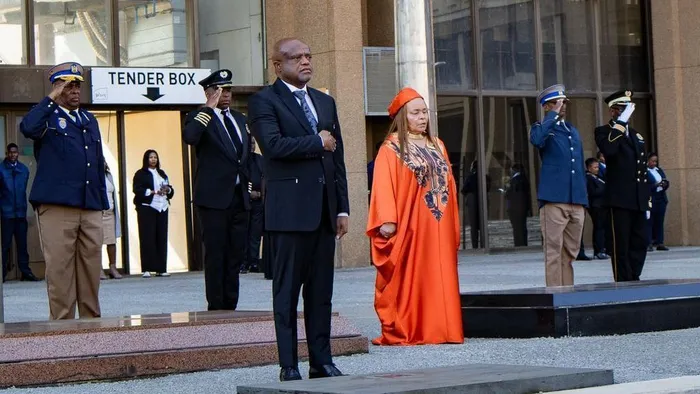
Dada Morero delivered the 2026 State of the City Address at the Cathedral Church of Saint Mary the Virgin in Johannesburg.
Image: City of Johannesburg
The Organisation Undoing Tax Abuse (OUTA) has criticised Johannesburg mayor Dada Morero’s 2026 State of the City Address, saying the speech presented an optimistic picture of a metro facing severe infrastructure, financial and service delivery pressures.
The outgoing mayor delivered the address this week at the Cathedral Church of Saint Mary the Virgin in Johannesburg, where he repeatedly described Johannesburg as a “performing City” built on a “solid foundation”.
The mayor positioned Johannesburg as the economic engine of South Africa and Africa, highlighting investment inflows, infrastructure projects, energy initiatives and service delivery interventions underway across the city.
However, OUTA said the city’s own disclosures pointed to deep operational and financial strain.
“The speech attempted to present Johannesburg as a city on a path to recovery, yet many of the City’s own admissions point to a municipality under severe strain,” OUTA executive manager Julius Kleynhans said.
The criticism comes after National Treasury recently warned that Johannesburg was facing severe financial distress, with the city owing creditors R25.2 billion while holding just R3.9 billion in cash – enough to cover only about 15.5% of its obligations.
A leaked letter from Finance Minister Enoch Godongwana to Morero warned that the municipality faced a funding gap of more than R21 billion and risked losing more than R8 billion in funding.
Treasury reportedly described the situation as “a marker of severe financial distress”, warning that the city did not have sufficient liquidity to meet its obligations.
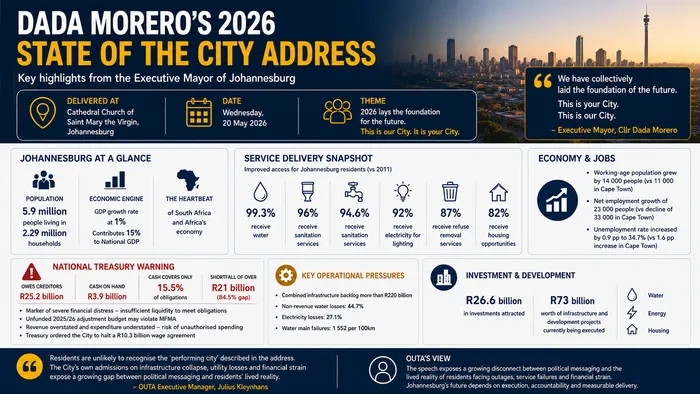
2026 State of the City for Johannesburg in numbers.
Image: ChatGPT
At the centre of the dispute was Johannesburg’s unfunded 2025/26 adjustment budget, which Treasury said may violate the Municipal Finance Management Act because revenue was overstated while expenditure was understated, potentially resulting in unauthorised spending.
Treasury also reportedly ordered the city to halt implementation of a controversial R10.3 billion wage agreement.
“You are hereby directed to stop proceeding with the implementation of this illegally signed agreement,” Godongwana reportedly warned, adding that it had the “potential to destroy the sustainability of the City of Johannesburg beyond this term of Office as well as the negative impact on the national economy at large.”
The warnings stand in contrast to Morero’s presentation of Johannesburg as a metro stabilising its finances and rebuilding investor confidence. During the speech, Morero said Johannesburg had adopted a fully funded R89.4 billion budget for 2025/26 and achieved a debt-to-revenue ratio target of 30%.
Morero also said the city had attracted R26.6 billion in investment and was executing R73 billion worth of infrastructure and development projects, including energy, housing and water initiatives.
At the same time, Morero acknowledged major operational pressures, including a combined infrastructure backlog of more than R220 billion, non-revenue water losses of 44.7%, electricity losses of 27.1%, and high levels of water main failures across the metro.
The mayor also highlighted improvements in service delivery, including what he described as “record-setting response time” during recent water crises and an 86% resolution rate for service delivery escalations.
OUTA disputed those claims, arguing that many residents and businesses continued to experience prolonged outages, poor communication and infrastructure failures.
“Residents living through collapsing infrastructure, water outages, refuse failures, billing chaos, and deteriorating roads are unlikely to recognise the picture presented in this address,” Kleynhans said.
Morero also used labour market data from Statistics South Africa to argue that Johannesburg’s economy remained resilient despite demographic and economic pressures. He said the city recorded net employment growth of 23,000 people while Cape Town recorded an employment decline of 33,000 over the same period.
The mayor further argued that lower levels of private medical aid membership in Johannesburg compared to Cape Town showed that residents continued to rely on the city’s public healthcare system.
OUTA rejected that interpretation, saying many residents used public healthcare because they could not afford private alternatives rather than because they were satisfied with public services.
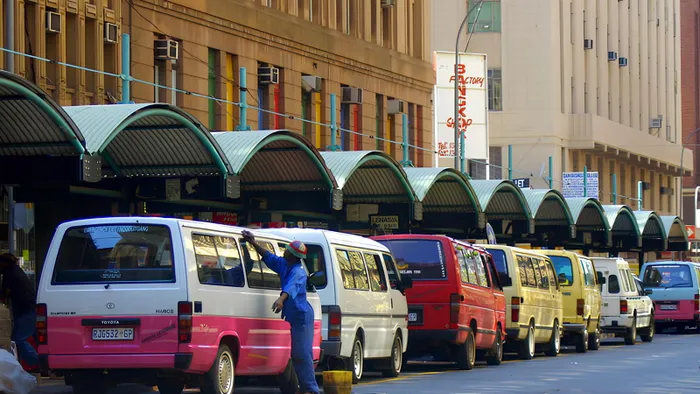
A taxi rank in downtown Jozzi.
Image: Nicola Mawson | IOL
The organisation also raised concerns about the timing of growing calls for provincial intervention in Johannesburg, warning that intervention discussions intensifying months before local government elections raised questions about accountability and governance.
OUTA said Johannesburg’s recovery would require measurable delivery rather than political messaging.
“Johannesburg residents have heard promises of renewal and turnaround for years,” Kleynhans said. “Increasingly, people are no longer judging government by speeches or slogans. They are judging government by lived experience.”
IOL BUSINESS