

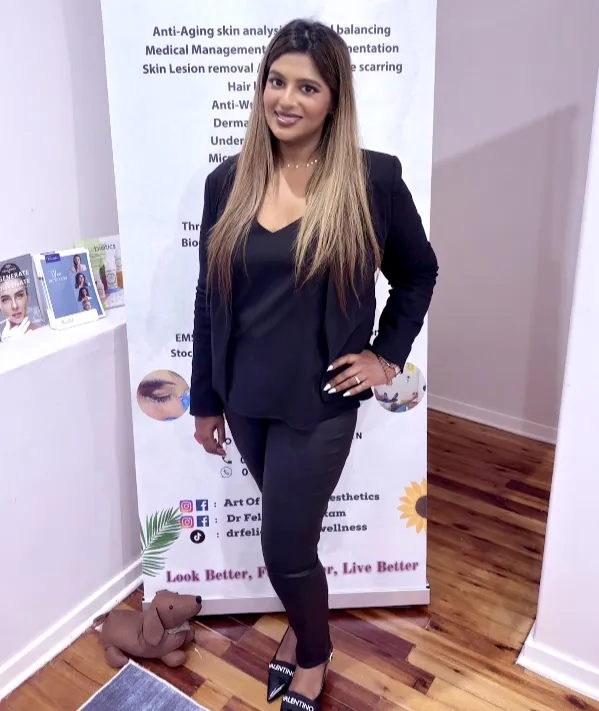
Dr Felicia Manickam opens about the art of wellness and how to stay youthful at every age.
Image: Supplied
In a digital world saturated with quick fixes and viral health trends, Dr Felicia Manickam is offering something refreshingly grounded: a return to holistic, accessible wellness.
The Durban-based GP and founder of Art of Wellness has built a loyal online following by bridging the gap between clinical medicine and everyday lifestyle choices - all while staying rooted in her own story.
For Manickam, that story begins far from the polished world of aesthetic medicine and curated wellness routines.
“I was born at RK Khan Hospital and raised for a time in an outbuilding without hot water. There were years I wore my aunties’ hand-me-downs. Life was simple, sometimes hard, but it shaped everything I am.”
Raised by parents who prioritised education above all else, Manickam describes a childhood defined by sacrifice, discipline and quiet resilience.
“My mother is the hardest working woman I know,” she reflects.
“She completed her degree while working, raising children, and being a wife … My father is the gentlest soul - he spent his free time teaching me words on flashcards and patiently answering every question I had.”
Although she always envisioned a future in healthcare, becoming a doctor was less about prestige and more about purpose.
“For me, success always meant studying hard so I could one day help the people around me. I didn’t grow up dreaming specifically of being a doctor - but I always knew I would work in healthcare.”
That purpose deepened during her decade-long experience working with cancer patients - a period that would ultimately reshape her approach to medicine.
“I became consumed by one question: why? Not just how do we treat disease - but what leads us there in the first place?”
The answer led her into integrative and functional medicine, and eventually to the creation of Art of Wellness - a platform designed to make preventative health accessible.
“The people I grew up around were focused on survival … There wasn’t space to think about vitality or longevity,” she explains.
“But in those integrative medicine spaces, I encountered people who lived by entirely different principles … I remember thinking: why should that be a privilege?”
Her solution was simple but powerful: translate wellness into something practical.
“Look better. Feel better. Live better. It’s not a luxury philosophy - it’s a practical one, built for real people with real lives.”
Central to her philosophy is a redefinition of wellness itself - one that extends far beyond aesthetics.
“I think of it in three layers: mental health first, physical health second, and appearance last. In that order, always,” she says.
“I can give someone clear skin, but if the confidence isn’t built from the inside, they will find something else to fix. That’s not healing - that’s chasing.”
Her approach resonates strongly in an era increasingly focused on outward perfection, particularly when discussing ageing.
According to Manickam, one of the most overlooked factors is not skincare, but muscle.
“People with good muscle reserve age better, recover from illness faster, and maintain a healthier metabolism for longer,” she explains.
“Weight training isn’t just for athletes - it is one of the most important investments you can make in your future self.”
Beyond that, she points to what she calls the “normalised accelerants” of ageing: chronic stress, poor sleep, and a lack of purpose.
“These aren’t soft concepts - they have measurable biological impact.”
Her online presence, while influential, is carefully balanced with medical responsibility.
“I try to speak about what I see in real clinical practice - not trends,” she says.
“Medicine is deeply individualised … I guide people online, but I’m always clear: this is general information, not a prescription.”
That clarity becomes especially important in an age of misinformation, where harmful trends can spread rapidly.
Among the most concerning, she highlights skin-lightening practices and unregulated weight-loss products.
“If it doesn’t have a label, it does not belong on or in your body,” she warns.
A key part of her work is also deeply personal: speaking directly to the South Asian diaspora.
“Because I am that audience,” she says simply.
“Healthcare is not one-size-fits-all. Cultural context shapes everything - our diets, our beliefs, our relationship with emotional expression.”
She notes that within these communities, conversations around health need to evolve.
“Our typical diet … contributes significantly to insulin resistance and increased colorectal cancer risk,” she explains.
“We tend to prioritise academics, sometimes at the cost of physical activity… These conversations are overdue.”
While her work spans both wellness and aesthetics, Manickam is deliberate about maintaining authenticity in a space often driven by unrealistic standards.
“The goal is always enhancement, never erasure,” she says. “If it’s coming from a place of pure insecurity or outside pressure, we pause.”
As cosmetic procedures become more accessible, she acknowledges the dual nature of that shift.
“Honestly, both, but I think the pressure is winning at the moment,” she says.
“No procedure will ever be enough if the internal work hasn’t been done.”
Ultimately, her message circles back to something far less complicated - but far more difficult to practise.
“Chronic stress is one of the most powerful accelerants of biological ageing,” she says.
“But rest, reflection, and genuine human connection … It’s medicine.”
And perhaps, in true Art of Wellness fashion, she leaves room for both science and softness: “And on a lighter note - chronic frowning really does lead to deep-set forehead lines. So for purely aesthetic reasons alone: find your peace.”