


The industry that was never designed with Afro-textured hair in mind.
Image: Jedidiah-Jordan O / Pexels
For years, hair transplantation has quietly failed a large group of patients, and not for the reasons many assume.
It is not about hair being “too difficult” or “too different”. It is about an industry that was never designed with Afro-textured hair in mind.
Across the globe, standard transplant techniques have been built around straight hair follicles.
But beneath the scalp, Afro-textured hair behaves very differently. It curves, bends and often spirals, which changes everything when it comes to surgical precision.
“We’re taught to extract follicles at a perpendicular angle,” explains Dr Nishal Kalan, a surgeon and Afro-textured hair specialist at Alvi Armani South Africa.
“But Afro hair curves and sometimes spirals completely beneath the skin, which means that standard punches slice right through the shaft. We often consult patients who have had two, sometimes three, failed procedures elsewhere. The transection rates are catastrophic.”
It is a stark reality that many patients only discover after multiple unsuccessful procedures.

Beneath the scalp, Afro-textured hair behaves very differently.
Image: Mukhtar Shuaib Mukhtar / Pexels
The numbers help explain why a one-size-fits-all approach simply does not work.
African patients are significantly more prone to keloid scarring, with risks far higher than in other groups.
At the same time, their hair strands are thicker, yet grow at a lower density.
That combination demands a far more tailored approach. Precision becomes critical, not optional.
Instead of forcing a standard technique onto a different hair type, some clinics are now adapting their tools.
Specialised curved extraction punches and skin-responsive FUE devices are designed to follow the natural shape of the follicle beneath the scalp, rather than cutting against it.
The aim is to reduce damage during extraction and improve long-term results.
Post-treatment care is also evolving, with therapies focused on healing and reducing scarring, something that has historically been a major concern for patients.
Hair loss in African patients is not only about genetics. For many women, everyday styling choices play a significant role.
Tight braids, weaves and chemical treatments have led to a rise in traction alopecia, a form of hair loss caused by prolonged tension on the scalp.
It often starts subtly, with thinning edges, but can become permanent if left untreated.
Dr Kalan recalls a recent consultation with a South African media professional who had worn braids for most of her adult life.
By the time she sought help, the damage had already progressed too far for a transplant.
“We opted for regenerative therapy instead, which entails coaxing dormant follicles back to life where possible,” he says.
It is a situation that is becoming increasingly common. What makes it more concerning is how long many women wait before seeking help.
“The tragedy isn’t just the hair loss itself, but how long women wait before seeking help,” he says.
“Five years can make the difference between saving a hairline and losing it permanently. The industry has failed these patients. Not due to a lack of solutions, but by never offering them in the first place.”
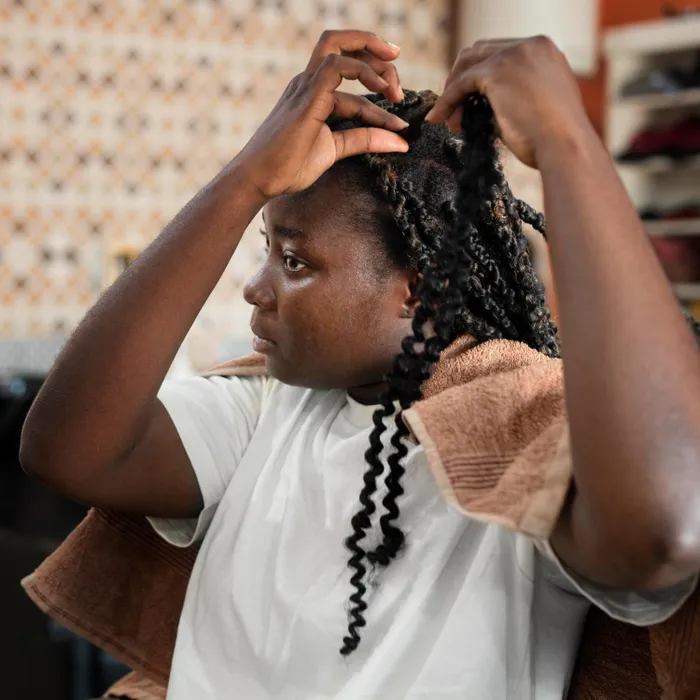
Tight braids, weaves and chemical treatments have led to a rise in traction alopecia, a form of hair loss caused by prolonged tension on the scalp.
Image: Freepik
There is, however, a growing shift in how Afro-textured hair is being treated within the medical space.
“Afro hair actually gives us an advantage. Because it’s thicker and curlier, it creates more visual volume. We can achieve full, natural-looking coverage with fewer grafts, but only if we respect the biology,” says Dr Kalan.
That understanding is opening the door to more successful outcomes, not just for scalp hair, but also for beards, eyebrows and other areas affected by hair loss.
There is also a broader move towards greater inclusivity in access to treatment.
Through partnerships with organisations such as the Cancer Association of South Africa, some clinics are extending support to cancer survivors dealing with treatment-related hair loss, an area that has often been overlooked.
For a long time, many African patients were told that their hair was too complex for reliable transplantation. That mindset is slowly being challenged.
“Hair loss doesn’t care about your story,” Dr Kalan says. “But your story should determine your treatment. That’s what we’ve been missing.”
Science has caught up. The tools exist. What remains is ensuring that patients have access to the right expertise and are no longer told that nothing can be done.