

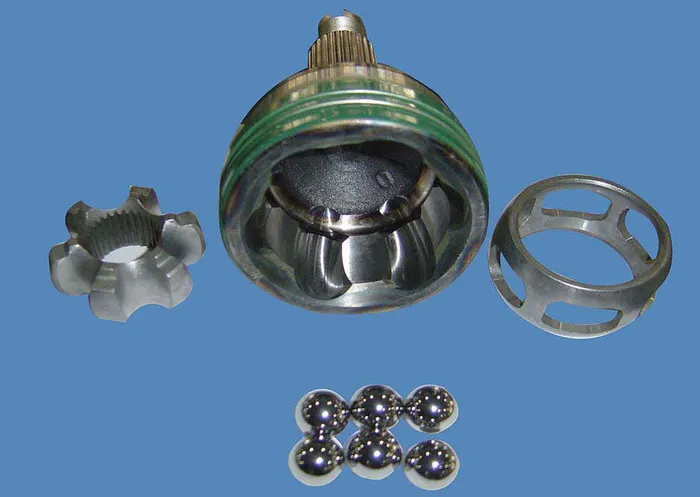
A constant-velocity joint dismantled to show its constuent parts. A constant-velocity joint dismantled to show its constuent parts.
The advent of front-wheel drive tolled the death knell for universal joints because the latter could work only at small operating angles and with angles of up to 40 degrees on front-wheel drive, the universal joints could not cope. And so in came the constant-velocity joint.
But first let us look at a typical universal joint operating angle. Imagine a transmission installation of, say, five degrees from horizontal and a driveshaft operating angle of eight degrees.
Subtract the transmission angle from the driveshaft angle it gives us three degrees - which the universal joint could handle.
So why could the universal joint not cope with steeper angles?
If two shafts are angled and the driving shaft rotates at a constant angular velocity, every 90 degrees the driven shaft is slower than the driving shaft, then faster.
In other words, it has a cyclical variation every 90 degrees and this means vibration. OK, at up to, say, 10 degrees this is acceptable, but the higher the angular displacement, the more the velocity variation and vibration increases.
Then along came front-wheel drive with operating angles of up to 40 degrees. There is no way universal joints could manage that, so constant-velocity joints appeared. But what exactly does constant-velocity mean?
With constant-velocity joints both balls and cage remain in the plane which bisects the angle between the driving and driven shafts even when the angle changes. Driving and driven shafts rotate at the same angular velocity.
This means no cyclical variation and no vibration problems.
Constant-velocity joints wear and regular checking of the rubber boots and ensuring there is still sufficient grease inside is essential.
There are clip-on boots which make renewal easier.
If you are not afraid to get your hands dirty, it’s a good idea at every 50 000km to strip, clean and re-grease where this is possible. I say where this is possible because many of the Japanese type cannot be dismantled. Check with the local garage about the difficulty of working on your car’s constant-velocity joints. You may slip a pipe under the rubber and pump grease in. This might deaden a knock but does not guarantee the bearing surfaces will be properly lubricated if old grease has formed a barrier there.
IMMEDIATE ATTENTION NECESSARY
Worn constant-velocity joints will knock as the balls run over pits in the raceways. When this occurs on tight turns only, you can reckon on a few thousand kilometres more before renewal becomes necessary.
Knocking during tight turns under power means wear in the outer joints. Immediate attention is necessary if knocking is heard in the straight-ahead position.
Drive in a constant circle easing power on and off to check for wear on inner joints. Lastly, study the manual before working on constant-velocity joints. An incorrectly assembled constant-velocity joint will collapse in seconds!