

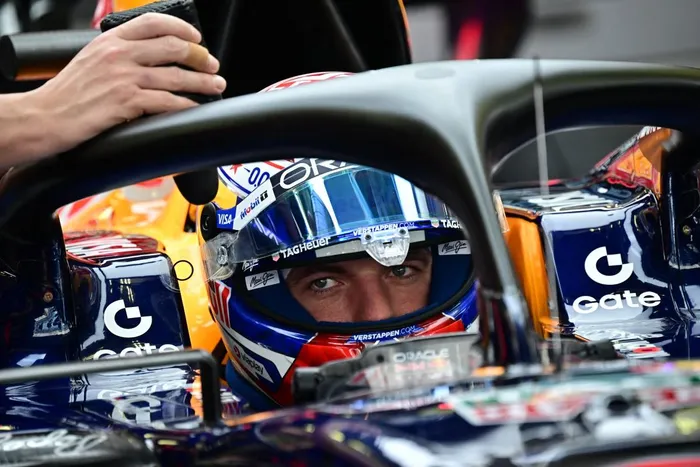
Red Bull Racing's Max Verstappen sits in his car during the first day of Formula One pre-season testing in Bahrain.
Image: AFP
“You can’t just go flat out anymore.” That was the blunt assessment from Max Verstappen when asked about Formula 1’s new-generation 2026 machinery during pre-season testing in Bahrain.
For a driver whose identity has been built around relentless pace and instinctive aggression, the inability to simply attack every lap cuts to the core of what he believes the sport should be. Instead of pushing to the absolute limit, Verstappen says drivers are now “constantly managing, constantly thinking about energy,” and that shift fundamentally changes the experience behind the wheel.
His biggest frustration lies with the new power unit philosophy. From 2026, Formula 1 moves towards an almost equal split between internal combustion and electric power. While the intention is to modernise the championship and make it more road-relevant, Verstappen believes the emphasis has swung too far.
“It’s more about management than racing,” he explained, describing the cars as feeling “not very Formula 1-like.”
The heavy reliance on electrical harvesting and deployment means drivers must plan corners in advance — lifting and coasting, adjusting brake migration, and carefully timing energy release rather than simply extracting maximum performance. Verstappen even went as far as to label the concept “anti-racing,” adding that the cars feel “like Formula E on steroids.”
"It is not that they are slow, but that the speed comes in controlled bursts dictated by battery state rather than pure mechanical grip and aerodynamic load. You’re basically driving around to charge the battery half the lap. That’s not what I enjoy.”
For a driver who thrives on rhythm and momentum, that interruption is jarring. Historically, Formula 1 cars have possessed character. Some required bravery on corner entry, others rewarded patience on the throttle, and the best allowed drivers to lean on them relentlessly. Verstappen suggests the 2026 machines lack that personality.
“It just doesn’t feel natural. The car doesn’t really have a character, because you’re always limited by energy.”
There is also a philosophical element to his criticism. Formula 1 has long sold itself as the pinnacle of motorsport — the fastest and most extreme racing category in the world. Verstappen questions whether a formula dominated by efficiency targets can still claim that mantle.
“For me, Formula 1 should be about going to the limit every lap. If you have to back off so much, it takes away that feeling.”
Supporters of the 2026 regulations argue that adaptation has always been part of Formula 1. Hybrid systems have existed since 2014, and strategy has always mattered. But Verstappen’s argument is about proportion.
“Of course you adapt, that’s normal. But when it becomes too much management, then you lose the racing.”
Ultimately, his frustration mirrors his racing DNA. Verstappen’s success has been built on precision at the edge, on instinct rather than conservation. A car that constantly demands restraint will never sit comfortably with that mindset. Whether the new era proves competitive and exciting remains to be seen. For now, however, Formula 1’s most outspoken champion has made his position clear.
“It’s just not that fun to drive,” he said.
And for a driver of his calibre, that may be the most damning verdict of all.