

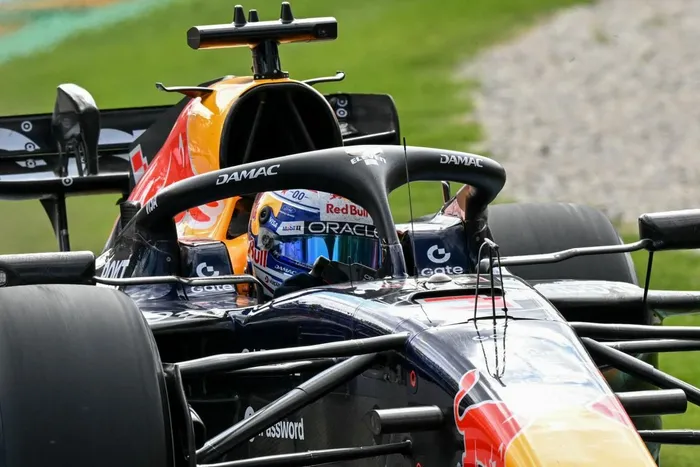
After weeks of "sandbagging" rumours, Mercedes proved their 2026 dominance with a front-row lockout in Melbourne. Was Max Verstappen, pictured, right all along about Toto Wolff's pre-season narrative? Photo: AFP
Image: AFP
The distance between Mercedes and the rest of the field in testing and then in Melbourne suggests Max Verstappen was correct to question Toto Wolff's narrative that Red Bull had the "benchmark" power unit this season.
The four-time champion suggested Wolff was full of it and leading the media on. This weekend's Mercedes domination backed up his claim.
From the outset of preseason running, Verstappen made it clear he was cautious about reading too much into testing talk.
“I’m very happy with what we did in pre-season, but of course looking on the performance side of things, I think we want to be a little bit faster,” he said. We didn't realise it at the time, but that comment, in hindsight, reads like a subtle nod to the gap that would later show up on the timing sheets.
After Australian qualifying, the Dutch world champion again pointed toward Mercedes’ apparent edge.
“I said already in Bahrain, let’s wait and see in Melbourne, and you will see how fast they are. We have to improve to fight Mercedes.”
Wolff’s own words from early testing helped fuel the suspicion that Mercedes might have been underplaying its hand. At one stage he declared Red Bull “the benchmark” after a session, a remark many around the paddock interpreted as classic deflection designed to ease pressure and shift attention.
However, after Mercedes locked out the front row in Melbourne, Wolff pushed back strongly against claims of deliberate sandbagging.
“Everybody will say that we were sandbagging. You can’t really sandbag, or at least we can’t do that. We’re surprised by the gap, but I’m taking it.”
So what does the proof say? On pure pace, Mercedes has clearly held an advantage in both single lap speed and long-run performance.
The stopwatch rarely lies, and the consistency of their edge suggests preparation and execution rather than theatre.
Their performance also hints at smart engineering choices under the new regulations, possibly extracting more from areas rivals have yet to optimise. The contrast between modest testing rhetoric and emphatic race weekend dominance highlights how pre-season narratives often double as psychological strategy.
In that context, Verstappen’s scepticism looks less like rivalry driven sniping and more like an accurate reading of the situation. Words are part of each team's arsenal just like their power units and drivetrains – alpha dogs like Wolff just chose to use them.