

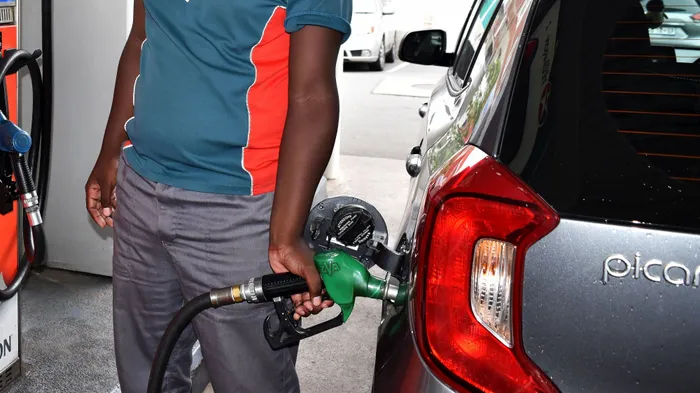
Petrol and diesel prices are set to rise in March.
Image: Tumi Pakkies / Independent Media
Following February’s significant fuel price decreases, petrol and diesel prices are set to rise once again in March.
Late-month data from the Central Energy Fund (CEF) is pointing towards a petrol price increase in the region of 18 cents, while diesel is looking set to rise by between 60 cents in the case of 500ppm and 62 cents for 50ppm.
Keep in mind that these predictions are based on unaudited data, and the final price adjustments, which will be announced by the Department of Mineral and Petroleum Resources early next week, could differ.
95 Unleaded petrol currently costs R19.27 at the coast and R20.10 in Gauteng, where the cheaper 93 Unleaded retails for R19.99.
The projected price increases come as a result of higher international product prices during February. Thankfully, a stronger South African rand has shielded the increases, which would otherwise have been in the region of 35 cents for petrol and 80 cents for diesel.
April is set to see further increases, given that the 2026 Budget Speech, delivered by Finance Minister Enoch Godongwana on Wednesday, signalled increases to the General Fuel Levy (GFL) as well as the Road Accident Fund Levy (RAF).
To that end, GFL will increase by 9 cents per litre for petrol and 8 c/l for diesel, while the carbon fuel levy goes up by 5 cents and 6 cents respectively, and the RAF sees a hike of 7 cents. All together, motorists are looking at a 21-cent increase for both fuel types.
Following the tax increases, which are set to come into effect on April 1, motorists will be paying R2.25 per litre towards the RAF, while the GFL levy will increase to R4.10 for petrol.
Bobby Ramagwede, CEO of the Automobile Association, said the blanket inflationary adjustment to these levies will apply further pressure to already embattled consumers.
“The Minister had an opportunity to provide much-needed relief to consumers in an effort to promote economic activity by making mobility more affordable.
“Whilst the inflationary adjustment to taxes may be justified, the prevailing inefficiencies of RAF won’t be remedied by ‘throwing more money’ at the problem.”
The Organisation Undoing Tax Abuse (OUTA) said it is particularly concerned about the continued increase in the RAF levy.
“The annual fuel levy for the RAF contributes over R45 billion per annum, which falls well below the long-term provisions for the fund at R387.4bn, and is expected to increase to R426.2bn by 2028/29,” said OUTA CEO Wayne Duvenage. “Increasing the levy by a further R1.5 bn per annum, without fixing the structural failures of the RAF, simply shifts the burden to motorists while liabilities continue to grow,” he added.
“South Africans are paying more into a system that remains fundamentally broken.”
IOL Motoring