

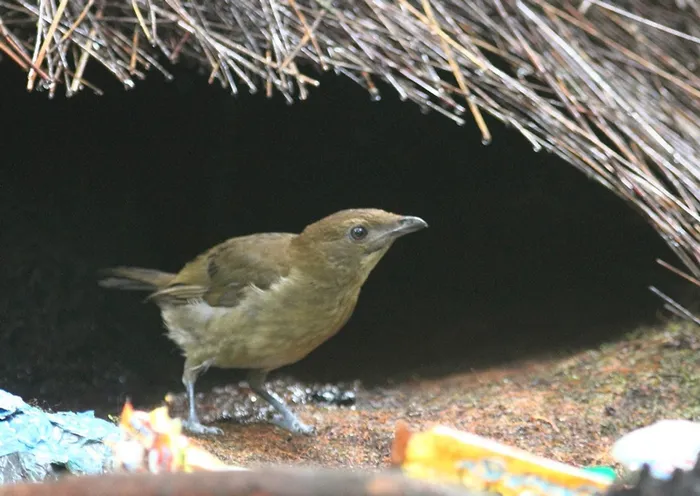
The bird, known as the Romeo of the bird world, resides in the mountains of Western New Guinea, and the male of the species is famed for creating intricate flower displays to attract females. The bird, known as the Romeo of the bird world, resides in the mountains of Western New Guinea, and the male of the species is famed for creating intricate flower displays to attract females.
London - Sir David Attenborough has marvelled at thousands of species in a career that has spanned 60 years.
So it is some accolade for the Vogelkop Bowerbird that the TV presenter says watching it trying to woo a mate is his most enduring memory.
The bird, known as the Romeo of the bird world, resides in the mountains of Western New Guinea, and the male of the species is famed for creating intricate flower displays to attract females.
In an interview published today in the Radio Times, Sir David, 86, says watching it provided an “undeniable truth that birds have an aesthetic sense”.
He explained: “Instead of growing pretty feathers, they use inanimate objects to attract a mate. Just seeing the lovely little male coming out, as pleased as Punch, and putting a flower in one particular place on this lawn in front of us and then cocking his head and thinking, ‘I don’t think so… I think it needs to be another six inches to the left…’, that’s an extraordinary sight.
“A lot of the anthropomorphic things you can explain away, but you can’t explain that away. It’s incontrovertible.”
Sir David was being interviewed by his fellow wildlife presenter Chris Packham to mark Attenborough: 60 Years In The Wild, a three-part BBC2 series starting on November 16 that looks at his career highlights.
He also sticks to the bird theme for his British nature highlight, saying: “I wanted very much to have the dawn chorus in this country properly done so that you could see all the birds in sync with the warm puff of air coming out of their lungs and condensing into a mist. A great moment.”
And when it comes to regrets, Sir David admits: “I would have loved to have gone across the Gobi. Of course you won’t go across the Gobi if you’re making a film about animals because you only see one animal every 1,500 miles. Because of the emptiness it’s the absolute opposite of what one is accustomed to and of course there are fabulous fossils there. Amazing!”
Sir David’s passion for nature stems from a childhood left free to roam and collect bird eggs – an option he acknowledges is not there for youngsters today.
He says: “Part of the reason for that is easy to identify and that is because it’s no longer allowed, no longer legal to be a collector. I openly admit that I collected birds’ eggs.
“And I knew when the right moment was when you could take one and the bird would lay another so you didn’t damage the population and I learnt a lot.” - Daily Mail