

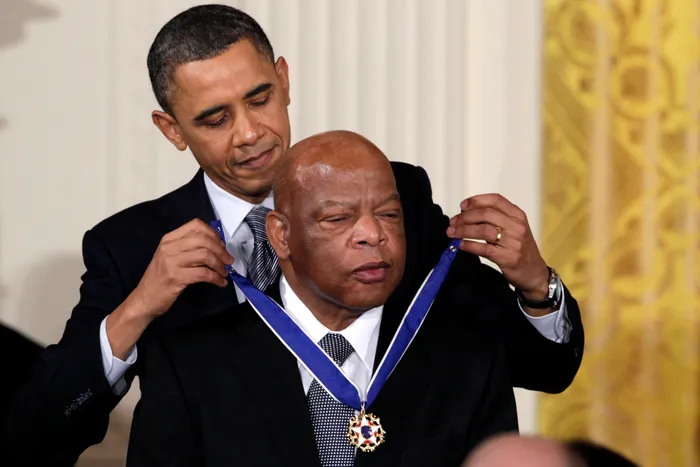
President Barack Obama presents a 2010 Presidential Medal of Freedom to U.S. Rep. John Lewis, D-Ga., during a ceremony in the East Room of the White House in Washington. Lewis, who carried the struggle against racial discrimination from Southern battlegrounds of the 1960s to the halls of Congress, died Friday, July 17, 2020. (AP Photo/Carolyn Kaster, File) President Barack Obama presents a 2010 Presidential Medal of Freedom to U.S. Rep. John Lewis, D-Ga., during a ceremony in the East Room of the White House in Washington. Lewis, who carried the struggle against racial discrimination from Southern battlegrounds of the 1960s to the halls of Congress, died Friday, July 17, 2020. (AP Photo/Carolyn Kaster, File)
WASHINGTON - John Lewis, who died on
Friday at age 80, was a hero of the U.S. civil rights movement
of the 1960s who endured beatings by white police and mobs and
played an outsized role in American politics for 60 years.
Lewis, an Alabama sharecropper's son elected in 1986 as a
Democrat to the U.S. House of Representatives from Georgia, died
after a battle with pancreatic cancer.
A protege of civil rights icon Martin Luther King Jr., Lewis
led sit-ins to integrate all-white lunch counters, was one of
the original "Freedom Riders" who integrated buses, and suffered
a skull fracture while demonstrating for Black voting rights in
a savage beating by a nightstick-wielding white Alabama state
trooper during an incident now called "Bloody Sunday."
Lewis was just 18 when he first met King and went on to play
a vital role in the civil rights movement that strove for
equality for Blacks in an America grappling with racial bigotry
and segregation, particularly in the South.
As a congressman, Lewis tangled with President Donald Trump
starting even before Trump took office. Lewis in January 2017
said he did not view Trump as a "legitimate" president because
of Russian meddling in the 2016 election to boost his candidacy.
Trump drew criticism even from fellow Republicans when he called
Lewis "all talk" and "no action."
Lewis was present at many of the civil rights movement's
seminal moments, and was the youngest speaker at the 1963 March
on Washington where Martin Luther King delivered his "I Have a
Dream" speech, hoping for a land where Blacks "will not be
judged by the color of their skin but by the content of their
character."
Lewis, the last surviving speaker at that speech, maintained
the fight for civil rights until the end of his life. He made
his last public appearance in June, as protests for racial
justice swept the United States and the world.
Using a cane, he walked with Washington, D.C., Mayor Muriel
Bowser on a street by the White House that Bowser had just
renamed Black Lives Matter Plaza, which had just been dedicated
with a large yellow mural - large enough to be seen from space -
reading "Black Lives Matter."
Amid a national movement to abolish Confederate monuments
and symbols, calls have grown rename the bridge in Selma,
Alabama, where Lewis was brutally beaten during a 1965 voting
rights march, for Lewis. It is named for Edmund Pettus, who
fought in the Confederate Army and robbed African-Americans of
their right to vote after Reconstruction.
Long before the March on Washington, Lewis helped found the
Student Nonviolent Coordinating Committee (SNCC), which became a
prominent civil rights group, and served as its president for
three years.
He proved he was willing to risk his life for the cause of
civil rights and non-violent protest and organized the first
lunch-counter sit-ins demanding service for Blacks at
whites-only eateries.
In 1960, at a whites-only diner in Nashville, Tennessee, a
white waitress dumped cleaning powder down his back and water on
his food. He was beaten by whites in South Carolina and Alabama
during 1961 anti-segregation bus tours called Freedom Rides. And
he suffered further injuries during "Bloody Sunday" in 1965 in
Selma.
"I thought I was going to die a few times," he said in a
2004 interview, mentioning Selma and a 1961 mob beating at a bus
station in Montgomery, Alabama. "I thought I saw death, but
nothing can make me question the philosophy of non-violence."
Barack Obama, the first Black U.S. president, awarded Lewis
the presidential medal of freedom, America's highest civilian
honor, in 2011.
"Generations from now, when parents teach their children
what is meant by courage, the story of John Lewis will come to
mind - an American who knew that change could not wait for some
other person or some other time, whose life is a lesson in the
fierce urgency of now," Obama said a White House ceremony.
Lewis was born on Feb. 21, 1940, in Troy, Alabama, when
Blacks faced segregation in all public facilities and were
effectively barred from voting in the U.S. South - where Black
slavery ended only due to the 1861-1865 Civil War - thanks to
the notorious "Jim Crow" laws.
Lewis plunged into the civil rights movement as a student at
Fisk University in Nashville, where he organized the sit-ins at
segregated lunch counters.
"The Nashville sit-ins became the first mass arrest in the
sit-in movement, and I was taken to jail," Lewis said.
"I'll tell you, I felt so liberated. I felt so free. I felt
like I had crossed over. I think I said to myself, 'What else
can you do to me? You beat me. You harassed me. Now you have
placed me under arrest. You put us in jail. What's left? You can
kill us?'"
The "Bloody Sunday" attack took place when segregationist
Alabama Governor George Wallace directed police to use night
sticks and tear gas to stop the peaceful march for voting rights
led by Lewis and others.
As hundreds of Black protesters crossed the Edmund Pettus
Bridge, state troopers, many on horseback, waded into the crowd
swinging billy clubs. Lewis was beaten so badly that his scars
were visible decades later when he served in Congress.
The horrific nature of the event inspired action in
Washington. President Lyndon Johnson days later demanded that
Congress approve legislation removing barriers to Black voting.
Lawmakers then passed the landmark Voting Rights Act of 1965.
In a moving postscript to his protest years, Elwin Wilson, a
white man who assaulted Lewis at a bus station in Rock Hill,
South Carolina, in 1961, traveled to Washington in 2009 to
apologize tearfully to Lewis, who forgave him.
"That's what the movement was always about - to have the
capacity to forgive and move toward reconciliation," Lewis told
the New York Times in 2013 after Wilson died at age 76.
After leaving SNCC in 1966, Lewis worked for community
organizations. He later was Democratic President Jimmy Carter's
choice to head the federal volunteer program ACTION and he was
elected to the Atlanta City Council in 1981.
Lewis lost his first run for the House in 1977 to Democrat
Wyche Fowler in the campaign to replace Andrew Young, the first
Black elected to Congress from Georgia in modern times. Carter
had picked Young to be U.S. ambassador to the United Nations.
When Fowler headed to the Senate, Lewis defeated another
civil rights figure, Julian Bond, in 1986 for the House seat
representing the congressional district encompassing Atlanta.
In the House, he amassed a liberal voting record and was a
member of the House Democratic leadership team.
Lewis began the 2008 campaign supporting Hillary Clinton as
she faced Obama for the Democratic presidential nomination.
After Obama won Georgia's Democratic primary, Lewis switched
allegiance in a key moment of the campaign.
As a congressman in June 2016, Lewis used the non-violent
protest tactics he learned from King to help organize a 24-hour
sit-in on the House floor to push for gun control legislation
following a shooting that killed 49 people at a gay nightclub in
Orlando, Florida. The rare protest virtually shut down the
chamber.
Lewis had one son with his wife Lillian, who died in 2012.