Standoff in KwaZulu-Natal: Governance Crisis Halts Services in Umkhanyakude District
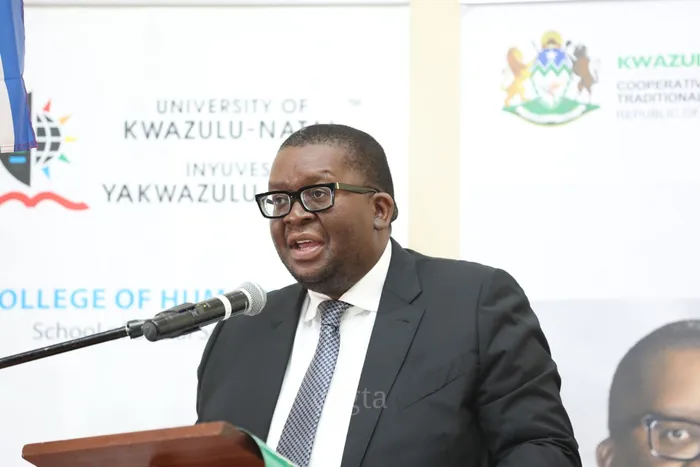
KwaZulu-Natal MEC for Cogta Thulasizwe Buthelezi
Image: Supplied
THE ongoing standoff between KwaZulu-Natal's Cooperative Governance and Traditional Affairs (Cogta) MEC, Thulasizwe Buthelezi, and Umkhanyakude District Municipality's Speaker, Solomon Mkhobo, has led to a significant halt in essential services within the municipality.
The clash underscored deeper issues of governance, accountability, and local authority autonomy.
At the core of the disagreement was Mkhobo's accusation that Buthelezi was wielding his power to undermine the municipality's council authority.
“Let us start off by sorting out issues of abusing law, grandstanding, and suppressing the inferior party,” Mkhobo remarked, implying that the MEC may be concealing other troubling matters.
He further denounced Buthelezi's leadership, referencing his tenure as a former mayor in Zululand and suggested that his current administration was being force-fed to the local council.
The hostilities escalated following a letter from the Auditor General of South Africa (AGSA), Tsakani Maluleke, which requested Buthelezi's intervention due to the municipality's persistent failure to address material breaches in its operations.
These breaches primarily stemmed from the municipality's inability to implement a credit and debt collection policy, as mandated by the Municipal Finance Management Act (MFMA) of 2003.
Maluleke's correspondence defined a "material irregularity", as being, “any non compliance with legislation, fraud, theft, or breach of fiduciary duty,” which resulted in potential financial losses for the municipality.
She highlighted the municipality's continued failure to recover outstanding debts from consumers, warning that such negligence was likely to cause significant financial harm.
In response to the AG's urgent request for intervention, Buthelezi acknowledged the severity of the issues raised, affirming his commitment to act in the best interests of the residents of the Umkhanyakude District.
He emphasised that the residents were the most affected by the pervasive lack of governance and service delivery.
“These residents bear the brunt of failed service delivery due to a lack of governance, financial, and consequence management measures within the district,” he stated, and committed to meet the AG's deadline for a formal report by August 15.
However, Speaker Mkhobo contends that the municipality should not be held liable for interventions purportedly executed by “faceless forces.”
He pointed to the irregularity of the MEC's recent intervention, which came unexpectedly after a previous intervention had ceased on April 30, 2025, without being extended.
“What should have happened is that the MEC should have alerted us and drawn our attention to the emergence of new triggers that require resolution,” he responded, and articulated his concerns over the constitutional validity of the MEC's actions.
As both parties dug in their heels, service delivery in the area hung in the balance, with residents of the district left in an uncertain position.
Meanwhile, finance MEC Francois Rodgers has withdrawn financial support to the troubled municipality.
Rodgers said they have applied almost all avenues to help Umkhanyakude, but it was to no avail.
“We have a limited budget as a provincial Treasury. Our teams have been involved there for six years trying to help in turning around the situation, but officials on the ground are making it difficult for us to do our work."
Rodgers believes the funds could be better spent elsewhere.
Umkhanyakude was placed under administration recently by the KwaZulu-Natal government.
Last week, IFP leader and National Minister of Cogta, Velenkosini Hlabisa, vowed to defend the KwaZulu-Natal government’s decision to place the struggling ANC-led Umkhanyakude District Municipality under administration, despite the ANC’s defiance.
Hlabisa stated that the government’s decision remained firm and will not be influenced by political pressures.
“This is not a political intervention. This is a Cabinet decision. As long as municipalities are passing unfunded budgets, Section 139 will apply.
"You can go and check the financial audit outcome of that municipality. It is not good; therefore, it qualifies for an intervention of this kind,” Hlabisa empathised.
Premier Thamsanqa Ntuli, echoed Hlabisa’s sentiments saying that there was a unanimous decision in the Cabinet with all MECs, including the three from the ANC; therefore, he did not understand why the leadership was challenging it.
Ntuli said Umkhanyakude was placed under administration alongside two IFP-led district municipalities, so the assertion by the ANC that it was targeting its municipalities was unfounded.
“We removed an ANC-led Mooi Mpofana Local Municipality from the administration in the same Cabinet meeting, so we do not understand why the ANC is complaining in Umkhanyakude,” said Ntuli.
However, the ANC held a differing view.
In a strongly worded statement, the ANC indicated that it rejected the unwarranted and politically charged decision by MEC Buthelezi to invoke Section 139(1)(b) of the Constitution in the uMkhanyakude District Municipality.
It said the so-called intervention was nothing short of abuse of constitutional provisions for political gain, adding that it lacks merit, rationale, and integrity.
“The ANC is appalled by the continued misuse of Section 139(1)(b) by the MEC, who has turned what should be a last-resort mechanism into a political weapon, one that is selectively and cynically deployed against ANC-led municipalities, regardless of their performance.
"The uMkhanyakude District Municipality has made tangible progress in governance, financial recovery, and service delivery.
There is no objective basis for this draconian step, which appears designed not to improve governance, but to score narrow political points and destabilise a functional administration,” the party's statement read.
DAILY NEWS