

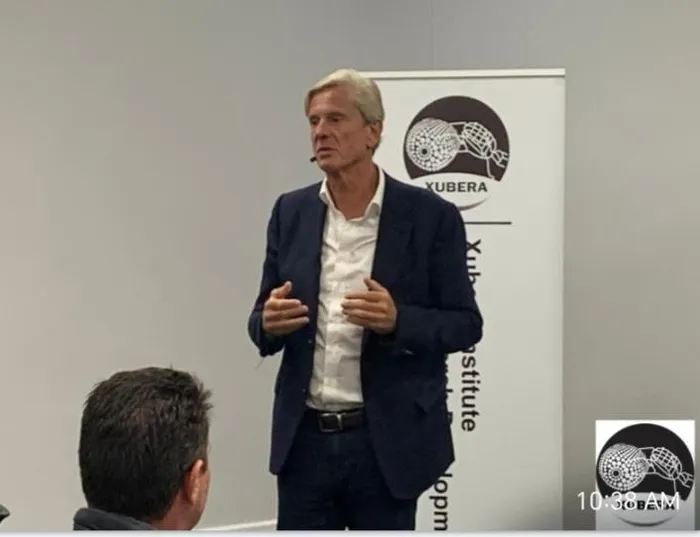
Businessman Rob Hersov
Image: Supplied
South African businessman Rob Hersov ignited controversy when he fired a series of inflammatory remarks about the country's black population and the historical figure Shaka, a Zulu king, during a recent episode of the American podcast "Thought Leaders."
His comments drew widespread condemnation but have also reignited discussions about the delicate fabric of race relations in South Africa.
Speaking on a platform associated with the conservative Epoch Times, Hersov referred to black South Africans as "barbaric." He also labelled Shaka a "rapist" known for throwing people off cliffs.
Such statements were seen as promulgating deeply entrenched stereotypes and alarmist narratives regarding violence in South Africa.
Hersov did not shy away from insisting that the country was plagued by two farm attacks each day and two murders of farmers each week. He asserted that farmers were three times more likely to be murdered than police officers, a statement that lacked reliable data or credible sources to back it up.
When the podcast host Liam Tuff asked him if the late statesman, Nelson Mandela was a terrorist, the businessman did not mince his words by characterising him as a terrorist, saying that he was convicted fairly by what he called "the court of law" during the apartheid era.
"He was convicted in a fair court of law; in fact, all the international justice organisations of human rights followed the law of the case and decide not to contest it because it was a fair hearing.
"He was a terrorist; he set up the armed wing of the ANC - Mkhonto WeSizwe and he said if women and children are killed in it. so be it," Hersov exclaimed.
He, however, said in his view the ANC was an "evil organisation" that took its mandate from the party's National Democratic Revolution.
Hersov further made startling revelation that Iran was funding the ANC, hence the country filed a case against Israel.
"I believe that the ANC new about the Hamas attack in Israel before it happens, and if there's proof that they were aware there would be a law sued not just for the ANC but for Ramaphosa as well".
On the question of whether he does not fear for his life, Hersov said he was capable of protecting himself.
"If anyone would come for me, i have a gun and i will shoot back," he said.
His utterances aligned with the rhetoric associated with organization's like AfriForum, which faced accusations of misrepresenting the realities of farm violence, even though official statistics for the 2022/23 period told a different story.
While Hersov claimed farm murders were rampant, reports indicate that 111 police officers were killed during that period. This was in contrast to AfriForum's figure of 49 alleged farm murders. Furthermore, a recent assessment by suspended police minister Senzo Mchunu revealed that, out of 12 farm murders in the last quarter of 2024, only one victim was white.
Similar sentiments have been echoed by US President Donald Trump, who recently alleged that a "white genocide" was happening in South Africa. He proposed measures such as cutting US aid to the country and granting expedited citizenship to Afrikaners.
Those assertions were rejected by President Cyril Ramaphosa, who, during a meeting with Trump, stated that the narrative of a white genocide does not reflect the realities of the nation.
Ramaphosa underscored the South African government's dedication to democratic principles and freedom of expression while also stressing that extreme views do not represent state policy.
"What you saw in the speeches made is not government policy. We have a multiparty democracy in South Africa that allows people to express themselves," he stated previously.
Political analyst Siphamandla Zondi denounced Hersov's claims as mere election-style rhetoric lacking substantive evidence.
He noted that the narrative of "white genocide" serves to amplify fears and alarm without addressing the broader context of violence that affects all demographic groups.
Zondi suggested that such hyperbolic claims served to elevate the concerns of white South Africans while minimising the suffering faced by others in the country.
He expressed concern that those narratives have found an audience with influential figures like Trump, allowing the misrepresentation of South African realities to influence U.S. policy towards the nation.
Fellow analyst GoodEnough Mashigo added that media outlets and the public should not give credence to Hersov's comments, and described them as remnants of a bygone era.
“I don’t think anybody takes him seriously, nor do I think he can impact the reconciliation journey initiated in 1996,” he remarked, likening Hersov to controversial figures of the past.
The Daily News attempted draw comments from Hersov but we were unsuccessful, the newspaper understands that he's currently out of the country.
DAILY NEWS