

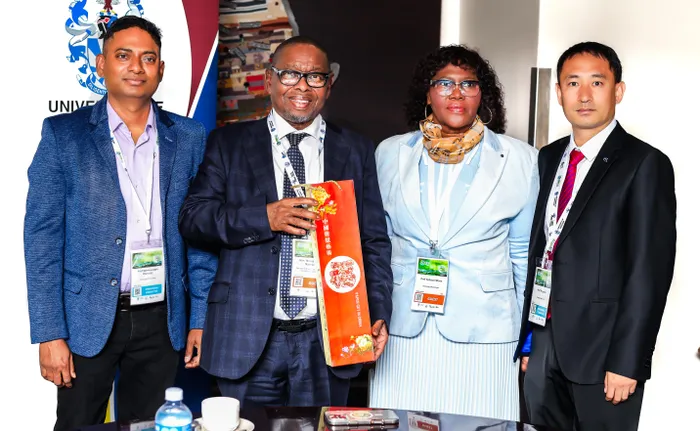
Professor Vetrimurugan Elumalai from University of ZuluLand, Minister of Science, Technology and Innovation Blade Nzimande,Vice Chancellor of the University of Zululand. Xoliswa Mtose and, Professor Peiyue Li from Chang’an University of China.
Image: Supplied
Minister of Science, Technology and Innovation, Blade Nzimande, said yesterday that one of the fundamental challenges facing the scientific community presently was the imbalance in the world system of knowledge production.
He was speaking at the 3rd International Conference on Earth and Environmental Science, hosted by the University of Zululand at the Durban International Convention Centre (ICC), which runs until Wednesday
Nzimande expressed concern that historically disadvantaged South African universities must not fall into the trap of merely consuming knowledge produced elsewhere. Instead, he urged these institutions to actively contribute to the global knowledge project. He said: “While we value collaboration, we do not want our historically disadvantaged universities to be comfortable with simply being consumers of the knowledge that others produce.”
The minister emphasised the importance of establishing a robust and sovereign research and development agenda for Africa, where historically black universities played a pivotal role. The partnership between the University of Zululand and Chang’an University in China was cited as a significant example of international collaboration that benefitted both parties while deepening ties with the People’s Republic of China.
In drawing attention to the urgent environmental challenges faced in Africa, Nzimande referenced the 2023 state of the climate report by the World Meteorological Organisation, which revealed that African countries were incurring staggering economic losses due to climate change. He noted that, on average, African nations were losing between 2% and 5% of their Gross Domestic Product (GDP) and diverting up to 9% of their budget to combat climate extremes.
“Our country is experiencing the acceleration of rising temperatures and extreme heat, droughts, and water shortages.
"South Africa is already a water-scarce country, and climate change is exacerbating the situation, leading to more frequent and intense storms, thus resulting in unusual flooding in some areas,” Nzimande remarked. He emphasised the threat these climatic changes posed to agricultural productivity and food sovereignty across the continent.
The minister went on to outline the government’s proactive initiatives to combat these environmental challenges through the establishment of a Science Mission on Global Change and Biodiversity Science.
This initiative builds on more than two decades of sustained funding and leverages South Africa's geographical advantages to mitigate environmental crises effectively. Key programmes under this mission include the South African Environmental Observation Network (SAEON) and the South African Risk and Vulnerability Atlas (SARVA), among others.
Professor Vetrimurugan Elumalai from the University of Zululand lauded the collaboration with Chang’an University, emphasising its importance in addressing the country’s pressing water challenges. “Through this partnership, we will be able to manage sustainable water resources and share knowledge effectively,” he stated, highlighting student exchange programmes that foster mutual learning.
Echoing Elumalai’s sentiments, Professor Peiyue Li from Chang’an University stated that both institutions were gaining invaluable insights through their collaboration.
“We face numerous challenges such as water shortages and environmental degradation. By working together, we can tackle these issues more efficiently. No one can face these challenges alone,” Li said, noting that the partnership had been in existence for 12 years and continued to evolve through conferences held bi-annually in China and South Africa.
DAILY NEWS