

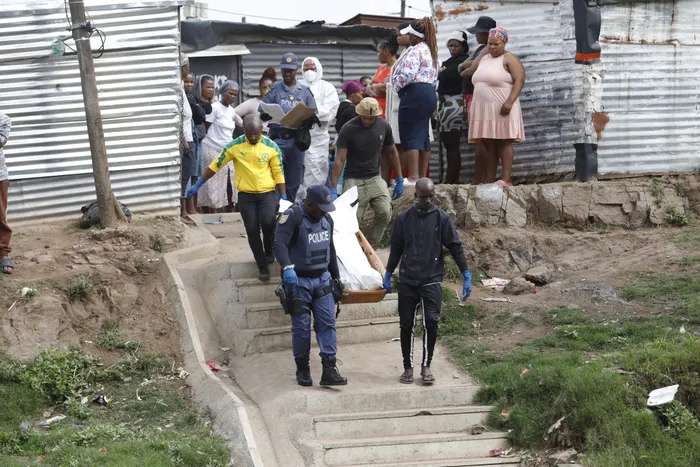
Caption: Members of the SAPS are seen removing the body of one of the five deceased who were involved in a shootout with police at the Lusaka informal settlement, Moorton, Chatsworth on Monday
Image: Doctor Ngcobo
A shootout with police in Chatsworth that claimed the lives of five youngsters, believed to be part of a gang responsible for a long list of serious crimes, bore a grim reminder of the growing number of youth turning to criminal activity as a way of life.
In January, members of the notorious "West" gang, which has been terrorising communities in the area of Inanda with their reign of terror, also endured a fatal end after a shootout with police.
The West gang's members were also mostly youngsters.
Independent crime analyst Dr Chris De Kock has identified the absence of positive male role models as a significant factor driving young men towards a life of crime.
In the Chatsworth shootout during the early hours of yesterday, all the deceased were in their late teens to mid-twenties, which sparked serious alarm among community leaders, law enforcement officials, and others.
An intelligence-driven operation by KwaZulu-Natal police resulted in a shootout that led to the deaths of five suspects, believed to be linked to a range of criminal activities in the Durban area.
They were holed up in a shack in the "Lusaka" informal settlement in Moorton, Chatsworth when they were confronted by police.
Police spokesperson Robert Netshiunda confirmed that their actions were part of an intelligence-driven operation.
The police had been tracking the suspects in connection with a series of violent crimes committed across the Mpumalanga township, Mariannhill, and uMsunduzi areas, including murder, house robberies, and extortion.
As officers moved in to arrest the suspects, the criminals opened fire on the police. “When police arrived on the scene, the suspects opened fire at them, and that’s when the shootout ensued,” Netshiunda explained.
This violent incident serves as a stark reminder of the deep-rooted challenges faced by the youth of South Africa today, and De Kock said worsening this growing trend was the many boys who idolise hardened criminals, which was largely the case because of the absence of positive male figures in their lives.
"These children engage in criminal activities due to unemployment and a lack of positive male role models. Many come from families without a proper structure, leading them to become sole providers through unlawful means," he explained.
Concerns about the effectiveness of South Africa's correctional facilities have also arisen, with De Kock asserting that rehabilitation for inmates was sorely insufficient.
"When these kids come out of prison, they often return to the same criminal systems they left behind, perpetuating a cycle of crime that is difficult to break," he said.
Willem Els, a security expert from the Institute for Security Studies (ISS), echoed De Kock’s sentiments.
He emphasised that societal tolerance of violence has resulted in a dangerous culture where young people disregard law enforcement.
"The violent behaviour ingrained in our communities makes these kids act with impunity and shows a distinct lack of respect towards the police," Els said in stressing the urgent need for effective strategies to disrupt this ongoing cycle of crime.
With violent crime perpetually on the rise, suspicions have been raised once again regarding the source of firearms used by youth in violent confrontations.
Els suspected that some children might be procuring weapons from rogue security companies, which further complicates the fight against crime. "These companies are putting guns into the hands of criminals, enabling the very violence we are trying to combat," he stated.
Earlier this year, KZN Premier Thami Ntuli expressed grave concerns over the increasing involvement of youth in serious criminal activities and labelled the trend as troubling.
He called upon government departments, schools, law enforcement, and community members to unite in tackling the pressing issue. "These children are not only committing crimes outside but also within their schools," he said.
As a way forward, Ntuli announced the proposal from the Department of Community Safety and Liaison to link police stations with schools.
This initiative aimed to assign a designated officer to handle criminal activities on school premises as a proactive approach to curbing the prevalence of crime amongst youth. Following his announcement, Ntuli embarked on heightening school safety and crime prevention campaigns throughout the province.
These engagements sought to bring together diverse stakeholders and sharpen ideas that would deepen collaborative efforts to address safety challenges and ensure sustainable solutions.
Participants included business leaders, academia, Justice, Crime Prevention and Security Cluster (JCPS) cluster members, community safety structures, faith-based organisations, civil society, and the private security sector.
DAILY NEWS