

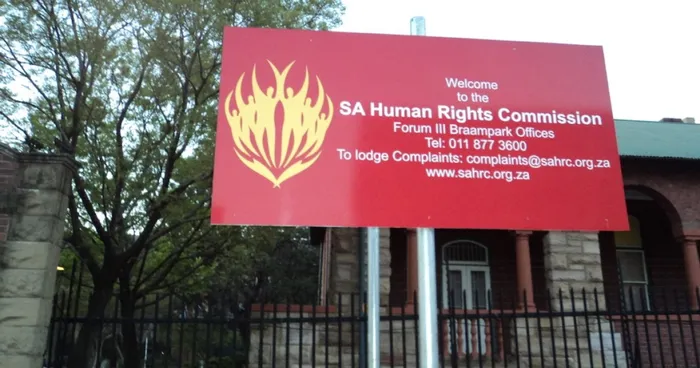
South Africans question the appointment of a foreign national to lead the Human Rights Commission.
Image: Supplied
The appointment of a foreign national to lead the South African Human Rights Commission (SAHRC) has stirred significant discontent among South Africans.
This follows Tuesday’s press briefing by the Commission, during which it was revealed that the head of research was Ugandan Dr. Martin Nsibirwa.
The revelation prompted widespread apprehension regarding the agency's priorities and its perceptions of local citizens.
ActionSA's national spokesperson, Lerato Ngobeni, articulated his party's concerns about national sovereignty and the essence of local representation within governmental institutions.
Adding to the general public sentiment, Ngobeni commented, “Institutions established in terms of the South African Constitution must be led by South Africans who understand, live, and are directly impacted by the historical and present struggles that the Commission was mandated to address.”
Her remarks were a direct appeal for leadership positions within national institutions to be filled by those who genuinely comprehend and advocate for local citizens’ interests.
Many South Africans took to the social media platform X, voicing their frustrations.
User Baine stated, “Ramaphosa's administration just keeps on showing us South Africans the middle finger.
"I mean really, though, a foreigner as a head researcher of the South African Human Rights Commission?”
Such sentiments echoed a broader belief that the SAHRC had become an institution more attuned to foreign interests rather than the specific rights and needs of South Africans.
Another X user, Ndlombango Ka Tomase, added fuel to the fire and accused the commission of bias towards foreigners and questioning its commitment to upholding the rights of South African citizens.
"This is why the SAHRC screams when illegal foreigners are brought before the law. The SAHRC is led by foreigners," he remarked.
Ngobeni stressed that ActionSA stands firmly on the principle that South African citizens must take precedence in leadership roles within such critical institutions.
“The South African Human Rights Commission (SAHRC) is a Chapter 9 institution created to give expression to the rights enshrined in our Constitution, and its leadership must carry the confidence and legitimacy of the South African people,” she stated.
Her call for South Africans to lead the commission aimed to safeguard its integrity, accountability, and commitment to local governance.
The African Transformation Movement's (ATM) spokesperson Zama Ntshona expressed dismay at the apparent inaction of the SAHRC in supporting South Africans facing challenges in various sectors, from microeconomics to agriculture and hospitality.
He highlighted the absence of advocacy for South Africans under threat from displacement and asserted the need for a clear policy that prioritised locals for job opportunities, unless there were scarce skills, which must be accompanied by a transparent skills transfer programme.
Not In My Name International President Siyabulela Jentjile sought to underscore the urgent struggles faced by South Africans, urging the SAHRC to maintain a balance in defending all human rights while ensuring that the needs of locals were not overshadowed.
He raised critical issues regarding the commission’s approach to eviction plans by the Gauteng government and the perceived emphasis on foreign nationals’ rights in healthcare while South Africans struggle to access basic services.
“The SAHRC must urgently explain how it is working to advance this right equitably and fairly for all," he demanded, calling for better transparency regarding its staff composition and mandate.
“Is it a South African Human Rights Commission, rooted in our Constitution, or positioning itself as an international body?”
The SAHRC did not respond to questions at the time of publishing
DAILY NEWS