

Mutharika's political resurgence mounts as official results remain elusive In a dramatic electoral turn, former President Peter Mutharika leads incumbent Lazarus Chakwera amid growing concerns over the silence of the Malawi Electoral Commission.
Image: Supplied
In an unprecedented turn of events, former president Peter Mutharika appears poised for a remarkable comeback in Malawi's tripartite elections, according to unofficial tallies from private media. Mutharika, who previously held office from 2014 until 2020, has taken a commanding lead over the incumbent president Lazarus Chakwera, raising alarms and eyebrows as the nation grows increasingly anxious over the Electoral Commission's suspicious silence following the polls.
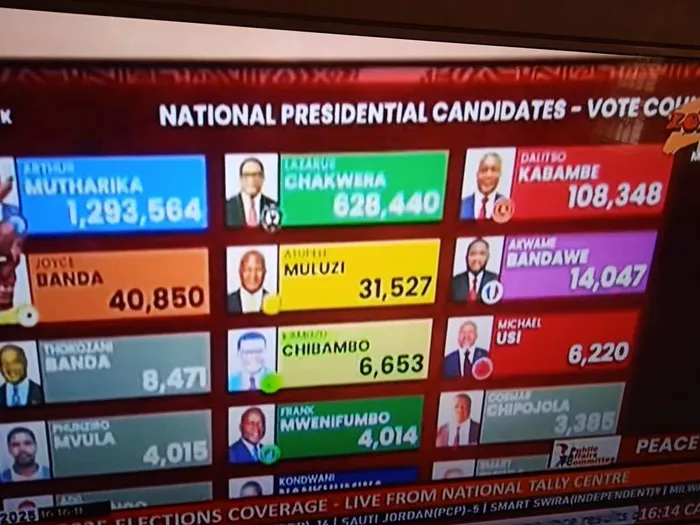
As of this afternoon, Zodiak Television, Malawi's foremost private broadcaster, revealed dashboard figures showing Mutharika of the Democratic Progressive Party (DPP) leading with a staggering 1,293,564 votes, significantly outpacing Chakwera's tally of 628 440. This shocking electoral outcome, if validated, would illustrate a monumental shift in Malawian politics and serve as a repudiation of Chakwera's administration, which came into power on the heels of a court-mandated electoral revote in 2020 that promised economic renewal.
The current election climate is steeped in tension, exacerbated by an ongoing economic crisis characterised by fuel shortages, soaring food prices, and a severe decline in currency stability. The kwacha has depreciated by 70% against major currencies since Chakwera's ascension, leading to inflation rates surpassing 30% and significantly diminishing the standard of living for ordinary citizens.
Amid this political storm, the Malawi Electoral Commission (MEC) has come under scrutiny for its bewildering silence—now extending past 48 hours after polls closed. Despite confirming they have collected 99.86% of polling station records, the MEC has yet to announce official results, leaving many Malawians to seek solace in the unconfirmed figures circulating via WhatsApp and social media.
The precarious situation is further complicated by the presence of additional candidates, including former Reserve Bank governor Dalitso Kabambe of the UTM party, who has garnered 108 348 votes, trailing behind Mutharika and Chakwera. Former president Joyce Banda and Atupele Muluzi have managed 40 850 and 31 527 votes, respectively, but their impact appears minimal compared to the Mutharika-Chakwera showdown.
Rather than addressing public anxieties regarding vote counts, the MEC has focused its latest communication on procedural matters, particularly complaints surrounding campaign handouts. Their insistence on withholding results until all physical polling station records are received from district councils defies the principles of transparency essential for a functioning democracy.
Malawi's current predicament is a concerning reminder of the continent's harrowing history of electoral disputes, from the violent crises in Kenya and Zimbabwe to the political unrest spawned by manipulated results. Though there is no direct evidence of foul play in Malawi, the opacity fostered by the MEC's silence fuels speculation that could ignite tensions. The international community, historically supportive of Malawi as a model of stability in Southern Africa, is now apprehensively observing the evolution of the situation.
As ordinary Malawians navigate daily life, exhausted by relentless economic hardship, the wait for official election results becomes increasingly unbearable. Market vendors in cities like Blantyre and Lilongwe gather around their smartphones, yearning for updates to make sense of their democratic choices.
As the countdown to the third day without official results continues, Malawi finds itself perched precariously on the brink of an information crisis. The MEC must recognise that in democracy, transparency delayed is transparency denied. The true question awaiting resolution is whether Mutharika's apparent momentum will hold once the official results materialise. What remains indisputable, however, is that Malawi's democratic framework is facing a significant test: the fundamental right of its citizens to remain informed about their electoral choices.
With tensions mounting and the region's stability at stake, the Malawi Electoral Commission teeters on a precarious tightrope, something that resonates deeply within the history of Southern African elections. The nation and its people deserve better than this disquieting silence, now is the time for responsible governance and unwavering transparency.