

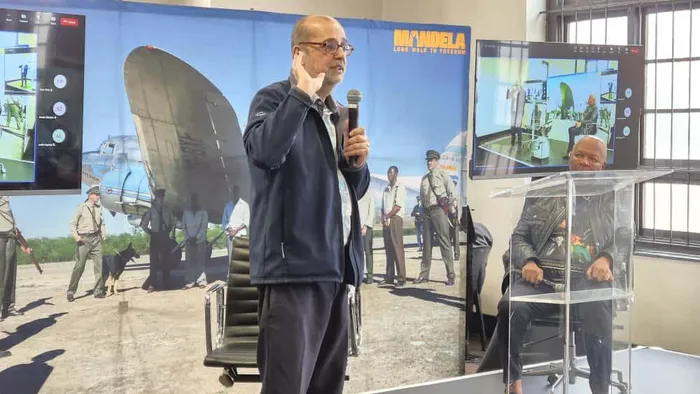
Former MK member and cabinet executive Yunus Carrim at the launch of his Book titled Attacking the Heart of Apartheid: The ANC’s MK Special Operations Unit
Image: Sibonelo Ngcobo
For over three decades, the intriguing saga of the Umkhonto we Sizwe (MK) Special Operations Unit has remained overshadowed, largely undocumented in the annals of South Africa's struggle against apartheid history.
That was until now. Former MK member and cabinet executive Yunus Carrim is set to shed light on the machinations and manoeuvres of the MK with the launch of his new book, Attacking the Heart of Apartheid: The ANC’s MK Special Operations Unit, published by Penguin Random House South Africa. The third launch of Carrim's book took place over the weekend at the Natal Command in Durban, a venue deliberately chosen for its symbolism of apartheid's brutal repression. Previous launches were held in Cape Town (22 July) and at Exclusive Books, Johannesburg on 21 August.
The elite unit, founded under the command of ANC President Oliver Tambo and prominent leaders like Joe Slovo, executed some of the most daring operations aimed at dismantling the apartheid regime, including attacks on strategic military and economic targets such as Sasol, Koeberg, and Voortrekkerhoogte. In conversation with the Daily News, Carrim expressed his realisation of the glaring absence of documented history regarding the Special Operations Unit. After consulting with Ismail Aboobaker, affectionately known as Rashid, the only surviving commander of the Special Operations team, Carrim took it upon himself to rectify these historical oversights.
“Rashid intended to write the history himself but lacked the time,” Carrim explained. “We both agreed that I should take on the task.” Driven by the belief that the sacrifices made by both known and unknown heroes of the struggle deserve recognition, Carrim's narrative does not merely glorify the unit's deeds; it also holds it accountable where necessary. “The book does not romanticise the armed struggle,” he clarified. “The ANC's decision to undertake armed actions was a reluctant response during a time of dire urgency following the 1960 Sharpeville massacre and the subsequent State of Emergency.”
The international community, including the United Nations, recognised the ANC's fight as legitimate, which included campaigns for the release of Nelson Mandela, MK's Commander in Chief. Carrim stresses the necessity of remembering the sacrifices made by those who fought for a democratic South Africa, especially as the country navigates its contemporary challenges. “People’s perceptions of the ANC today should not erase its historical contributions,” he asserted. “Many were ready to give their lives, and countless did, to achieve the breakthrough in 1994.”
At the book launch, Carrim revealed intriguing observations about the non-racial character of MK's Special Operations Unit, which starkly contrasts with current perceptions of the ANC. He emphasised that the armed struggle of the ANC was inherently linked to mass protests, political activism, and international pressure—a collective effort that ultimately forced the apartheid state to relent.
The challenges Carrim faced while compiling his work of history included resistance from some comrades; only two out of the fifty approached for comment declined to be interviewed. However, the overwhelming support from other contributors illustrated the importance of this narrative.
Carrim highlighted how those who participated in the interviews, especially Rashid and Ernest Pule, generously shared their testimonies, ultimately turning the book into a collaborative oral history that celebrated the MK's legacy. This project has reinforced Carrim's commitment to fulfilling the vision of the Freedom Charter and advocating for an effective democracy that caters to all South Africans. In highlighting the hard-fought path to democracy, Carrim noted that it is crucial for the current generation to acknowledge and learn from the struggles that shaped their society.
DAILY NEWS