

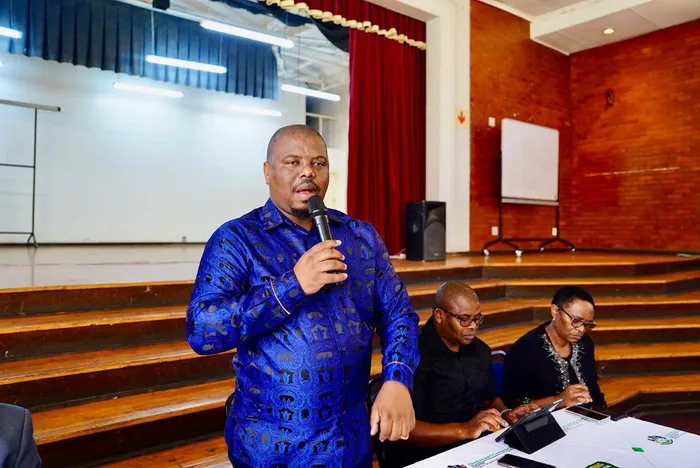
KZN MEC of Education Sipho Hlomuka KZN MEC of Education Sipho Hlomuka
Image: Supplied
The education system in KwaZulu-Natal is facing daunting challenges as the KwaZulu-Natal Parents Association (PA) voices its concerns over what it describes as a state of disarray within the province's Department of Education.
PA Chairperson Vee Gani highlighted that education serves as the cornerstone of any society, emphasising that the future of the nation rests on the shoulders of its learners.
The Parents Association is an organisation that seeks to protect the rights of learners and parents, as well as School Governing Bodies (SGB), to ensure a better quality of education for all. Gani said the alarming condition of schools across the province has left many questioning how quality education can be achieved when the department operates in crisis mode.
He stated, “It has been happening for a while now. Our schools have been suffering, and the responsibility has been put squarely on the shoulders of Principals and School Governing Bodies (SGBs).”
The PA’s Chairperson went on to lament the deteriorating state of school infrastructure, the lack of educational resources, and insufficient personnel, all exacerbated by high unemployment rates and poor recovery of school fees.
“These issues have made some schools dysfunctional,” he added.
These concerns were echoed by the Democratic Alliance (DA) spokesperson, Sakhile Mngadi, who expressed alarm over the department’s chronic underfunding of schools.
The redistribution of funds, especially concerning the Norms and Standards allocations as mandated by the South African Schools Act, is notably lower than national benchmarks.
The DA's investigations revealed that KZN's Department of Education is paying far below the required amounts per learner, restricting schools from meeting basic operational needs such as water and electricity. According to Mngadi, while the national benchmark allocates R1,672 per learner for no-fee schools, KZN’s allocation has plummeted to R955.
Furthermore, for fee-paying schools, the Department should provide R838 for quintile 4 schools and R289 for quintile 5 schools; however, these figures are only R522 and R179, respectively, leading to an overall underfunding exceeding R2 billion across the province.
During an oversight visit to Phuthini Secondary School, the stark reality of this underfunding was apparent, where the principal resorted to running a power line from a neighbour’s home due to the school’s inability to pay for electricity.
Mngadi outlined these distressing conditions as “untenable and deeply unjust,” asserting that schools cannot plan, manage, or account for necessities when funding is consistently erratic.Departmental spokesperson Muzi Mahlami noted that the issues raised by the DA are not new, but were rather the information the department shared in the education portfolio committee.
“This is not scientific information that someone has researched but it is always given by us to all oversight committees. It's public knowledge that over the years there have been budget cuts affecting all the departments with education being the hardest hit because of her size and being underfunded,” Mahlami explained.
Reflecting on the implications of entrenched funding issues, Gani expressed his concerns over the impact on learners: “No textbooks delivered, no electricity in some of our schools. Yet we constantly hear excuses that there is no money to assist our schools, while we see examples of corruption where millions are stolen.”
In response to the systemic failures, Mngadi indicated that the DA would explore proposals to safeguard all Norms and Standards funding to ensure it is appropriately allocated and not diverted.
He also urged for a guarantee that funds would be made available six months in advance, allowing schools sufficient time for financial planning. Furthermore, Mngadi said the persistent erratic implementation of the National School Nutrition Programme continues to create uncertainty for learners who rely on it.“KZN’s schools are collapsing under the weight of a system that refuses to take operational sustainability seriously,” concluded Mngadi.
“Our learners’ futures cannot be compromised due to the government’s failure in its most basic duty to adequately fund the schools it expects to function.”