

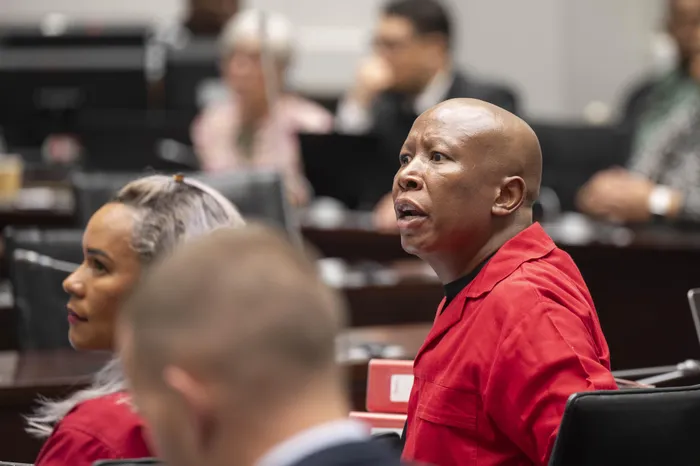
Call for recusal of key figures from parliamentary committee on police allegations EFF leader Julius Malema is one of those facing calls for recusal as KwaZulu-Natal Police Commissioner Lieutenant General Nhlanhla Mkhwanazi appeared before Parliament’s Ad Hoc Committee today to testify on allegations of corruption, political interference, and criminal infiltration in the justice system. Mkhwanazi is the first senior police official to appear before the committee. Advocate Norman Arendse has been appointed as the evidence leader in the inquiry. Photographer: Armand Hough / Independent Newspapers
Image: Armand Hough
THE integrity of the South African Parliament faces a critical test as an urgent appeal has been made for the recusal of three prominent members from an Ad Hoc Committee tasked with investigating allegations made by KwaZulu-Natal Police Commissioner, Lieutenant General Nhlanhla Mkhwanazi.
This request raises serious concerns over potential conflicts of interest that could undermine the committee’s proceedings. In a letter addressed to the Honourable Speaker of the National Assembly, the chairman of the advocacy group Real Democracy has called for the immediate withdrawal of MPs Julius Malema, Dianne Kohler Barnard, and Ian Cameron from the committee currently scrutinizing Mkhwanazi's sworn statement.
In the letter, Srinivasen Naidoo, the chairman of Real Democracy alleges that each of these members faces circumstances that could compromise the integrity of the investigation, potentially damaging public confidence in the Parliament's ability to oversee law enforcement matters. Recently convicted for misconduct, Malema is awaiting sentencing while under the undeniable scrutiny of ethical governance norms.
Although the Constitution stipulates that his disqualification as a Member of Parliament will only take effect post-sentencing, the letter argues that his ongoing participation in deliberations on sensitive law enforcement topics raises grave ethical concerns. Critics assert that his presence could detract from the moral authority of Parliament.
Weighing in on the matter, political analyst Sipho Seepe previously warned that should Malema be incarceration for more than 12 months that would lead to the forfeiture of his parliamentary seat. “The law is clear: if Malema receives a custodial sentence exceeding 12months, he will lose his position in parliament,” Seepe explained.
"While the judgment impacts his role and could potentially weaken his standing, the final determination is yet to unfold. "At the same time Constitutional law expert George Devenish also previously echoed Seepe’s statement saying
that the court ruling would jeopardise Malema’s political career. “This judgement may endanger his political career and he may lose his job in Parliament. No one should serve in Parliament while having a criminal record against them,” Devenish added. On the other hand, Kohler Barnard and Cameron find themselves directly implicated in Mkhwanazi’s allegations, further complicating their roles.
The request urges that their participation as adjudicators in a process where they are named parties is contrary to the principles of natural justice.
Instead, it proposes that these members should testify under oath, allowing them the opportunity to respond to the claims made against them without compromising the committee's credibility.”
The principles laid out in Parliament’s Code of Ethical Conduct exhort members to uphold high standards of integrity and to avoid conflicts that may affect their official duties. Allowing Malema, Kohler Barnard, and Cameron to remain involved in the Ad Hoc Committee while either facing conviction or directly implicated in serious allegations stands at odds with these principles,” says Naidoo.
He further asserts that this situation could lead to procedural unfairness and an erosion of the public’s faith in parliamentary oversight. Naidoo’s letter concludes with a call to action for the Honourable Speaker: to facilitate the immediate recusal of the implicated members and to consider appointing temporary replacements. “This move aims to preserve the
integrity and continuity of the Commit-tee while ensuring that all proceedings adhere to the principles of accountability and impartial governance,” he said.
He added: “The ongoing situation threatens not only the credibility of the Ad Hoc Committee but also the broader discourse surrounding parliamentary oversight of crucial law enforcement and justice matters.” Failure to address these conflicts, advocates suggest, risks tarnishing the entire investigative process, leaving the public to question Parliament’s commitment to fair governance.
“Responding to the request for both him and her colleague to recues themselves, Ian Cameron said him and Kohler Banard won’t be dictated by anyone as the fact that they should recuse themselves or not lie squarely on their party. "I can tell you now that from where we stand now no one will recuse them-selves. We all keep mentioning a constitution of democracy and we all keep the constitution and we keep hearing what would happen in a court of law but now we're finding someone guilty without an opportunity for them to speak on their own behalf I think it’s actually unfair,” Cameron retorted. Umkhonto we Sizwe MP David Skosana dismissed the assertion by Cameron that the matter of whether to recuse themselves was a party issue.
“A police officer with a constitutional responsibility and who has been testifying under oath, has made allegations against a member of this committee. "These allegations are not made by a layman but by a police officer who has the powers to investigate. "Her continued presence in this committee undermines the integrity of this process. This is not a DA mat-ter, but a committee matter,” Skosana concluded.