

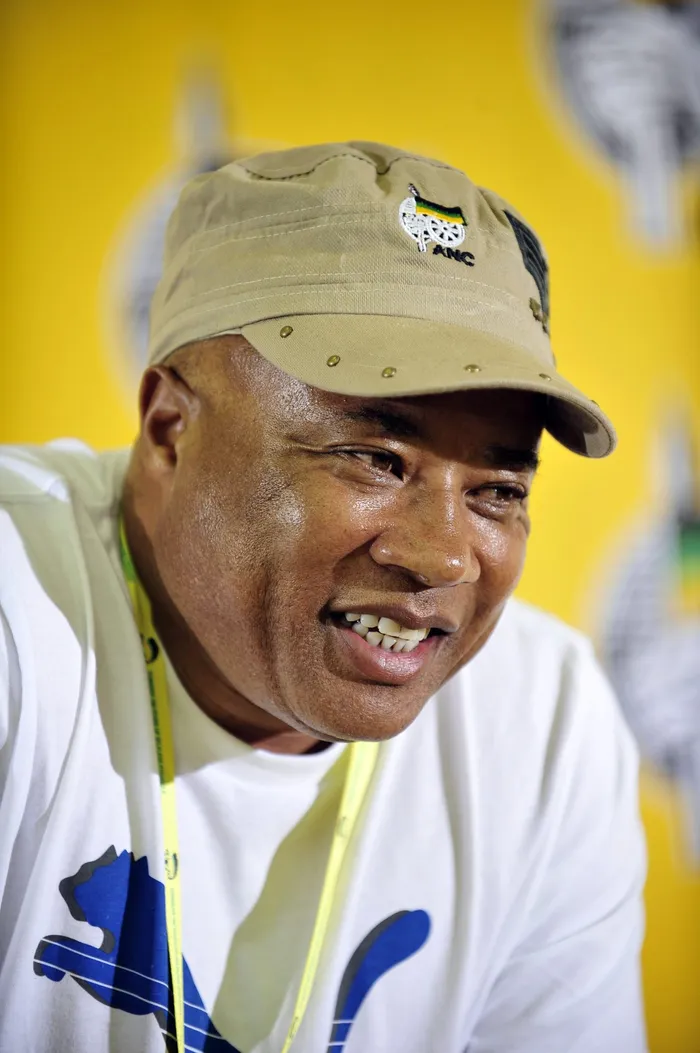
Former ANC veteran Tony Yengeni has been appointed as the second deputy president of Jacob Zuma's Umkhonto WeSizwe (MK) Party, signalling a significant shift in South African politics.
Image: file image
In a stunning development within South African politics, former African National Congress (ANC) stalwart Tony Yengeni has been named the second deputy president of Umkhonto WeSizwe (MK).
The announcement was made by President Jacob Zuma during a media briefing in Durban on Thursday, marking a significant reshuffle in the political landscape.
Yengeni, a prominent figure and a long-time critic of President Cyril Ramaphosa, will join forces with current party president Jacob Zuma.
Expressing his enthusiasm for his comrade's new role, Zuma stated, "We come from very far with our second president, comrade Yengeni."
The president highlighted his trust in Yengeni's capabilities and his potential to rejuvenate the party, describing him as an all-rounder adept in various roles within the organisation.
Addressing journalists, Yengeni shared his excitement about joining the MK Party.
He articulated a clear vision for the future, stating, "The MK Party is the only organisation that I see has the potential to truly liberate the people of South Africa."
His sentiments were met with surprise from several long-time comrades within the ANC, highlighting the emotional and ideological complexities of such transitions in the politically charged environment.
Pat Matosa, a former MK military wing member and a Robben Island prisoner, expressed disbelief at Yengeni's decision.
"This is not good for the ANC," Matosa lamented.
"Tony is a very senior, matured, and experienced member and leader of the ANC. At this juncture, the ANC must not lose any member."
He noted that Yengeni's well-respected status might influence others to follow him to MK, which could alter the dynamics within the ANC.
However, political analyst Professor Sipho Seepe told Daily News that Yengeni's move to join MKP did not come as a surprise.
Seepe continued to say his decision was reflective of a sense of frustration that members experienced within the ANC.
"The likes of Yengeni had never had faith in Ramaphosa but were willing to give him the benefit of the doubt.
They are now convinced that the liberatory project is as good as dead under Ramaphosa's presidency.
This is a motion of no confidence in Ramaphosa.
Many leaders within the ANC privately harbour the view that Ramaphosa is a modern-day Askari or a hired gun that has been contracted to destroy the ANC," he added.
To many, Seepe said, Yengeni may not appear to be influential but he remained a political heavyweight.
Yengeni took a moment to commend Zuma for his leadership within the ANC, likening the current struggle led by the MKP and other black political organisations to a call for national identity and dignity.
"The glory and dignity of South Africa and its people, and among other nations, must and will be restored. South Africa and its people must and will be free," he asserted, evoking a sense of collective resolve.
The political heavyweight sentiment echoed with Zuma's comments when he mentioned that the country was gripped by a deep moral and institutional crisis.
MKP's president hailed Lieutenant General Nhlanhla Mkhwanazi's bravery as well as members of the Political Killings Task Team, whose explosive revelations have shaken the very foundations of the criminal justice system.
"His courage has exposed how the state apparatus is manipulated to protect the interests of the few whilst persecuting the many.
As the MK Party we demand full accountability from those implicated and therefore, we will use every parliamentary and legal instrument at our disposal to ensure that the truth triumphs over corruption and cover-ups.
We are particularly concerned about the use of state police resources to protect private corporate interests, as witnessed in Richards Bay Minerals, a scenario disturbingly reminiscent of when Cyril Ramaphosa infamously called for 'concomitant action' against the Marikana miners, which led to the massacre of 34 innocent workers."
A seasoned political activist, Yengeni began his journey in anti-apartheid politics through the Black Consciousness Movement, eventually joining the ANC in 1976.
His political trajectory has seen him undergo military training in various African states, fortify his credentials with education in Moscow, and even serve as regional secretary of the African Congress of Trade Unions in Lesotho.
His experience and strategic insight signify a transformative phase for MK and a challenge to the ANC's current leadership.
This high-profile defection comes at a critical time for South African politics, with the ANC facing increasing internal divisions and external pressure.
Yengeni's move strengthens the MK Party's position as a significant opposition force while potentially weakening the ANC's traditional support base.