

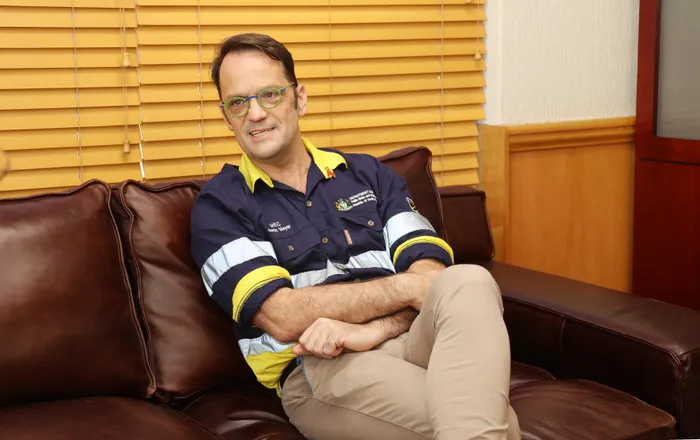
KZN MEC for Public Works Martin Meyer during an exclusive interview with Daily news.
Image: Tumi Pakkies/ Independent Newspapers.
In a bid to address an overwhelming tax and rates bill amounting to R1.8 billion per annum, the Department of Public Works has unveiled plans to sell off some government buildings.
This decision comes in light of a looming financial crisis that has left the department grappling with significant budgetary gaps.
During an exclusive interview with the Daily News, MEC for Public Works Martin Meyer expressed the urgent need for strategic intervention.
“With an annual tax and rates budget allocation of R900 million, which falls drastically short of the required R1.8 billion, we face a massive crisis,” he stated.
The shortfall, he explained, significantly hampered the government's ability to effectively manage over 10,000 properties under the department’s purview.
The lack of adequate financial resources has created a pressing environment where the department struggled to meet essential obligations, including maintenance and service delivery.
“We owe this much but only receive this much; it's a daunting gap that needs serious discussion,” Meyer said in describing the situation."
To mitigate these challenges, Meyer said many municipalities had been incorrectly billing the department, thus exacerbating the strain on available resources.
However, plans were being put in place, after recent evaluations of their property portfolio, to renegotiate property rates, which could potentially reduce expenditure by up to 40%.
“This could make a huge difference,” he said.
In addition, the department estimated it could generate around R225 million from the sale of surplus properties, a sum that could alleviate some of the financial strain.
While acknowledging that this figure is modest compared to their broad financial needs, Meyer remains hopeful that it represents a step toward addressing some pressing obligations.
“Even though we are negotiating to pay only 25% of our rates, it's a starting point that brings us a little closer,” he remarked.
Meyer’s statements emphasise the urgent nature of the department’s situation, as they prepare a detailed report for the cabinet outlining possible solutions.
The MEC is acutely aware that overcoming these financial obstacles requires that properties not only remain viable but also yield sufficient income.
With ownership of over 10,000 buildings across the province, the department bears the responsibility for properties such as clinics and hospitals.
Meyer noted the absurdity of the provincial government continuing to rent office space when it possesses more than enough buildings that could be utilised.
“If we own buildings, why are we renting from others? We really have to eliminate our rental expenses,” he stated defiantly.
In light of the pressing financial situation, Meyer acknowledged that the department was currently in arrears with several municipalities regarding unpaid rates for government-owned properties.
He stressed the urgency of finding innovative solutions to avoid further financial deterioration.
“I don’t know why people talk about budget cuts when the budget was actually slashed.
We have to learn how to do more with less,” he said, expressing both frustration and resolve during his candid conversation.
Meyer was appointed as MEC in June following the formation of a Government of Provincial Unity.
DAILY NEWS