

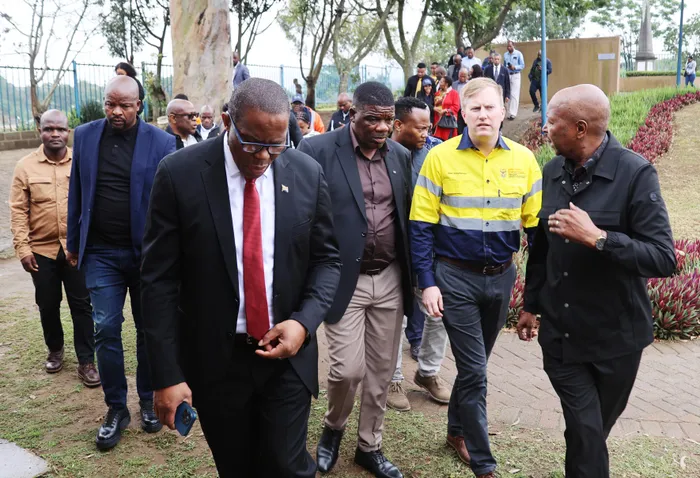
Langa Dube, a grandson of the late John Langalibalele Dube narrates the history of the Dube family and goes through the unfinished project that was abandoned by different tenderpreneurs years ago. Alongside him is Minister of Public Works and Infrastructure Dean Macpherson, MEC for Sports Arts and Culture Mntomuhle Khawula, Ethekwini Mayor and the rest of Dube family members
Image: Tumi Pakkies/ Independent Newspapers.
In a move aimed at revitalising one of South Africa’s important historic institutions, Minister of Public Works andInfrastructure Dean Macpherson has announced the establishment of a special technical construction team.
This initiative stems from his recent oversight visit to the Ohlange Institute, where he observed the unsatisfactory state of completion on a project that was intended to uplift the facility. Instead, the exercise has remained stagnant for over a decade.
Accompanied by Mntomuhle Khawula, KwaZulu-Natal's Member of the Executive Council (MEC) for Sport, Arts and Culture, eThekwini Municipality's mayor, Cyril Xaba, and KwaZulu-Natal National Council of Provinces (NCOP) member Mzamo Billy, Macpherson outlined the team's mandate: to deliver a clear action plan for the project’s completion within the next two months.
While attempts to upgrade the institute have been long-running, the project was formally announced by former MEC Mbali Frazer during the budget speech in April 2023.
Frazer stated at the time that her department would prioritise the renovation and upgrade of Ohlange High School in the 2023/24 financial year. “We are here to fulfil that commitment,” said Frazer.
Construction work was scheduled to run for a period of 10 months and be completed by the end of October 2025.
The Ohlange Institute is a beacon of education that was inaugurated by Dr John Langalibalele Dube in 1901 and has become a symbol of lost potential as it stands incomplete despite investments exceeding R33 million since 2012.
Macpherson said: “It is simply unacceptable that for more than 10 years the Ohlange Institute, which was supposed to honour the legacy of Dr Dube, was left to decay while millions were spent to upgrade it, yet it was never completed.”
He highlighted the urgency of changing the status quo of unfinished public projects and emphasised a renewed commitment to accountability and efficiency.
The Minister attributed a significant portion of this renewed focus to the advocacy efforts of NCOP member Billy, who recently tabled a motion for immediate action on the Ohlange project.
“I look forward to the construction team, which will be composed of senior officials within the Department and the Independent Development Trust to provide us with a pathway towards the project’s completion within the shortest timeframe possible,” Macpherson stated.
As the Ohlange Institute was the site where former President Nelson Mandela cast his historic first democratic vote in 1994, the project holds cultural and emotional significance that transcends its architectural goals.
“It is through the completion of long-delayed projects such as the Ohlange Institute, which many people have forgotten about, that we can reform the Department of Public Works and Infrastructure,” Macpherson added, reinforcing the importance of restoring the nation's heritage sites to their intended purpose.
The Minister’s commitment reflects the broader strategy within the Department of Public Works and Infrastructure's focus on timely and transparent project delivery, as articulated in the recently launched South African Construction Action Plan.
“The era of half-completed public works and infrastructure projects across South Africa is coming to an end. In its place, we are introducing urgency, transparency, and accountability to ensure that projects are completed on time and within budget,” Macpherson concluded.
DAILY NEWS