

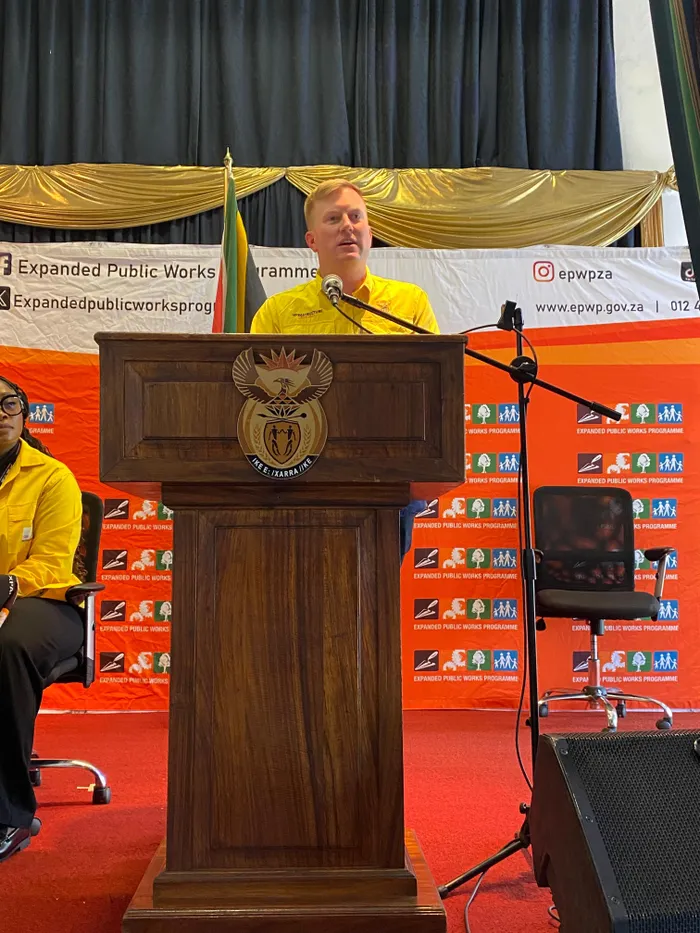
The South African government is taking significant steps to reform the Expanded Public Works Programme. In Picture: Public Works Minister Dean Macpherson
Image: Sipho Jack
The Expanded Public Works Programme (EPWP) has been riddled with allegations of jobs for pals and exclusion of people with disabilities.
To curb such tendencies, the department launched its EPWP Disability Framework in Chatsworth, south of Durban, yesterday, which is intended for the meaningful functioning of the programme.
Dean Macpherson, the Minister of Public Works and Infrastructure, was in attendance.
Macpherson said, at the sidelines of the launch event held in Sungam Crescent, Westcliff, that his department was commitmented to reforming the EPWP initiative to ensure transparency in its operations.
He said some politicians and officials misused the EPWP to coerce individuals into compromising situations as a prerequisite for employment.
“Horrific stories abound of people being asked for money and producing party membership cards to secure jobs,” MacPherson said, in denouncing such practices.
“Women are being pressured into providing sexual favours to gain employment opportunities.
"This is completely unacceptable in South Africa.”
The minister said a crucial focus area of the reforms was the removal of local councils from the EPWP's project allocation process.
“If we get our way, councils will not have any control over allocating EPWP projects,” he said with the belief that such a stance would public backing.
Deputy President Paul Mashatile, who heads the Inter-Ministerial Committee on Public Employment Programmes (PEP-IMC), is also driving the evolution and improved coordination the EPWP
MacPherson noted that previous approaches were inadequate, focusing excessively on menial tasks like litter collection.
The revamped programme will include a nine-month training module designed to equip participants with essential skills for more substantial employment opportunities.
MacPherson emphasised the need for the programme to cater for individuals with disabilities, who were largely overlooked previously.
“We are making it a priority to ensure that local administrations take up the challenge to drive inclusion actively.
"Failure to do so will result in accountability measures against responsible officials.”
The newly proposed framework outlined stringent guidelines for public bodies, ensuring that they include persons with disabilities as active participants, including equal pay.
A representative from the Ubuntu Crisis Centre, a Non-Governmental Organisation (NGO) that was part of the programme, Nokuthula Phungula, said that the programme has brought about significant changes in terms of providing them with experience and expertise in administrative and other aspects of their work.
Phungula said the funds they receive from the programme made a significant difference in their lives.
“Since the inception of the programme, I have been able to see a difference in my life and my colleagues' lives.
"There are things that I am now able to do on my own since the programme started,” she added.
Carmen Joy Abrahams, the Deputy Director General in the department, said the initiative should guide numerous public entities, including municipalities and national departments, in establishing a fair recruitment process and effectively integrating persons with disabilities into the workforce.
Abrahams said the framework was expected to eliminate discriminatory practices and raise awareness regarding the rights and capabilities of individuals with disabilities.
And the collaboration with NGOs and disability groups was another significant step toward fostering an inclusive work environment.
“We are not leaving much to chance or to the discretion of local councillors or officials,” stated Abrahams.
“This will be a monitored process with clear expectations and accountability.”
DAILY NEWS