
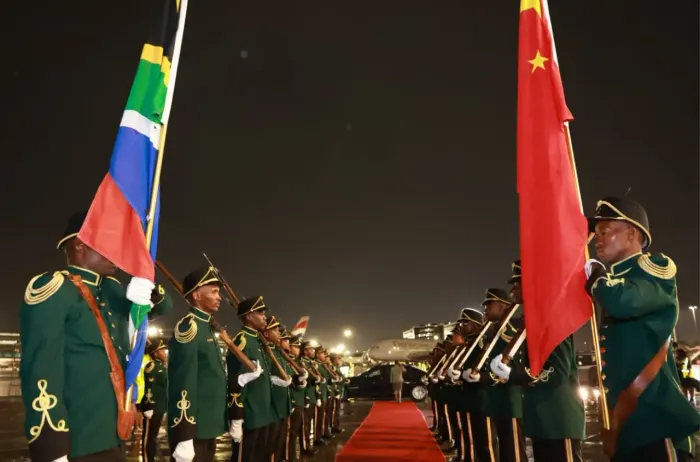
G20 summit arrivals A guard of honour welcomes one of the many heads of state to the successfully hosted G20 summit.
Image: GCIS
I would like to congratulate President Cyril Ramaphosa and his team for successfully shaping and hosting the G20, despite the fallout involving the US and Argentina.
Ramaphosa’s decision to adopt the G20 declaration at the outset of the conference deserves particular recognition, as it safeguarded the integrity of the first African-hosted G20. By securing agreement upfront, he ensured that diplomatic tensions would not derail the summit’s ability to deliver a meaningful and coherent outcome.
The US boycott of the G20 is not only unreasonable; it is remarkably revealing. Washington appears to believe that if it walks out, the global conversation will simply stop. When the dialogue is no longer structured around US priorities, America may choose not to participate.
If this continues, the US risks isolating itself because the world cannot be managed from the Oval Office. The G20 is about global financial stability and collective survival, not catering to Western egos or preferences.
The Global South, and the African continent in particular, must be included in shaping solutions to shared challenges. If the US continues to withdraw whenever the global agenda shifts toward inclusive growth, solidarity, equality, and sustainability, it may soon find that the discussions defining the future are taking place without its presence. | MOHAMED SAEED Pietermaritzburg
Eighty years ago, the Nuremberg Trials began, bringing to justice the crimes committed by the Nazis. Yet the world is witnessing a new era of impunity that has claimed more than 40 million civilians since those trials in 1945.
The deadly assaults in Ukraine, Sudan, and the Middle East are violations of international law. These brutal and savage conflicts are aided and supported by major military powers in pursuit of strategic dominance.
The Middle East has become a shooting gallery where high-tech weaponry is tested and perfected – a sordid display of gunboat diplomacy in which human lives are dismissed as “collateral damage”.
Aggressive war is prohibited by the Nuremberg Tribunal and must be prosecuted by the International Criminal Court. The use of outlawed weapons violates Protocol I of the Geneva Conventions. Regime change, too, is prohibited by the International Covenant on Civil and Political Rights.
The warning of Nuremberg Prosecutor Robert Jackson should haunt the wars of today. He reminded the world: “The crimes of the Nazis were so devastating that civilisation cannot tolerate their being ignored because it cannot survive their being repeated.”
Yet crimes committed in today’s immoral wars are grimly reminiscent of – and in some cases worse than – the atrocities of the World War II.
The targeting of civilians and the use of banned weapons are grave breaches of the Geneva Conventions and are war crimes. The world’s major and minor military powers have brazenly violated the UN Charter, the foundation of modern international law.
Wars that incinerate civilians and send young combatants to die in mounting numbers deaden our collective conscience. We must oppose aggressive war with righteous indignation.
As concerned global citizens, we must urgently seek alternatives to war. | Farouk Araie Benoni
DAILY NEWS