

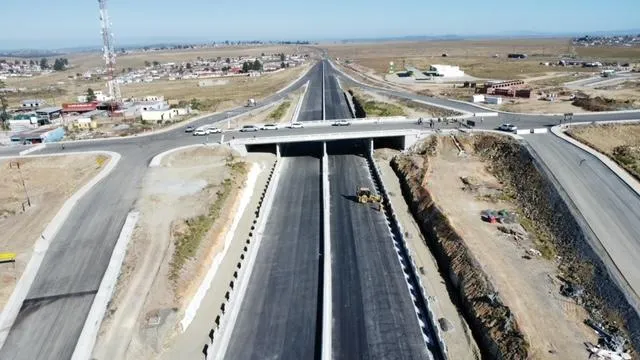
Long-standing maintenance contractors have filed an urgent application in the Pretoria High Court to stop SANRAL from implementing new road maintenance contracts, citing procedural irregularities and potential impacts on road safety.
Image: SANRAL
A group of seasoned maintenance contractors has filed an urgent application in the Pretoria High Court seeking to halt the South African National Roads Agency (SANRAL) from implementing its new national Routine Road Maintenance (RRM) contracts.
The service contracts relate to the maintenance of around 20,000 kilometres of the country's national roads. The affected contractors (the applicants) claimed that SANRAL's tender awarding processes were fraught with flaws.
Therefore, they resorted to court action to interdict SANRAL from concluding service level agreements with another conglomerate of contractors and to stop any maintenance work from commencing until a full judicial review is heard.
Included in the affected group of contractors were BCB Solutions and others, who were awarded the same contract over previous cycles.
Some of the assertions of the applicants included claims that the tender process was riddled with procedural and administrative irregularities, and that SANRAL did not open the submitted bids publicly as required.
They contended that their current contract with SANRAL, which ends this month, provides for an extension of the contract, but that option was not afforded to them. Instead, SANRAL put out a new tender and has awarded the work to a group of 20 contractors that entered into a joint venture.
Another claim included in the contractors' court documents was the failure by SANRAL administrators to publicly open tender submissions approximately one hour after the tender deadline, and the tender opening register was not made available to the bidders.
The aggrieved parties alleged that several of the appointed panel members in the group that landed the award did not meet the minimum requirements, such as CIDB (Construction Industry Development Board) grading, which relates to their financial capability, BBBEE status, and having meaningful experience in routine road maintenance.
The "Routine Road Maintenance" contract in question relates to the upkeep and safety of approximately 22,000 kilometres of national roads.
The work includes pothole repairs, vegetation control, drainage clearing, emergency responses, road markings, signage repairs, and cleaning.
The unfolding dispute raises potential operational impacts on the maintenance programme of the country's road networks, which could compromise road safety and service delivery across multiple provinces, especially at a time when the festive season was in full swing.
The applicants claimed that some of the panel members had previously received rolling contracts and received astronomical increases when contracts were renewed. In one instance, an emergency RRM worth R394 million was issued without the necessary authority.
Therefore, they asked that the new award be placed on hold until the court made a determination on whether the tender was lawful, fair, and consistent with constitutional procurement principles.
In response to the allegations, SANRAL’s spokesperson, Vusi Mona, stated that the issued tender did not require bidders to provide offers, adding that the bidders were evaluated based on administrative and B-BBEE criteria.
Regarding whether bidders received the two-tender validity period extension notices, and whether SANRAL believed the tender remained valid after the expiry of the initial period, Mona stated that the tender had a compulsory briefing session, where bidders attended.
“In addition, bidders provided contact details on the tender close register. Communication to extend validity was sent to all contacts as per the tender close register,” said Mona. He stated that the list of the 20 appointed panel members was published on the SANRAL website.
“The award was also published on the Construction Industry Development Board (CIDB) and National Treasury websites.” Mona assured the publication that all bidders met the requirements to be included in the panel, which include CIDB grading, functionality thresholds, and B-BBEE. “The criteria were stated in the issued tender document and discussed in detail during the compulsory briefing session,” he explained.
On the question of whether the agency would respond to the PAJA (Promotion of Administrative Justice Act) request within the reduced five-day timeframe, Mona said SANRAL followed the rules set out in the PAJA prescript.
Mona stated that the agency was proceeding with work allocation to the panel, regardless of the ongoing dispute. “Once the award has been made and communicated to bidders, SANRAL implements the award unless instructed to hold the award by a court of law. It is common for unsuccessful bidders to dispute the outcome of the tender process. However, the dispute does not stop the award implementation,” Mona emphasised.
DAILY NEWS