

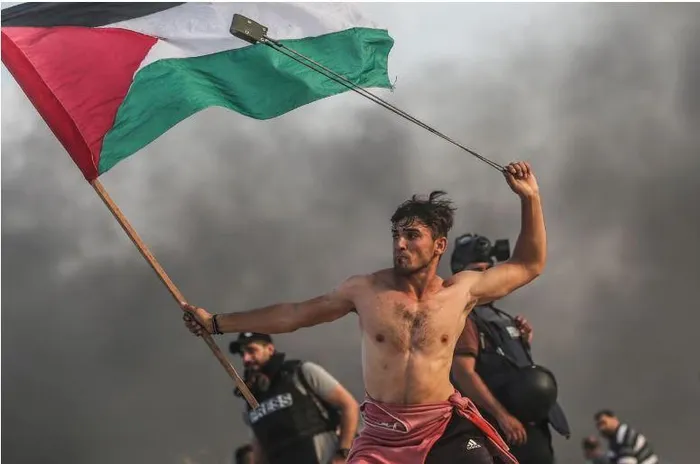
A Palestinian facing off with the invading Israeli army, readies his sling above his head, building up enough momentum to to give the projectile devastating accuracy, range and deadliness.
Image: File
Diamonds aren’t forever – and neither is the value we assign to human struggles.
The global diamond market is losing its shine. Lab-grown diamonds – cheaper, cleaner, and conflict-free – have surged to nearly 20% of global sales. As technology improves, their production costs keep falling, and so do their prices. Meanwhile, natural diamonds – long marketed as rare and eternal – are losing value as consumers question what makes a stone “worth” anything at all.
This shift reveals a truth we rarely admit: Value is not inherent. It’s engineered. In the diamond world, half the price tag reflects psychology, branding, and narrative – more than the stone.
And this lesson extends far beyond jewellery.
Consider global politics, where perception often dictates which struggles command attention. The situation in Palestine is a stark example. International engagement is shaped not only by the human reality on the ground, but by how the story is framed, whose voices are amplified, and which narratives dominate the headlines.
Just as natural diamonds were declared “rare” by decades of clever marketing, public understanding of political struggles is shaped by who controls the narrative. Some issues receive immediate outrage; others are quietly deprioritised. The difference is rarely the severity of the suffering – more often, it is the perception surrounding it. Both diamonds and global conflicts teach us that: What the world chooses to value – or ignore – is a matter of collective storytelling.
And those choices have consequences. Diamonds lose their sparkle when the narrative shifts. Human struggles lose visibility when attention drifts. In both cases, lives and livelihoods hang in the balance.
We like to believe that value is objective, but it isn’t. It’s a mirror reflecting what we decide to see. | Zaynab Naushaad Khan Durban
Prosecuting South Africans who break our laws by fighting for foreign countries without permission, should be a priority for our government.
We can all be at peril, if their new bosses would order them to attack our installations, or provide sensitive information.
If a local group would go on the rampage, blowing up buildings, torturing doctors to death, forcing people to drink water from ditches, and setting dogs on them, they would be arrested immediately.
Likewise, those who have been fighting for Israel in particular, should also be arrested. The same rules should apply. It it’s dangerous to let such people run loose, because one doesn’t know when they would repeat like their crimes against innocent people here.
Advocate Feroz Boda SC has raised the issue of South Africans being involved in the use of the highly flammable, toxic and self-combusting white phosphorus against Palestinians.
Not only have those soldiers proven that they would quite happily partake in violence against the indigenous people in the Holy Land, but they also developed a morbid sense of humour. One, with the surname Taljaard, posted videos of himself, mocking Palestinian homes being blown up. A person with a conscience would be horrified. A sane person, would, at least, not broadcast such a reaction over the internet. It shows not only total lack of remorse, but taking pride in the actions that cause tremendous pain. It is frightening that someone like that would be allowed to freely walk our streets As accomplices to Israel’s violence against Palestinians (for decades), they should be rehabilitated first.
That is the least our government can do. Because other enablers, like pro-Israel Christian groups, are getting away with their support for the Israeli apartheid system.
These groups use certain parts of the Bible to justify Israeli actions against Palestinians. Conveniently, they leave out the Ten Commandments, that preach against murder and robbery. Or Matthew 25, which speaks about caring for those who are in a predicament.
Or the parable about the Good Samaritan who cared for a stranger who had been robbed and left for dead (an organisation like Gift Of The Givers actually fills the role of the Samaritan.)These Christian groups, and the media stations here, that broadcast or print their complicit support for Israel, support the ongoing Nakba, which means “the catastrophe” and is the Israeli ethnic cleansing of Palestinian Arabs through their violent displacement and dispossession of land, property, and belongings, along with the destruction of their society and the suppression of their culture, identity, political rights, and national aspirations. Even before October 7, this included the siege of a Gaza, counting even the calories going in. Other over forms of current persecution are:
These Christian organisations tend to be sneaky, because they talk at length about October 7, but never about all the other atrocities.
Unsurprisingly they were very vocal in their criticism of the organisers of an interfaith service in Cape Town’s Goote Kerk, which hosted Francesca Albanese, the United Nation’s Special Rapporteur on the occupied Palestinian territories.
Fortunately, for them, their actions, like raising funds to support the genocidal, apartheid regime, does not warrant prosecution under our legal system.
Therefore, the least our government could do, is to prosecute those who are involved in military operations on behalf of Israel. | Dr Elma Ross Rosebank, Cape Town
DAILY NEWS