

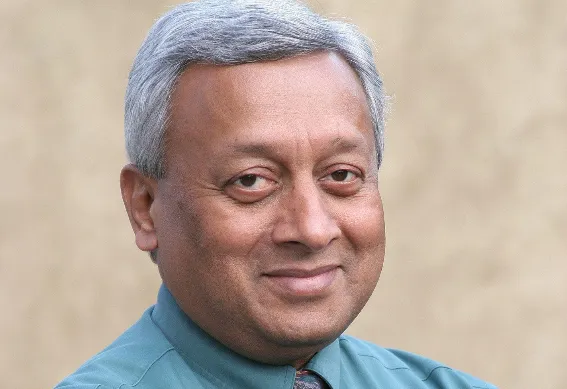
Dennis Pather was laid to rest on Saturday
Image: File
Under brooding skies streaked with light and dark clouds and the threat of drizzle, the journey’s end for award-winning veteran journalist, retired editor and author Dennis Pather came on Saturday at a 160-year-old Durban church — a fitting farewell for a man whose life was inseparable from his hometown.
A witty wordsmith to the end, Pather passed away peacefully on December 7, aged 80, after a long battle with heart ailments.
He had survived triple and quadruple bypass surgeries, yet his spirit remained undimmed. Even in retirement from the Daily News — the Grey Old Lady of 85 Field Street whose 140th anniversary he lived to celebrate — he continued to write incisive columns infused with dry humour, insight and anecdote.
Pather’s body lay in state from 10am to noon at St Thomas Anglican Church in Musgrave Road, one of Durban’s oldest places of Christian worship and a spiritual home he and his wife Kay, a former bank employee, cherished throughout their retirement years.
He was cremated later at the Stellawood Cemetery, where scores of colleagues, friends and former protégés gathered to pay their final respects.
Tributes flowed freely at both the funeral service and cremation, with speaker after speaker saluting one of the longest-serving editors in the Argus Company’s Natal Newspapers and later Irish-owned Independent Newspapers.
Independent Newspapers chairman Dr Iqbal Survé joined a growing list of personalities and organisations — including the South African National Editors’ Forum (SANEF) — in honouring Pather’s contribution to the science and practice of journalism.
Pather carved out a rich and colourful career, becoming one of the rare journalists to edit nearly half a dozen titles across the Argus Company and Independent Newspapers stable.
His final WhatsApp message to this writer on Diwali hinted at the quiet toll of age, yet even then he remained intellectually sharp, continuing to produce socio-political commentary despite declining health.
He was a familiar and much-loved figure in the Musgrave CBD, admired for his warmth, charm and unwavering commitment to journalism.
SANEF treasurer-general S’bu Ngalwa described Pather as a model editor and mentor: “Dennis was a great mentor and a genuinely kind man. He took a chance on me as a starry-eyed 22-year-old and entrusted me with leading the Daily News politics desk.
"Even when I doubted myself, I knew Dennis believed in me — and from there I never looked back.”
Despite failing health, Pather persisted in doing what he loved most: writing.
As his strength waned, his devotion to the craft did not. News of his death triggered an outpouring of tributes from across the country’s media fraternity.
“Dennis is in a better place now, free of pain and tiredness after undergoing multiple heart surgeries,” said Geeta Maharaj, his long-time secretary at Post, the Indian community newspaper he edited at the outset of a distinguished editorial career.
Pather later served as editor of The Daily News, The Mercury and The Sunday Tribune, earning a reputation as a newsroom leader who blended charm, humour and firm editorial discipline.
SANEF, in an official tribute, highlighted his autobiography Copy Boy: A Journey From Newsroom Gofer to Award-Winning Editor, noting that his career spanned decades during which he mentored countless journalists.
That mentorship — patient, exacting and quietly transformative — is widely regarded as his most enduring legacy.
Pather published his memoir in 2023, offering a candid reflection on newsroom life and the evolution of journalism in South Africa.
His own journey began in 1967 after studying at the University College at Salisbury Island, later the University of Durban-Westville and today part of the University of KwaZulu-Natal.
He cut his teeth at Post and Drum, before moving to The Leader and The Graphic. For this writer, the symbolism of receiving news of Pather’s passing while on Robben Island was profound. I was in the company of one of his closest political peers, Dr Saths Cooper, chair of the Robben Island Museum Council.
Cooper, Pather, Strini Moodley and the late Dr Aubrey Mokoape shared bonds forged in the crucible of Black Consciousness activism in the 1970s —bonds that began at Salisbury Island and deepened at UDW, where Cooper later became the institution’s last vice-chancellor.
Pather also played a pivotal role in transforming South African newsrooms. Alongside colleagues such as the late Ticks Chetty, he was central to the formation of the Writers’ Association of South Africa (WASA), a forerunner of the Media Workers’ Association of South Africa (MWASA).
The historic 13-week strike of the 1980s, which halted printing presses nationwide, forced the industry to confront entrenched racism and opened pathways for journalists of colour to become editors, political reporters and foreign correspondents.
Even after undergoing bypass surgery during his editorial years, Pather remained undeterred.
His career began in Durban’s Grey Street precinct at The Leader and The Graphic, apartheid-era tabloids that voiced the aspirations of the Indian community.
His defining professional chapter unfolded at the Daily News, where he rose from reporter to editor.
Internationally, Pather worked at the Argus Company’s London bureau on Fleet Street from1983 to 1985 and, in 1987, was awarded the prestigious Nieman Fellowship at Harvard University.
Yet to those who knew him best, Dennis Pather was more than an editor. He was a conscience— a Durban son whose belief in ethical, courageous journalism shaped generations.
His humour, humility and humanity ensured that every story carried not only insight, but heart. He is survived by his wife Kay, his children, Brendan and Nisha, and grandchildren, and sisters, and a media fraternity that will remember him as a towering figure whose career spanned the censorship-ridden apartheid era and the hard-won freedoms of democracy.
*Durban-based Marlan Padayachee is a former political, foreign and diplomatic correspondent at Independent Newspapers in the transition to democracy, and continues to work as a freelance journalist, photographer and researcher.