
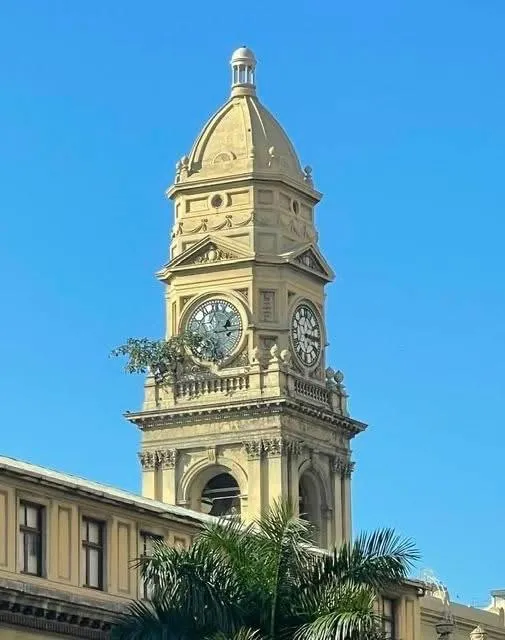
Durban's iconic but sadly neglected central post office clock tower – just across the road from the Mayor's office. The tree's been there for six years, how much longer will it be there, asks a letter writer.
Image: Supplied
This is Durban’s Central Post Office clock tower with trees growing out of its clock face. Opposite the City Gardens and the Memorial to the Fallen.
Once the Durban Town Hall on whose steps in December 1899 a young war correspondent named Winston Churchill made a famous speech after escaping Boer captivity during the siege of Ladysmith.
In full line of sight of the eThekwini Mayor’s Office in the City Hall across the road. That tree is now easily twice the size in the photograph; it’s been steadily growing for over six years….Take a drive past and have a look for yourself. This is what ANC municipal government looks like. No pride. No shame.
I’ve written about it for years. Complained, objected, protested, even offered to climb up and remove it myself.
My missives have only been met by withering silence. The Mayor and municipality don’t want to know about it. They’ve even blocked me from the eThekwini municipality’s community Facebook page.
As if I’d go away.
Durban deserves so much better. | Mark Lowe Berea
Good morning,
With sadness I hear of the passing of Graham Linscott (former Daily News associate editor and Mercury columnist).
I have been one of many readers of Graham’s Idler column and so perhaps it may be fitting to fuel his new journey with a limerick. They were such a part of his repertoire.
There may be a place in the new empty space,
to pay tribute to a man that is hard to replace.
It was Linscott, limericks and rugby galore,
That could bring on a gentle guffaw,
To a pen he was born,
And to all those that now mourn,
Will must cherish the prose of a journalist of yore.
From a correspondent and appreciative reader of his column. | Richard Isemonger Hillcrest
To all these dear friends and colleagues of Graham Linscott: I was so very sad to hear that Graham died at his ‘home’ in Amber Glen, a retirement village in Howick, late last week.
I had known Graham since I was a young reporter on the Daily News in Durban, starting in 1970. Over the years our paths crossed may times and I spent time with him and Dr Don Beck on many occasions.
Don was influential in shaping communication and helping guide the new South Africa in 1994. Their book, The Crucible, is ironically the subject of Graham’s next Idler’s Column, which he had already sent in for publication in The Mercury today.
I recently stayed at Amber Valley in Howick for just over a year, during which time Graham and I spent many happy hours at the local eating and drinking spots in Howick, and at Amber Glen’s famous Friday night social evenings.
With love and sadness. | Pixie Emslie (nee Malherbe)
Dear Editor,
As we move through 2025, disasters – both man-made and natural – continue to engulf our fragile planet. This year alone, an estimated 300 000 civilians have been killed in more than 10 conflicts raging across the world.
Humanity, supposedly the most intelligent species in a richly endowed biosphere, has painted itself into a corner, creating a future of existential peril.
Every day, about 25 000 people die from hunger or hunger-related causes – one person every three and a half seconds. Most of them are children.
The Finnish philosopher Georg Henrik von Wright warned that when humanity places competition before morality, materialism before community, and the economy before ecology, it risks its own annihilation. Today, we are living that warning. We face the worst economic and financial pressures since the Great Depression, yet after experimenting with religion, atheism, capitalism, communism, democracy, dictatorships, monarchies and more, the world remains mired in crisis.
Genocide, ethnic cleansing, terrorism, war, obscene inequality, mass poverty, malnutrition, environmental destruction and nuclear proliferation have become defining features of our age. Poverty itself is the absence of all human rights. The anger and frustration born of deprivation cannot sustain peace in any society.
If we are serious about building lasting peace and global security, we must confront the root causes of conflict: inequality, exclusion and despair. The coexistence of extreme wealth alongside extreme poverty is a contradiction too dangerous to ignore.
More than one billion people remain trapped in abject poverty.
Their daily struggle breeds instability that will continue to erupt unless we act. Despite the uncertainty ahead, we must still lay the foundations for a more just, stable and equitable world – one that offers hope, dignity and opportunity for all. | Farouk Araie Benoni
DAILY NEWS