

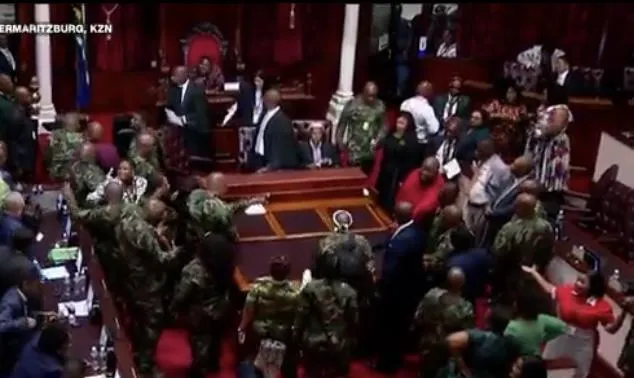
The KwaZulu-Natal Legislature descended into chaos on Monday as MK Party and Economic Freedom Fighters members clashed with police after a motion of no confidence against Premier Thami Ntuli was defeated in an open ballot.
Image: Screenshot/SABC News
The KwaZulu-Natal Legislature was plunged into chaos on Monday, leaving many political leaders aghast as a violent scuffle erupted during the debate over the latest motion of no confidence brought against Premier Thami Ntuli.
The chaotic scenes brought to light once again the growing trend of deteriorating respect for democratic institutions, where lawmakers were seen clashing with police after disputes during proceedings in Pietermaritzburg.
Following the failure of the no-confidence motion against Ntuli, members of the MK Party confronted police officers, resulting in a violent confrontation within the chamber that drew strong reactions from several political figures.
Herman Mashaba, leader of ActionSA, expressed shock at the disorder. He said that such scenes reflected a troubling erosion of mutual respect, which was essential for governance.
He stated that the state of democracy in the country was such that when no particular party had a clear majority, coalition governance should prevail without recourse to violence.
“The erosion of respect for democracy, for one another as political parties, and for voters is a crying shame that has regrettably become commonplace,” Mashaba stated, calling on all political leaders to rebuild the respect that is foundational to democracy.
“What we witnessed today (Monday) isn’t just contrary to our values; it is a disgrace to our democratic principles,” said Mashaba.
Mike Mabuyakhulu, the African National Congress (ANC) KZN coordinator, condemned the unsavoury behaviour displayed by some members of the legislature, whom he accused of undermining their oath to uphold the rule of law.
He said that the chaos was exacerbated by the presence of senior MK Party leaders who failed to intervene during the disruption.
“We are a rules-based society, not an anarchic society,” he said in calling for stern action from the legislature.
In defending the presiding officer Nontobeko Boyce's decision-making process, Mabuyakhulu said that her actions were not only morally justified but also legally sound.
“She articulated her ruling well, quoting case law and providing valid reasons,” he said, in recognising Boyce's authority in legislative matters.
“It is utterly disgraceful that lawmakers exhibited any form of intimidation towards her,” he said.
Professor Bheki Ngomezulu from the Nelson Mandela University's Centre for Advancement of Non-Racialism and Democracy expressed concern about the political ramifications of the Speaker's decisions.
He acknowledged Boyce's legal correctness but suggested a political misstep, advocating for a secret ballot that might have mitigated tensions.
“The biggest losers are the people of KwaZulu-Natal. The Speaker could have opted for a secret ballot, thereby satisfying the MK Party and the electorate,” he observed.
The National Freedom Party's (NFP) lack of support for the motion added to the tension that brewed in the legislature.
MEC for Social Development and NFP member Mbali Shinga stressed that the motion lacked a foundation in evidence and was instead fuelled by political theatrics rather than genuine governance concerns.
“A motion of no confidence must be rooted in accountability and constitutional integrity, not just mere political manoeuvring,” Shinga insisted.
Dean Macpherson of the Democratic Alliance (DA) echoed the stability of the current coalition government while also condemning the chaos that unfolded in the legislature.
He said that the unrest was indicative of the MK Party's inability to garner support. He said, “If they had the numbers, they would have simply raised their hands.”
The MK Party's KZN caucus whip, Siphiwe Mbatha-Moyo, expressed his disappointment that the democratic process was undermined by such disruptions, as he called for the Speaker to facilitate voting through a secret ballot in the interest of transparency and fairness.
Political analyst Zakhele Ndlovu said the request for a secret ballot revealed divisions within governing parties, highlighting the mistrust that exists among lawmakers. “The ANC’s insistence on an open ballot stems from a fear that some of their members may not align with party lines,” he said.
DAILY NEWS