

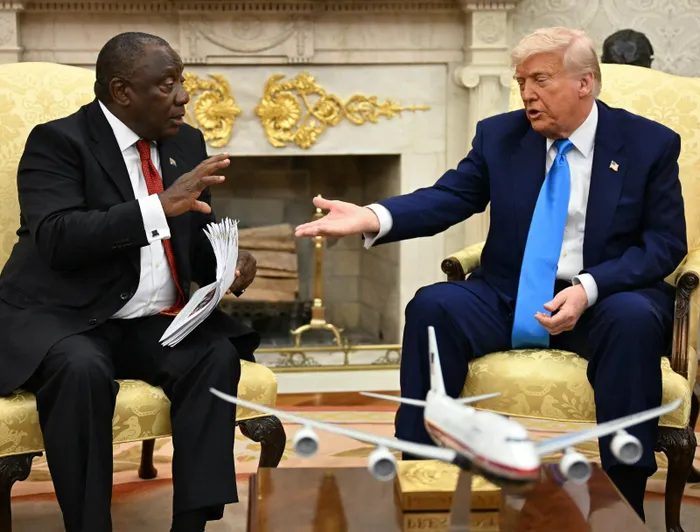
The tensions between President Cyril Ramaphosa and US President Donald Trump are ongoing.
Image: File/ AFP
During his Day of Reconciliation address in KwaZulu-Natal on Tuesday, President Cyril Ramaphosa fired back at his US counterpart, Donald Trump, and his apparent peddling of misinformation, particularly around the issue of farm murders.
“Fellow South Africans, there are those, inside and outside our country, who are trying their utmost to paint a false picture of us as the South African people,” Ramaphosa said.
He delivered the keynote address at the Ncome Museum, Nquthu Local Municipality, in the uMzinyathi District, with KZN Premier Thami Ntuli and Minister of Sport, Arts and Culture Gayton McKenzie present.
Ramaphosa stated that the Day of Reconciliation was another opportunity for the country to engage in honest introspection around complex issues related to the past and to use these experiences to shape a peaceful future for everyone.
He also reflected on the G20 Summit held recently in Johannesburg and the running battle with the US over South Africa's standing and had a dig at some of Trump's utterances on his social network “Truth Social"
Trump raised that the US did not attend the G20 in South Africa “because the South African government refuses to acknowledge or address the horrific human rights abuses endured by Afrikaners and other descendants of Dutch, French, and German settlers.”
Trump said: “They are killing white people, and randomly allowing their farms to be taken from them. Perhaps worst of all, the soon-to-be-out-of-business New York Times and the fake news media won't issue a word against this genocide.”
He also said that due to South Africa’s refusal to hand over the G20 Presidency to a senior representative from the US Embassy, “at my direction, South Africa will NOT be receiving an invitation to the 2026 G20,” which will be hosted in Miami, Florida.
“Our democracy was built on reconciliation. South Africans bear the scars of centuries of dispossession and oppression, where resistance was often met with batons and bullets.
“Fellow South Africans, there are those, inside and outside our country, who are trying their utmost to paint a false picture of us as the South African people. They do not tell us what the surveys say: that the majority of South Africans are hopeful about the state of our democracy.
"They do not tell us that the majority of South Africans believe race relations have improved since 1994. They do not show the pictures of African, white, Indian, and coloured children learning together, studying together, and playing together,” Ramaphosa said.
“They do not want to talk about the friendships, neighbourliness, and kindness shown by black and white towards each other. They don’t want to play all the social media clips we are seeing of young Afrikaners in veldskoens dancing to amapiano, and white teenagers speaking fluent isiZulu with their friends.
"Our country’s detractors are not talking about successful land restitution, of communities sharing the land, and of successful black farmers.
"Instead, they are painting a false picture designed to sow fear and hatred. We must not let them succeed in their efforts. If we continue and together we build our nation as South Africans, there will be no one who will be able to plant the seed of discrimination and exclusiveness amongst us.”
Ramaphosa acknowledged that South Africa was a country comprising people with a range of views, ideologies, cultures, and histories.
“We must not try to hide these differences. We must speak about them and continue to work to bridge them… For as long as the majority of black South Africans live in poverty, and for as long as inequality persists, our country will not find true reconciliation,” Ramaphosa said.
DAILY NEWS