


Liam Lupton-Smith with giant casava (a staple food source) in a market in Abidjan, the largest city, chief port, and economic/de facto capital of Côte d'Ivoire (Ivory Coast). Yamoussoukro is the actual capital.
Image: Liam Lupton-Smith
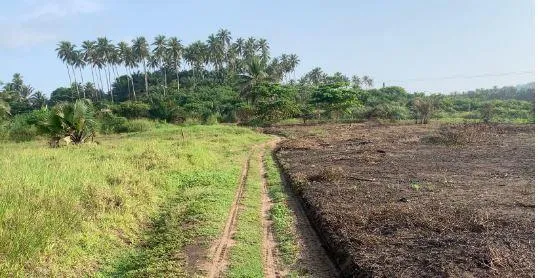
Ghana – the road leads south, always south.
Image: Liam Lupton-Smith
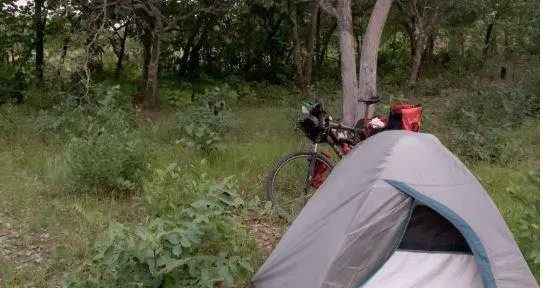
Camping in Benin.
Image: Liam Lupton-Smith
They say that it’s only mad dogs and Englishmen that go out in the midday sun, but it doesn’t stop there and the saying is wrong because it could apply to any of us, with important lessons.
Last week, Irishman Liam Lupton-Smith left Durban to fly back home to Delgany, a charming village 25km from Dublin, after spending 15 months on a curiosity-driven “voyage of discovery” that saw him cycle the length of Africa, chronicling his discoveries online and making some eye-opening discoveries about the goodness of Africa.
Engaging, tall and lankly with a shock of a red beard, Lupton-Smith, 25, is an engaging sort, keen to tell of his adventures that took him the length of Africa’s West Coast.
With a university background in mathematics and fresh from a master's in philosophy at the University of Leiden in the Netherlands, Lupton-Smith’s wanderlust got the better of him and he could no longer resist the urge to scratch the travel itch, having been inspired by “crazy” online tales and videos.
If they could do it, he reasoned, so could he, and money didn’t have to be an issue.
He began by hitch-hiking down to and through Belgium and France, learning French along the way in preparation for Africa’s francophone countries, and doing odd jobs to save a little extra – picking grapes for three weeks, and helping build a cabin in the woods.
The real journey began in Valencia, Spain, where he bought a cheap bike, left it to the shop owners to fit out as they saw fit and hopped on a ferry to cross the Mediterranean from Almería, Spain, to Nador, in Morocco, where the real journey began.
From there, he more or less followed the coast down to Mauritania, Senegal, Guinea-Bissau, Guinea, Sierra Leone, Liberia, Côte d’Ivoire (Ivory Coast, Ghana, Togo, Benin, Nigeria, Cameroon, Congo-Brazzaville, DRC, Angola, Namibia, and then South Africa via Kamiesberg and Namaqualand.
“My family (his mom is Irish, but his father was schooled at Hilton College and his aunt is married to a farmer in the Ladysmith area) flew out to meet me in Cape Town."
Along the way, he geotagged himself on polarsteps.com, creating an online photo journal for his followers “I had a solar panel,” he says, explaining how he’d stay in touch.
“Sometimes I would ride with the solar panel strapped to the back bags so it would charge while I was cycling, but I was also in a lot of rainy season areas. Most of the time I’d come to a town and search. In a lot of West Africa where there is not a lot of electricity, but there would be one fella in the village with a generator and he’d be the bloke to see.
“It can be quite a fire-safety problem,” he chuckles.
“In this one town there were about a thousand people all charging their phones off this one generator.
“But then that’s Africa.
“My impression of the continent was of how overwhelmingly kind people were and the incredible hospitality that everyone – in every culture, every back ground, every religion – were showing me.
“That was really mind-blowing. It wasn’t a cultural thing, It was everyone – everywhere I went.
“Maybe,” he said, “something that ties all Africans together is this strong sense of community that everyone has, and that impression extends to how that feeling of community was brought to me and I felt a part of people’s community very quickly.
“They wanted to introduce me to all their family and get me in with day-to-day life and tell me how this crop is doing and how the herd’s health is and whatnot.
”When Lupton-Smith wasn’t in a town with a place to sleep, he’d pitch his tent.
“I had a two-man tent that cost the equivalent of R400 that I had bought in Germany two years before.
Morocco’s a lot like Egypt in that the authorities didn’t like people camping out in the open, he said.
“I’d be picked up and taken to the nearest town, but that was mostly because of their tourism image – they didn’t want to take a chance that something bad might happen, but mostly I didn’t have any trouble with safety.
“By the end of the trip I had lost most of the pegs, the poles were bent and the zips weren’t working properly – you had to pull them a certain way – but it made do, especially when it wasn’t raining. “I didn’t really need a tent so much, just an outer layer for the mosquitoes – I spent the entire trip worrying about malaria, so there mosquitoes here in Durban don’t really worry me, he laughs, slapping at another.“
Clothing-wise I took my (Guinness-emblazoned) bicycle shorts, a Merino-wool top, a long-sleeved shirt to keep the sun off you. I had a pair of shorts, a pair of socks, and shoe and a pair of slops. “I had clothes for when I was in the city, and an outfit for night – long pants, long-sleeved shift, and some extra socks – 3 or 4 pairs of socks and underwear, a shirt and shorts for when on break and a set for when I'm at night.
"People kept giving me clothes, so I did have a lot of fleeces for the cold and a raincoat, but I also gave away a lot of things.
“I bathed as much as a could. Usually, when I arrived in a village I would ask where there was river nearby to bath.
“Later, when I cycled with a Ukrainian in Cameroon, I realised that what I thought was his dry bag actually doubled as a shower, which was a great idea.”
From then, he said, he would want to shower every second day in the most humid places along the equator.
"So I’d fill up the bag at some or other water point, hang it under a tree and I’d have some soap with me and stuff like that. When I got to a city I could stay somewhere and shower twice a day, which was very comfortable.
“But there were times when I went as much as 7-10 days without a shower.
Getting enough water into his system meant he was drinking about 5-6 litres of water a day in the deserts, but in the really humid, equatorial regions as much as 9 litres.
“I’d get into a town and just down a litre-and-a-half, and do the same at the next stop.
“It was just so hot. I’d wake up early, be on the bike at 6am so that I could finish by about 1pm, but I would still sweat so much”. Enter cashew wine.
Once you entre Guinea-Bissau there are all these cashew apples (the fruit that grows above the nut) lying about, which is what it is made from.
“They have a distinctive taste, and are extremely juicy, with a very strong taste and very sweet. I was eating them all day every day because it’s so hot and they are very refreshing but you do get sick of them because of the overpowering taste. The cashew wine tastes sort of the same: Sweet and dry, but it did the job.“
"I did pick up smoking a couple of times, but gave it up for health.
"In Guinea especially, it’s R10 for a box, sit down with these old men and have your coffee, smoke cigarettes – that was nice, but on my birthday I made it a thing to give up smoking.
“In Sierra Leone I had bronchitis. It wasn’t that bad, just difficulty breathing – I suppose it was the smog as well.
Then there was the rain.
“The wettest place on the trip was just after crossing into Cameroon, just below Mt Cameroon,” he says.
“It just didn’t stop raining and it was torrential – extreme. I remember waking up on my first morning in Cameroon and thinking, ‘I’ll wait until it stops'.
“Two hours later it hadn’t and I just had to cycle though the rain. It rained all day like that, all the way to Yaoundé, the capital, where there was a different climate. But it just rained non-stop for about a week. It was hectic. It was one of the wettest places in the world, I think.
“In Morocco, the roads were very good, but Sierra Leone definitely had the best.
“After the end of their civil war 20 years ago they got investment and the European Union built this network of lovely roads through-out the country.
“They were fantastic, and quite empty,” he said.
“On the other hand, the worst roads were definitely Guinea, which hadn’t been fixed in 30 years and were incredibly potholed.
“You have big stretches of main road that’s mostly mud, it was difficult because there would be so much traffic, and big trucks spraying the muck around and I’d have to go very slowly.
"They were barely roads, they were so bad, he said.
Then when he climbed up from the lowlands of the cashew plantations in Guinea-Bissau to the Fulani highlands, “between the heat and they type of terrain, there was so much powdery dust which would get thrown up by passing vehicles that you’d literally have the bicycle sink in dust”. “But the Chinese were up there building roads so it will get better.“
"The trip gave me perspective in that there are lots of ways to live. That was fascinating."
Having sampled the best that he could find, he rates Angola’s Cuca beer the world’s finest: “Very crisp and fresh, not just watery. It had a good laagery taste, although I really enjoy Windhoek.”
“I had such difference experiences during my cycle – above the Sahara and below the Sahara, and West Africa’s a very particular place. Then you get the Francophone and Anglophone portions of Africa.
“Liberia and Sierra Leone are really in a world of their own, then there’s Angola and Namibia with Angola having more of a Brazilian feel.
“I heard the most heart-breaking stories, particularly in Sierra Leone of the things that had happened in the civil war.
“Coming down from Namibia, South Africa had an incredible landscape. I thought I would cross the border and it would all be very familiar, but the Northern Cape and Namaqualand are very different to what I had experienced before around Cape Town and in KwaZulu-Natal
“South Africa is the most incredibly diverse place but it’s still very segregated, it feels like you come to a culture in one town and in the next another culture dominates – like everyone else is keeping to themselves.
“In Angola, for example, people intermingle freely, and places like Yaoundé (Cameroon) and Lagos (Nigeria) are very cosmopolitan.
“The Yoruba really dominate Lagos but there’s a willingness to eat, drink and mix with each other. There isn’t the same feeling in South Africa.
“I had a lot of conversations with people in South Africa just after crossing the border.
“There was almost a feeling of fear among them of each other, but that was overshadowed by the realisation about where I was and what I’d almost accomplished.
“It was a very warm feeling, indeed,” said Lupton-Smith, his Irish eyes smiling and not at all looking like a mad dog or an Englishman.
DAILY NEWS
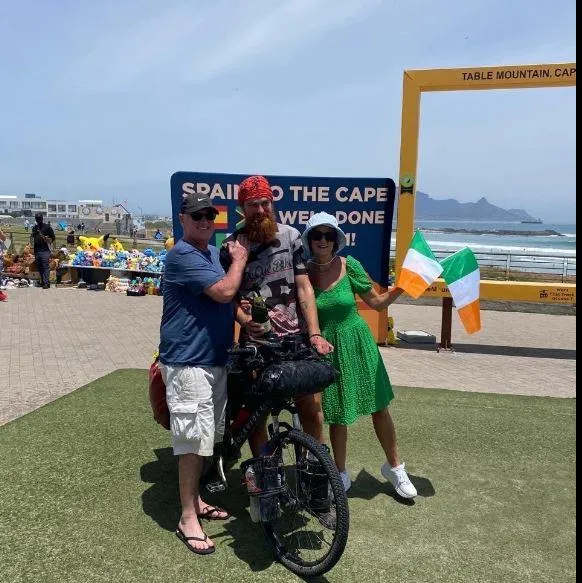
The thrill of seeing the folks (dad Bruce and mom Eibhlín) again after finishing the long road trip in Cape Town.
Image: Supplied