
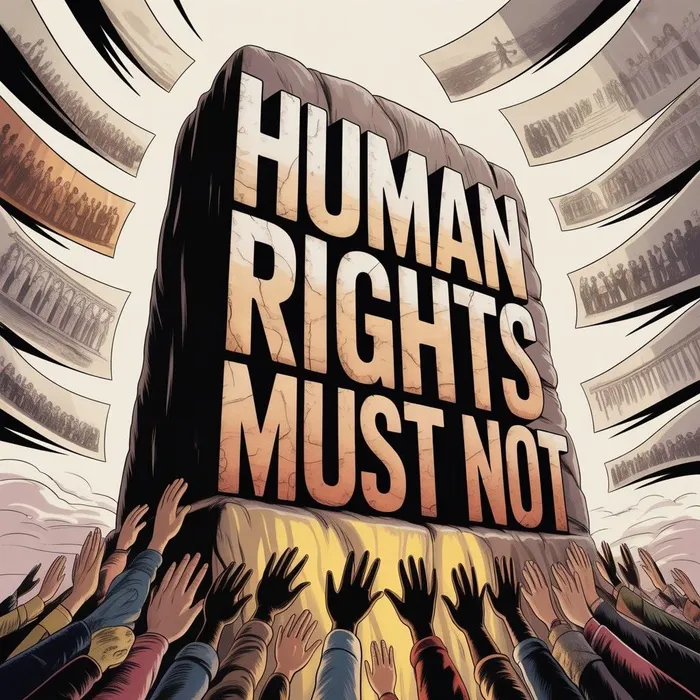
The rights of the many must not come before anything else.
Image: ideogram.ai
Dear Sir,
Does anybody really know what lay beneath every present-day famous building?
What indigenous American wigwam, tepee, or sacred totem pole lies under the ground where the Statue of Liberty now stands? What stood beneath the Tower of London? Perhaps Julius Caesar’s ghost still prowls Rome, murmuring, “Et tu, Brute?”
The earth is billions of years old, they say. Every synagogue, mosque, or temple is ultimately built from the same elements: mud, stone, and what are suddenly described as “rare earth metals”. In themselves, these materials are meaningless. Symbolically and emotionally, however, they carry immense weight for different people.
The destruction of one form, shape, or architectural design – such as the original temple said to have existed beneath the Babri Masjid – is, to me, just another expression of rejection. A rejection that moves in loops. The demolition tools merely change hands, depending on who rules at the time. Years later, the same act is repeated: the destruction of a mosque, a temple, or a church that was reportedly built on top of something else.
History repeats, rulers change, and the cycle continues.
As has often been observed, we are supposed to learn from history. We cannot change it, even if we demolish every temple or mosque – whichever appears last. The Mughals were invaders. They are long gone. The present-day minorities of India were born there. This includes Dalits, Christians who converted largely from so-called “low caste” communities, and the majority of Indian Muslims, many of whom also trace their origins to Dalits and scheduled castes who converted to escape the brutal caste system.
But even that is not the point. Conversion – as a human right that began the moment Adam supposedly landed on Earth – is a personal choice. Contrary to what many ignorant commentators believe, Muslims in India are not the direct descendants of Mughal dynasties.
Writers and readers who endlessly rehearse the “evils” of the Mughals are deliberately deflecting the real issue. The puerile argument about which structure represents which belief is not the point. History will continue demolishing. But it must not trample on basic human rights.
That a mosque replaced a temple is not the issue. The violence that followed is. The Babri Masjid episode became yet another excuse to turn against Muslims – and a signal to begin excavating every other archaeological site suspected of hiding a temple. It also inflicted deep wounds on the Indian Constitution itself.
What is required now is proof – from writers and readers alike – that Muslims and other minorities in India are not being marginalised today. That Muslims are genuinely represented in higher government circles. That the idea of Pakistan is not endlessly used to crucify local Indian Muslims. That minorities are not disproportionately among the poorest because of enforced lack of opportunity and systemic oppression.
There is no point in drawing comparisons with Pakistan, Saudi Arabia, or the Gulf states. None of them claim to be modern democracies. India once tried to be one – and still insists on calling itself “the world’s largest democracy”.
Someone, somewhere, must demonstrate that minority homes are not being bulldozed at the slightest whim of largely Hindu municipal councils. That the countless forms of copycat discrimination do not exist. What is unfolding increasingly resembles the treatment of Palestinians in Gaza and the West Bank – and, closer to home, the discrimination that Indians and other people of colour once endured in this very country, now seemingly forgotten.
Until credible light is shed to disprove these realities, I will continue to regard writers who defend RSS and BJP policies in India – and Zionist policies in Israel – as mere trolls who deflect from the real issue.
À la Azruddin. | Ebrahim Essa Berea
Dear Sir,
Over the past 30 years of our democratic “rainbow nation”, careers have been upended and reputations destroyed.
What began as a fall from grace has become a tsunami of monumental proportions. Power and prestige do not last forever, and over the past decade it has been graphically demonstrated how quickly they can dissipate – sometimes in the blink of an eye.
Many of our political leaders appear saintly only for as long as they wield power without consequence, then tumble from their pedestals of supposed cleanliness once ousted from the citadels of authority.
It has been grimly proven that politics is no cathedral of morality when one surveys the South African political landscape and the utter carnage it leaves in its wake. The depressing squalor of leadership has created among law-abiding citizens a gnawing hunger for an impeccable and honest leader, someone capable of restoring prosperity and political sanity.
The ruling class is deeply associated with the crassest forms of favouritism and cadre-based economic interests. We are told that history does not repeat itself, but it certainly rhymes. Charismatic leaders once revered for leading the struggle for liberation are now reviled for monstrous crimes committed while in high office.
Democracy and freedom cannot survive if we continue to accept the present state of affairs. Our problems are immense: bribery and corruption among political leaders and officials; the economic deprivation of the plebeians; the looting and embezzlement of public funds; and the naked lust for power and wealth.
What we are witnessing is the pauperisation of the masses. This is not a dream deferred – it is a dream utterly and irretrievably destroyed.
Adieu, our beloved rainbow nation. Resurrection now appears an impossible dream. | Farouk Araie Gauteng
The population of South Africa is about 60 million people, of which fewer than 3 million are Afrikaners.
Fewer 1% of Afrikaners have taken up US President Donald Trump’s offer to emigrate to the US, leaving 99% of Afrikaners saying “no”, meaning that 99% of Afrikaners are patriots and going nowhere, despite Trumps attempts to sow the seeds of division among South Africans, which he has already done in his own back garden by splitting the US down the middle with his hatred and vile utterances against those he perceives as his enemies.
Afrikaners need to ask why his vetting process is so biased and why they would want to live in such a country.
And as for Trump, he is a racist of the worst kind and his thought patterns are 200-years-old. | Colin Bosman Newlands
DAILY NEWS