
Our readers write
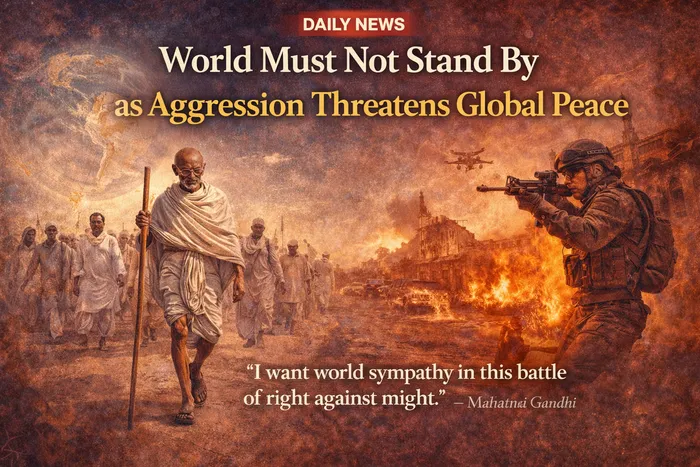
Image: ChatGPT
On 5 April 1930, Mahatma Gandhi wrote to an American businessman: “I want world sympathy in this battle of right against might.” This was at the peak of his famous Salt March, protesting British colonial rule and the tax on salt in India.
Today in the face of American aggression against Venezuela, and before that Syria (December 19), Iraq (March 13), Iran (June 22), Nigeria (December 25), Yemen and Somalia, and the labelling of countries such as South Africa for genocidal intent against Afrikaners while ignoring genocide in Gaza, we are reminded of this quote and ask the question can the world stand by and allow this kind of aggression to continue?
The Salt March and its international mobilisation against colonialism contributed to the end to colonialism in many countries not least the independence of India. The world is once again poised against dangerous aggression against smaller countries, leading to tensions and conflictual situation worldwide. This could easily lead to war and mayhem internationally.
We call on the American people to distance themselves from this unprovoked aggression. We have to actively but peacefully oppose these conflictual policies pursued by the present American administration. There must be an international outcry against this policy of aggression to stop this aggressive behaviour before it descends into the ruin of the planet.
The UN was created, “to develop friendly relations among the various countries of the world and to maintain international peace”. It was created so that countries may be able to resolve conflicts peacefully. The present situation indicates a total disrespect for this very structure. We respectfully request the USA government to utilise the UN to bring about any disputes it may have instead of violating international laws by both attacking and kidnapping a democratically elected leader of another country.
This situation, if allowed to continue unchecked can lead to consequences unimagined. As peace organisations we urge the United Nations to urgently intervene and stop this aggression and carnage. | Ela Gandhi Chairperson Gandhi Development Trust and Phoenix Settlement Trust
AN editorial comment yesterday (January 6, 2026) in your sister publications, The Mercury, struck a particularly positive chord with me.
It affirmed how poorly ANC national chairperson Gwede Mantashe understands the plight of South Africa’s majority – the jobless, hungry, and aimless masses. His suggestion that these citizens are merely “sitting in the sun, waiting for handouts” is both oversimplified and dangerous.
While he may believe he is correct in theory, the ANC’s history of handing out false promises, food parcels, and pledges of “free electricity, water, houses, and everything else” to secure votes has fuelled unrealistic expectations and a cycle of dependency. We saw this play out when the public reacted violently following former president Zuma’s brief incarceration, demonstrating the fragility of law and order when promises are broken.
Politicians must learn that teaching followers that “doing all the wrong things is right” – so long as it targets the opposition – cannot be repurposed for their own benefit when they fail the people. When electoral change is blocked, more radical forces can emerge. Hungry mouths and frustrated minds, especially when criminal and gang elements are added to the mix, are a recipe for disaster.
The culture of instant gratification undermines the public trust that oaths of office are meant to uphold. Words spoken during parliamentary swearing-in ceremonies evaporate if not matched by action. Meanwhile, honest citizens who live within their means are forced to pay for the bailouts and indulgences of those who do not.
As 2026 begins, we must hope for accountability – not only in government but in all public and private institutions. Those siphoning funds from hard-earned savings must face rigorous scrutiny, just as honest citizens are held to account. Court cases that have dragged for years must reach a finality, and the corrupt must be forced to repay what they have stolen. Too often, those who should wear the orange overalls continue to prosper financially while justice is delayed.
Finally, while we empathise with other countries’ struggles, South Africans must focus on repairing what is broken at home. We cannot continue obsessing over international “bugbears” without addressing the corruption, mismanagement, and inequality within our own borders. | John Knottenbelt Sherwood
What we call a “year” is little more than a virtual time capsule through which most of us pass as passengers. A mere handful sit at the controls of this spacecraft called Earth, much like the bridge crew in Star Trek.
The rest of us are largely powerless, separated from decision-makers by near-impenetrable walls, while those at the helm steer as they please. Our collective destiny is placed firmly in their hands.
The current position of this craft is troubling. The war between Ukraine and Russia shows no sign of improvement. Europe and the broader Nato alliance appear locked in a dangerous game of escalation that risks ending only in catastrophe.
India and Israel pursue territorial expansion with ideological zeal – Zionism on one front, Hindutva on the other – with little regard for the human cost, and with genocide looming as an ever-present threat. The US continues its belief in “democracy by force”, with regime change a favoured tool, now openly contemplated for Venezuela.
Oil, it seems, remains a powerful motivator – one also shared by Russia, China and others, enough to ignite yet another conflict.
Meanwhile, the self-styled experts in the control room appear determined to steer this craft straight into asteroid fields, carefully avoiding the emptiness of peaceful coexistence. As with all so-called remedies, the side effects are severe: prices rise, pollution worsens, and destruction accelerates with each new war.
So yes, 2026 will be different – almost certainly worse – unless the passengers rebel. Unless ordinary people collectively speak out, write, read, protest, and begin knocking on the walls that separate them from power.
There is little point wishing one another a “Happy New Year” unless we are prepared to take responsibility for the controls ourselves. Happiness will not arrive by default. | Ebrahim Essa Durban
DAILY NEWS