
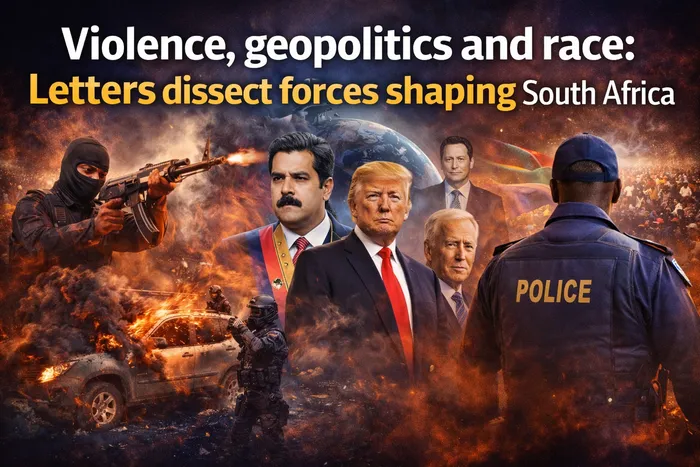
Readers tell us what's important to them.
Image: ChatGPT
Dear Editor,
The murder of AFASA chairperson Mbongeni Skhakhane, who was gunned down on his farm in Sweetwaters, Hilton, on December 26, followed by the death of a motorist on the N17 in Gauteng after a brick attack, starkly illustrates life in a crime-ridden country.
Violent crime in South Africa continues unabated. These killings are a graphic reminder that we live in a society that is morally and socially ill. A culture of violence has taken root – one that breeds individuals who believe they are entitled to decide the value of another human life.
We now live in a society that increasingly fails to recognise the inherent worth and dignity of every individual. There is mounting evidence that this disregard for human life has produced unspeakable tragedy. When the sanctity of life is no longer upheld, destruction inevitably follows.
Murder and violent crime are among the most inhuman acts imaginable. They violate the most fundamental of rights: the right to life. There are compelling reasons why any civilised, law-governed state must impose the severest penalties for such crimes. In certain circumstances, life imprisonment is not only justified but necessary to affirm society’s respect for life.
If the law fails to send a clear message that the calculated, cold-blooded taking of a human life will be met with proportionate punishment, then it communicates contempt for life itself. Justice loses its meaning when punishment bears no relation to the gravity of the crime.
Life imprisonment is not something to be desired, but it is sometimes demanded by a brutal reality. Harsh punishment should be seen as one instrument – among many – in the struggle for a safer and more just society.
We must also have the courage to place ourselves in the position of the victims. The victims of tomorrow live among us today. Our voices must speak for those who no longer can. Every day, for some, it is already too late to be heard.
Until punishment reflects the seriousness of violent crime, justice remains weak and morally compromised. A society that extends greater sympathy to perpetrators than to victims is one that has lost its moral compass. Justice and civilisation are inseparable – and without meaningful accountability, both are in danger. | Farouk Araie Benoni
Dear Editor,
The kidnapping of President Nicolás Maduro by United States forces should sound alarm bells across the Global South.
To understand its significance, one must look back to October 7, 2023. At that point, Israel was facing a severe internal crisis. The subsequent events functioned as a psychological reset – a manufactured security shock designed to reunite a fractured society through fear, revenge, and appeals to biblical destiny.
The abduction of Maduro rests on two dangerous myths.
The first is the belief that history can be rewritten through humiliation – that certain powerful actors can target leaders they assume will not retaliate. It is an ego-driven performance, a theatrical assertion of dominance meant to signal continued control in a world where economic and political power is visibly shifting.
The second myth lies in the conduct of figures such as Donald Trump and Elon Musk – men who avoided military service in Vietnam and apartheid South Africa respectively, yet now seek to relive militarised fantasies late in life. These are carefully chosen, “safe” targets.
If this were a genuine demonstration of strength, one might ask why Vladimir Putin is never considered. The answer is obvious.
The American empire is buckling under a debt burden of more than $38 trillion. As China rises and BRICS+ advances alternatives such as gold-backed settlement mechanisms, the US is increasingly desperate to assert relevance. The kidnapping of a sovereign leader is less about justice or democracy than psychological warfare – an attempt to intimidate countries moving toward a multipolar world.
South Africans, in particular, should recognise these actions for what they are: the frantic gestures of a declining hegemony. The truth is becoming clear.
The era of a world governed by Western ego and coercion is drawing to a close. | Khotso Moleko Bloemfontein
Dear Editor,
The famed Golden Mile was a sea of black faces on Boxing Day and New Year’s Day.
No whites, no Indians, no coloureds – only black South Africans.
What a dramatic transformation from the apartheid years, when the beachfront was reserved exclusively for whites. People of colour were not allowed to set foot on the golden sands; they could only drive past them. Today, democracy has turned that history on its head.
There is, of course, no legislation barring any race group from the beachfront. The absence of other groups during the festive period appears to be the result of sheer numbers, with the massive influx of black holidaymakers proving intimidating to some. It is also worth noting that this situation lasts only a few days each year. For the remainder of the year, Durban’s beachfront remains open and accessible to everyone.
However, one troubling aspect was impossible to ignore: the amount of litter left behind. Municipal cleaning teams were clearly overwhelmed. This raises uncomfortable questions about environmental education and responsibility. Are children adequately taught at school to care for public spaces and the environment? One is left wondering.
The Golden Mile stands as a powerful symbol of how far we have come – but also of the work that still needs to be done in fostering shared responsibility for our common spaces. | T Markandan Kloof
DAILY NEWS