
Strong views by our readers.
Image: ChatGPT
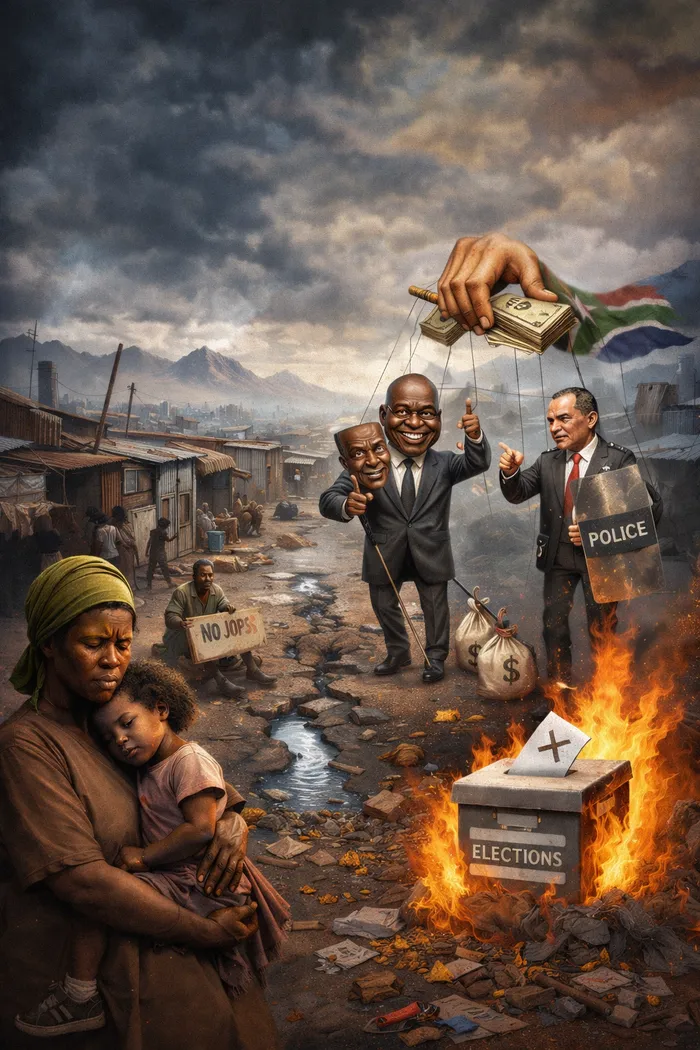
South Africa continues to face deep socio-economic challenges that disproportionately affect the black majority, more than three decades after the advent of democracy in 1994.
Democracy is not merely a concept; it is something that must be lived and felt in our communities. It is measured by whether people have access to quality healthcare, clean water and sanitation, reliable infrastructure, safe roads, and meaningful employment opportunities.
By these measures, our democracy remains incomplete. For many years, government failure has left millions of South Africans still struggling for promised basic rights.
As we enter 2026, the President’s New Year message acknowledged the hardships facing the country, particularly crime, poverty, and unemployment. While the call for hope and resilience is welcome, speeches alone cannot replace meaningful action.
South Africa’s painful history of apartheid systematically excluded the majority from economic participation, leaving black communities trapped in underdeveloped townships with limited access to basic services.
Democracy in 1994 brought hope, underpinned by a progressive Constitution and policies rooted in freedom, equality, dignity, and respect. However, many of these policies have since become unfulfilled promises. Poor implementation, corruption, and maladministration have undermined their impact, leaving inequality firmly entrenched.
Unemployment remains one of the most severe socio-economic crises. Although Statistics South Africa reported a decrease to 31.9% in late 2025, this figure remains among the highest in the G20. Such widespread joblessness fuels crime, social instability, and despair. In a country where so many are excluded from the economy, democracy becomes fragile. Gender-based violence is another national crisis that continues with alarming intensity. Women and children bear the heaviest burden, particularly in townships and rural areas.
Service delivery failures further expose the weaknesses in our democracy. Local government, established in Chapter 7 of the Constitution as the sphere closest to the people, is mandated to provide essential services such as water, sanitation, waste management, healthcare, and roads. Yet many municipalities have failed in this responsibility.
Corruption, particularly in procurement, has stalled development and eroded public trust. Access to clean water, functional clinics, and classrooms with basic furniture is not a luxury but a fundamental right. The continued misallocation of public funds has deepened inequality and kept millions marginalised.
The challenges South Africa faces are immense, but they are not insurmountable. Democracy is not only about elections; it is about safety, opportunity, dignity, and fairness for all. The real question is whether we are willing to confront our failures and demand better. | Natasha Ndlovu
As municipal elections approach in 2026, our divided country has increasingly become a theatre of political demagoguery and ineptitude.
Political gladiators cling to power at all costs. Some are compulsive liars, others consummate actors, and some merely photogenic performers.
The news media is filled with stories of leaders falling from grace after being exposed for lying and stealing. While we may lack a comprehensive historical database to compare political falsehoods across generations, it is undeniable that the scale and frequency of untruths today exceed anything previously witnessed in our political history.
We are living in an era where certain leaders display a malignantly narcissistic tendency to twist facts and distort truth according to their shifting personal interests, while targeting perceived enemies. In many cases, politicians distance themselves from the people they serve, pursue personal gain, mislead the nation, and exploit public issues for narrow political advantage. Responsibility, accountability, and ethical leadership are glaringly absent.
When a society loses the ability to distinguish between fact and fiction, between truth-telling and lying, democracy itself is hollowed out. Truth, critical thinking, and fact-finding – essential pillars of a democratic society – are reduced to empty platitudes. This erosion reinforces moral indifference and breeds political impotence among citizens.
The politics of lying and a culture of deceit are often cloaked in the dangerous logic of absolute certainty. This is an ominous sign of a growing civic illiteracy, where leaders feel no obligation to justify their claims or arguments. When dishonesty becomes normalised, it reflects not only how far we have fallen as a literate society, but also a profound disrespect for the rule of law.
We are in denial as a nation, lurching steadily into a tunnel devoid of light. This moment demands reflection and courage. Think carefully before casting your vote. Our vote is precious – almost sacred. It is the most powerful tool we possess in a democratic society.Be inspired to participate. Be inspired to vote. Every five years we are reminded that voting is a civic sacrament.
As Martin Luther King Jr. once said, “Our lives begin to end the day we become silent about things that matter.”
May the most honest, sincere, and dedicated candidate prevail. | Farouk Aarie Benoni
DAILY NEWS