

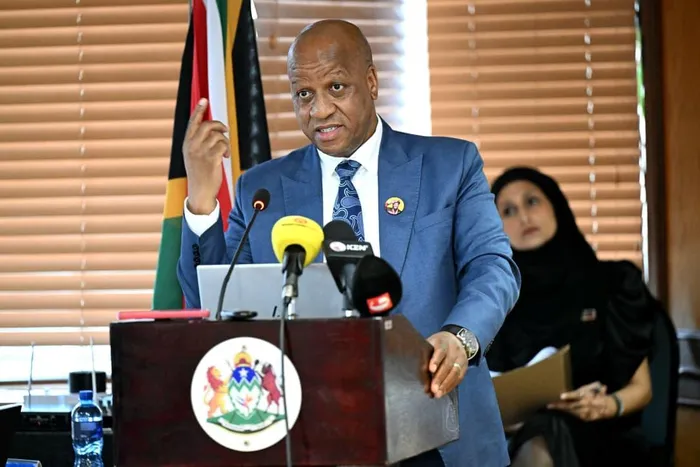
Premier Thami Ntuli of KwaZulu-Natal highlights the urgent need to bridge the skills gap affecting job seekers in the province.
Image: Supplied
The KwaZulu-Natal provincial government is intensifying efforts to combat unemployment by addressing the growing mismatch between the skills taught in schools and those demanded by the labour market.
Premier Thami Ntuli made the remarks on Wednesday at the Archie Gumede Conference Centre in Mayville, while delivering the closing report of the province’s Human Resource Development (HRD) Council, where he stressed the urgency of aligning education, skills development, and economic growth.
Ntuli said the province had established both the Economic Development Council and the Human Resource Development Council to bridge the gap between job seekers and employment opportunities, as well as to identify critical skills required by the job market.
While each council has a distinct mandate—one focused on economic growth and the other on skills development—Ntuli emphasised that the two are closely linked and must work collaboratively to achieve meaningful results.
“We cannot talk about economic growth without discussing skills development. Equally, we cannot discuss skills development without recognising the need for economic opportunities and job creation,” Ntuli said.
He noted that many residents in KwaZulu-Natal hold diplomas and degrees but remain unemployed because their qualifications do not match current labour market needs. Ntuli added that the skills mismatch is not unique to the province, but a nationwide challenge.
“The gap between economic development and human resource development has been a challenge not only in our province, but across the country,” he said. “Duplication of efforts, fragmented approaches, and siloed systems in skills development have all slowed progress.”
Ntuli described the recent joint forum between the two councils—bringing together their deputy chairpersons—as a significant step towards a unified and coordinated approach.
“By aligning strategies, jointly monitoring progress, and sharing evaluation methods, the councils can create synergies that deliver tangible outcomes,” he said.
The Premier also highlighted the need for innovative solutions, including partnerships with the private sector and non-governmental organisations, as well as the potential use of underutilised rural schools as skills development hubs.
“We are hopeful that the information shared by the Department of Education will enable us to engage the private sector, the public sector, and even partners from outside KwaZulu-Natal,” Ntuli said.
DAILY NEWS