
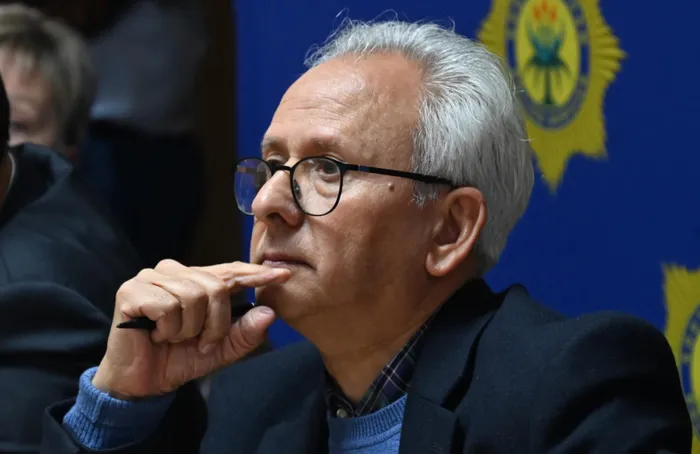
Acting Police Minister Firoz Cachalia said the SAPS is not winning the war on gangsterism in the country presently.
Image: Ayanda Ndamane / Independent Newspapers
Acting Police Minister Prof Firoz Cachalia has delivered a sobering assessment of South Africa’s fight against gangsterism, warning that the South African Police Service (SAPS) is currently not in a position to defeat organised crime in parts of the Western and Eastern Cape.
Cachalia made the remarks during a visit to the Nelson Mandela Bay metro on Wednesday, where he chaired a crime-focused engagement with local stakeholders.
His comments provided some context to the fatal shooting of eight people at a shebeen in the Marikana informal settlement in Philippi East on Saturday, January 17.
Police believe the massacre was linked to extortion, while residents were reportedly too fearful to speak out — a pattern authorities say was common in areas where gangs exert control.
“I do not believe we are currently in a position to defeat this crime,” Cachalia said. “They are on a killing spree in the Western Cape, with a similar pattern emerging in the Eastern Cape.”
He added that the use and effectiveness of anti-gang units remained a concern.
“I have made some observations, and I have indicated that the challenge of organised crime in the Western and Eastern Cape is one we still have to confront,” Cachalia said at the meeting, which brought together community leaders, church representatives, and members of community policing forums.
Cachalia’s visit follows months of sustained violence across Nelson Mandela Bay, including Gqeberha, Kariega and Despatch, where communities have been plagued by relentless bloodshed.
The metro’s northern areas — including Gelvandale, Algoa Park and Helenvale — experienced a sharp escalation in violence late last year, with 118 people killed between August and December, according to figures from the Spiritual Crime Prevention group.
Meanwhile, crime statistics for the second quarter of the 2025/26 financial year revealed that the Western Cape recorded the highest murder rate per 100,000 people in the country, while the Eastern Cape ranked second.
Cachalia described the overall situation as deeply concerning.
“We had a discussion about organised crime in the Eastern Cape, including extortion rackets, gang violence and related issues,” he said. “This is a grave problem across the country. These criminal cartels wield significant wealth and power, and that is deeply worrying.”
He cautioned that establishing anti-gang units on an intermittent basis amounted to an ad hoc response.
“I am waiting for the strategy that the police are working on to be presented to me,” Cachalia said.
Nelson Mandela Bay Mayor Babalwa Lobishe welcomed the minister’s visit, saying local concerns had been heard.
“The minister heard us well when we articulated our frustrations,” said Lobishe, of the ANC. “We are hopeful that, in the closed engagements, he heard us regarding the resourcing challenges facing the police.”
Nelson Mandela Bay SAPS District Commissioner Major-General Vuyisile Ncatha said the meeting was not intended to be a complaints forum.
“We have established a task team that executes intelligence-level operations,” Ncatha said. “In recent days, we have also arrested individuals linked to murders in Nelson Mandela Bay. Today’s meeting was a success.”
The DA’s mayoral candidate for the city, MPL Retief Odendaal, said the Eastern Cape Legislature had adopted a motion in December calling for the establishment of a permanent, 24-hour Joint Operations Centre in Nelson Mandela Bay.
The centre, he said, would coordinate SAPS, metro police, the Hawks and the National Prosecuting Authority through real-time intelligence sharing and joint operational command.
DAILY NEWS