
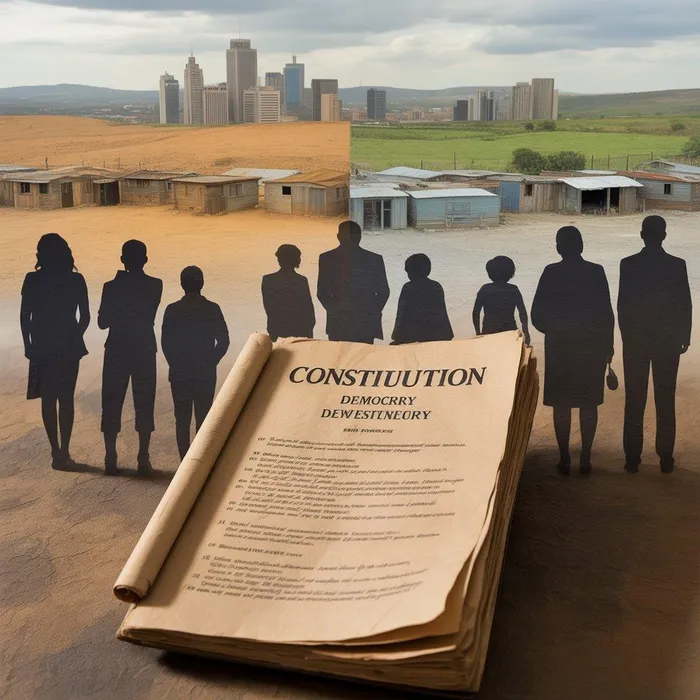
Is the South African public really getting a fair deal?
Image: ideagram.ai
Apropos Ebrahim Essa’s letter, “Thankful apartheid ended when it did” (Daily News, January 19, 2026), several assertions require challenge.
The suggestion that those who were historically discriminated against should “thank our lucky stars” that “racial discrimination was ejected from our cistern” is deeply problematic. It was apparent to many then, and to even more now, that the genuine liberation of the poor – largely African – was sacrificed on the altar of a negotiated political settlement brokered by big investors and powerful business interests (“white monopoly capital”), underpinned by political manipulation, crass opportunism, political naïveté, or, more generously, a lack of foresight. The historically poor and marginalised have largely remained so.
More than 30 years after the formal end of apartheid, South Africa remains one of the most unequal countries in the world. This is borne out by the Gini coefficient, which measures income inequality. The top 10% of earners in South Africa receive between 65% and 70% of all the country’s income, while the poorest half of the population earns only 6% to 7%.
About 55% of South Africans live below the poverty line, with child poverty and poverty among rural, female-headed and unemployed households especially acute. The appalling state of our education, health and security institutions constitutes nothing short of a tragedy of Herculean proportions.
In this context, exhortations to “confront the stench of global politics” are both questionable and inappropriate for long-suffering Black South Africans.
The reference to “Brown citizens” (presumably Indo-South Africans and so-called “coloureds”) is inaccurate. Statistics South Africa, which is responsible for official population group categories, says Indo-South Africans and so-called “coloureds”, while distinct demographic groups, are classified as “Black” in the political – legal sense since 1994.False equivalence has become the leitmotif of our times – a lazy device deployed to serve ideological or political agendas. To refer to “clear apartheid” in Donald Trump’s “somewhat disunited” US or in Narendra Modi’s India trivialises apartheid.
Apartheid must never be reduced to a metaphor. It was a systematic, state-sanctioned policy of institutionalised racial segregation and domination, enforced through comprehensive legislation that denied political rights, freedom of movement, residence, citizenship and basic human dignity.
While Trump’s policies included restrictive immigration measures, aggressive border enforcement and travel bans, they did not create a formal racial classification system, revoke citizenship or voting rights from racial groups, nor impose internal racial segregation in housing, education or movement within the US.
To describe this as “clear apartheid” is imprecise and dilutes the historical specificity of apartheid in South Africa.
It has also become de rigueur for those with a visceral hatred of Modi to denigrate him at every opportunity. Over the past decade, Modi’s government has implemented several initiatives that have gained global recognition.
Budgets for minority welfare and scholarships have increased, with Muslims receiving the largest share. India has experienced sustained economic growth, strengthening of the rural economy, and major investments in infrastructure, including highways, airports, smart cities, universities, and cutting-edge developments in STEM and telecommunications.
Yet, while much of the world acknowledges these achievements, detractors continue to take pot-shots without due balance or context. | Sathi Naidoo La Lucia
Fatalities caused by taxis are a daily occurrence on our roads, highlighted by the latest lunatic driving of a taxi in VanderBijl Park which led to 12 deaths.
But there is a way to rein in this lawlessness: follow the money.
With few exceptions taxis are owned by syndicates. They reel in millions in cash, most of it unseen by SARS. They determine who drives their taxi fleets. They are fully aware of how their vehicles are driven, yet do nothing about instilling respect for road safety. A way of curbing the rogue taxi driving is to criminalise the owners.
It should be easy to trace them via the registration plates on taxis. The owner of the taxi that caused the 12 deaths in VanderBijl Park should be indicted for complicity in those deaths. He supplied and owned the means that caused the carnage, and is responsible for hiring that driver.
Holding the taxi bosses accountable for the hooligan, rogue and lawless way in which taxis ply their trade on our roads may have a moderating effect on what has become an intolerable menace. And it should start with fining the bosses R10 000 each time a taxi is recorded ignoring traffic lights.
Besides law enforcement and the courts, SARS should set their sights on the taxi bosses. | DR DUNCAN DU BOIS Bluff
Lorenzo Davids’ insightful article, “The politics of elite predation” (Daily News, January 19), deserves to ignite a sustained national conversation.
South Africans must grasp the profound damage caused by the prolonged era of elite predation. Our Constitution and economy are being undermined by a political class entrenched in what Davids calls the “predatory phase of capitalism”.Section 1(d) of the Constitution demands accountability, responsiveness, and openness.
Yet accountability collapses when party loyalty trumps constitutional duty, leaving legislatures unwilling to hold the executive to account. This failure manifests in chronic service delivery breakdowns, corruption, and neglect of basic needs.
Openness has given way to opacity. Decisions are made behind closed doors, procurement is shrouded in secrecy, and elections increasingly feel ritualistic rather than transformative. Voter turnout in the 2024 national elections dropped to about 59% of registered voters, with millions disengaged or unregistered. This should alarm us.
Rigid, top-down party hierarchies no longer serve the public interest. We must learn from models such as Switzerland’s consensus-based federalism and Singapore’s meritocratic governance. South Africa needs a techno-democracy – blending democratic accountability with technical expertise and shared leadership.
Voters should explore the vision at sd-p.org, which proposes a community-owned political party free from rigid hierarchies and accountable directly to citizens. Representatives would be true public servants – a party of “all chiefs and no Indians”.Independent Newspapers could play a vital role by facilitating a robust national debate on non-predatory politics and party reform.
Such a discussion is long overdue. | FAROUK CASSIM Cape Town
DAILY NEWS