

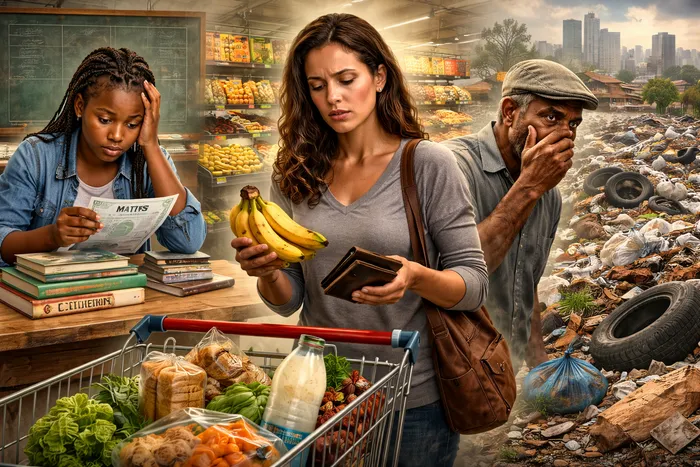
What matter to you.
Image: ChatGPT
I enjoyed reading Dr Sheetal Bhoola’s Daily News, January 22, article, Challenges Faced By South African Matriculants In Higher Education.
The piece was loaded with everything people need to know about the status quo. Congratulations for such a wonderful and insightful piece.
What do you think would have happened if all the learners at Grade 6 were able to get to Grade 12 and pass with bachelors pass? Imagine that?It appears education in South Africa is evolving to a point where it is becoming ever more expensive as education necessities evolve.
Therefore, with the writing acumen Dr Bhoola demonstrated, can she enlighten us on the education necessities and how they have evolved and affected education financing by both parents and government.
Congratulations once again.
Kind Regards | Prof Noel Kufaine
Not everyone is interested in heavy global issues such as Venezuela, Gaza or Russia. For many people – especially the average housewife or homeowner – everyday concerns such as the price of basic food commodities are far more immediate. Take bananas, for example.
A cursory visit to any supermarket will show customers instinctively checking this familiar, curvilinear fruit. The reasons are obvious: bananas are nutritious, rich in potassium and other mineral salts, tasty, readily available throughout the year – and traditionally cheap. Once, perhaps, not any more.
Plant and soil viruses have been partly blamed for South Africa now having to import most of its bananas. The South Coast was once fondly described as an almost endless banana farm, much like the North Coast was synonymous with sugar cane. Those days are gone.
Today, banana prices have gone through the roof, and this so-called “poor man’s fruit” has lost that distinction entirely.
Worse still than the price is the quality. The fruit often looks perfect on the outside – smooth, clean and firm – yet inside it is rotten, overripe or badly bruised. The peel conceals a disappointing reality.
This raises an obvious question: who takes responsibility for this poor quality and the resulting financial loss? The supermarket? Or the customer, once again warned only to “beware”?
Supermarkets are well aware of this problem, yet none alert customers that the fruit may be faulty. How many shoppers are realistically going to return the next day with half-eaten, darkened, bruised bananas as proof?
It is difficult to believe soil conditions are to blame. Just as greedy capitalism has destroyed vast sugar-cane fields to make way for expensive estate homes, banana plantations along the South Coast have also vanished.
This banana story is simply one more example of how unchecked greed – from profiteering developers and tariff-raising regimes to land pressures and conflict – harms ordinary people. Farms across the world are disappearing. And instead of modern technology increasing production and lowering prices, we now find even a simple fruit like the banana becoming unaffordable.
Small wonder that bananas are driving us bananas. | EBRAHIM ESSA Durban
Across our nation’s landscapes and surrounding areas, illegal dumping has transformed once-pristine spaces into trash heaps.
Residents continue to discard waste on an alarming scale, enveloping entire suburbs. Dirt and refuse carry deeply negative connotations – to be associated with filth is to risk losing respectability and social standing.
Those responsible include local residents, contractors, and even waste removal personnel. The illegal dumping of both industrial and household waste has become a major environmental problem. Evidence is everywhere: people throwing trash into streets, releasing toxic substances into the environment. Such dumping can block natural water runoff during seasonal downpours, while raw sewage continues to pour in certain areas.
Illegally discarded garbage is more than an eyesore. Animals consuming waste from these sites face serious health risks, even death. Residents exposed to trash in public areas are at risk of injury and disease. Piles of putrid garbage now dominate affected neighborhoods. Poor urban planning, rapid growth, and political dysfunction are key contributing factors.
Garbage in the streets isn’t just unsightly; it’s a public health hazard. It provides an ideal breeding ground for rodents and mosquitoes, which can spread deadly diseases. And the stench is unavoidable. This apocalyptic landscape has become all too common.
The scale of illegal dumping is growing, and with it comes widespread vandalism and the dismantling of infrastructure. Such decay illustrates that civility, rule of law, and common decency are being eroded. The degradation of our environment is a grim reminder that true progress and equality cannot be achieved when communities allow such destruction. The quality of life and societal advancement suffer immensely from these atrocious behaviour.
Is this our legacy for the next generation? | FAROUK ARAIE Benoni
DAILY NEWS