
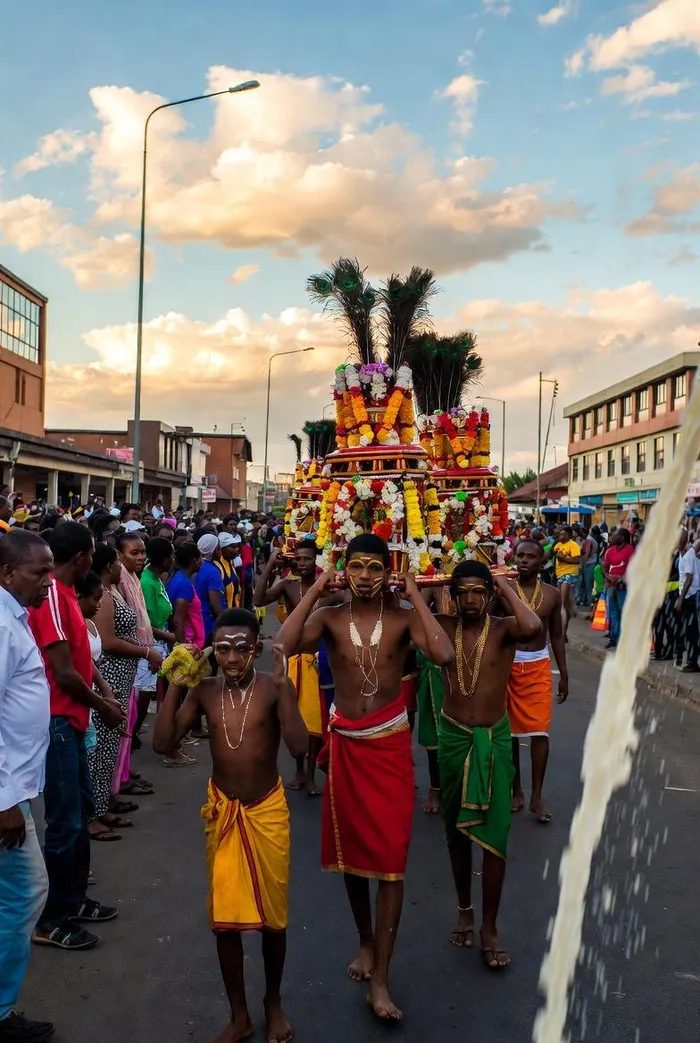
Well done to the younger generation for their devotion and commitment to keeping the beliefs of Kavady alive, writes a reader.
Image: Grok.com
This week, our air was filled with devotion and the rhythmic cadence of prayer as the community came together to observe the auspicious Kavady festival. It was a beautiful and affirming display of our rich, living cultural heritage.
What was especially heart-warming was the strong presence of young devotees, their faces alight with enthusiasm and purpose. They were not merely observing tradition, but actively embracing it – ensuring that these sacred practices endure. Their genuine passion is deeply inspiring and reminds us that the future of our faith remains vibrant when young people feel a personal and meaningful connection to it.
As elders and parents, we carry a profound responsibility to guide, support and encourage our youth as they learn to carry these traditions forward. They are, after all, the future custodians of our temples and our heritage. It was deeply moving to witness their dedication – from the solemn act of piercing to the energetic processions that brought our streets alive.
This widespread participation speaks volumes about our collective commitment to preserving what we hold dear. By gathering in a spirit of openness and unity, we strengthen relationships and build a more welcoming community for all.
Kavady is more than a festival; it is a sacred pathway that reconnects us with our roots.
That said, amid the celebration, one could not help but feel a pang of sadness at the sight of so much milk being wasted, while many children and families struggle to access even the most basic nourishment. Perhaps this is an opportunity for our elders and organisers to reflect on ways to channel some of this abundance towards those in need, without diminishing the sanctity of the ritual.
Congratulations and well done to the younger generation for their devotion and commitment. May we continue to guide them with wisdom, compassion and social consciousness. | Dhayalan Moodley Mobeni Heights
Power was never meant to be used responsibly by those who possess it. It is ridiculous to believe that people in power are able to wield it without being affected by it and the way it gratifies the ego.
Donald Trump, Vladimir Putin, the Supreme Leader of Iran, Hamas even- The possession of power, the potential to subjugate a people, to hold authority, no matter how well intentioned, creates tyrants, albeit in varying degrees. No actor is clean. Not by a long shot.
The man who believes in his own right to power is dangerous but not more dangerous than the one who believes his power is divinely attributed.
To be backed by a divine being makes one an extension of that divine being and therefore beyond reproach. One’s conscience is clear because they are merely vicegerents, carrying out divine will.
Therefore, no one can be trusted. Not Iran, not America, not Israel, not Saudi Arabia.
The citizens of the world risk being forced into neutrality: no side is worth fighting for. To believe that America champions democracy and freedom is to ignore the brutal crackdown on immigrants. To side with Iran, is to side with a regime that rules with an iron fist and does not tolerate dissent if it goes against its own ideologies.
To side with Saudi Arabia is to side with an authoritarian government that placates its citizens with material wealth but which bombs civilians in Yemen. To side with South Africa is to side with a country that united the global south against the terrorist Israeli regime but which is riddled with corruption in its own backyard. We are forced to choose a side and often, both sides go against core human values, again, in varying degrees forcing citizens into false moral binaries. So what is the solution?
Understanding how power works does not make it easier to control those who possess it. We cannot control the Kushners, the Trumps, the Putins of the world.
We have to learn to exist quietly within these frameworks and disrupt on a micro level by infiltrating the halls of power to create change. We need to create more Mamdanis and then quietly vote them into power. We need to focus on education building, nation building and fixing our societies ourselves on a micro level, bottoms up to create a more wholesome and happy society that will be able to survive under those in power. Change doesn’t happen in an instant. It doesn’t happen when a dictator like Maduro is removed. It doesn’t fix what was wrong.
Hoping for a utopian society is nonsense and even though micro reforms won’t change the system, it will allow us to exist within it. | Z Khan Durban
Speculation about an emerging “Middle Eastern Nato” has surfaced amid reports that Turkey is seeking closer defence ties with Saudi Arabia and Pakistan.
The proponents for it argue that the logic is straightforward: As global power fragments and Western security guarantees appear to be less and reliable, so regional powers are exploring alternatives. Pakistan offers military depth and nuclear deterrence; Saudi Arabia brings financial and political influence; and Turkey contributes a technologically capable force with Nato experience. In theory, such co-operation could enhance deterrence and regional autonomy.
Yet the idea appears more symbolic than substantive. Divergent strategic priorities limit the prospects for a formal alliance, and Saudi Arabia has emphasised that its arrangement with Pakistan remains strictly bilateral.
What is emerging is not a new “Nato”, but a fragile patchwork of security partnerships. Its logic lies not in collective defence, but in the survival instincts of autocrats, monarchies, and oligarchies.
This configuration is not designed to confront Western dominance, challenge Zionism, or advance Palestinian liberation. Instead, it functions as a safeguard to absorb and channel legitimate Muslim political and Islamic demands into tightly managed and controlled systems, while preserving the power of ruling elites while projecting the appearance of regional co-operation. | MOHAMED SAEED Pietermaritzburg
DAILY NEWS