

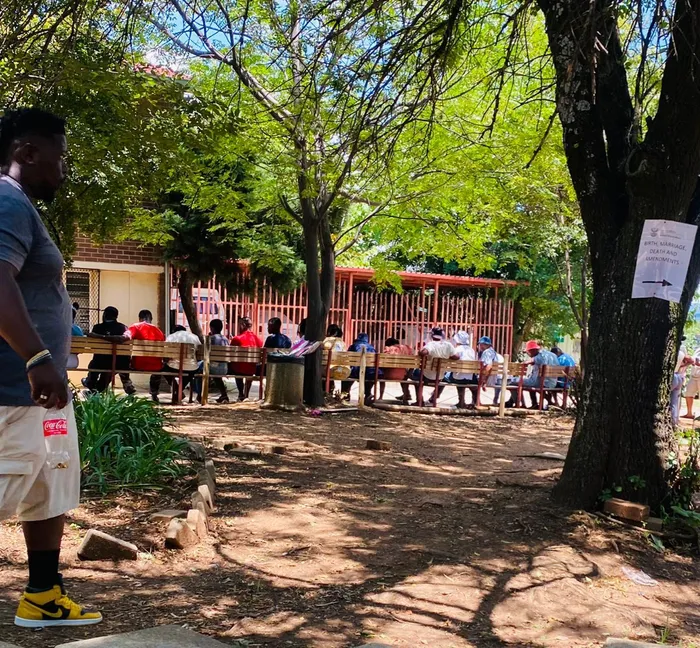
Rocks, chairs and bits of rubbish are planted in the queue to save places for those willing to pay.
Image: SIMON MAJADIBODU
The rigmarole of waiting hours at Home Affairs has become a money-spinner for thugs, who now charge desperate South Africans up to R200 just to jump the long queue.
Rocks, chairs and bits of rubbish are allegedly planted in the queue to save places for those willing to pay.
And for those who refused — or were simply unable — to fork out that kind of money, which some crooks had even accepted by card or EFT, the price they ultimately paid was having to wait far longer for the documents they so desperately needed.
Those documents, including an ID, birth certificate or marriage certificate, are among the basic requirements for Sassa grants, school registration, healthcare access, opening bank accounts and job applications.
Home Affairs spokesperson Thulani Mavuso said the allegations were being looked into by the department's Counter-Corruption Unit.
"It has been brought to our attention that there are unauthorised individuals who mislead clients into purchasing queue spaces and appointment slots," Mavuso said.
"These practices are illegal and exploitative.
"The department has not authorised any individual to sell or allocate queue spaces or booking slots on its behalf."
The allegations come after an IOL team visited several Home Affairs branches over the past two weeks.
Angry visitors spoke of rude staff, endless queues that went nowhere and being sent from pillar to post.
But it did not end there.
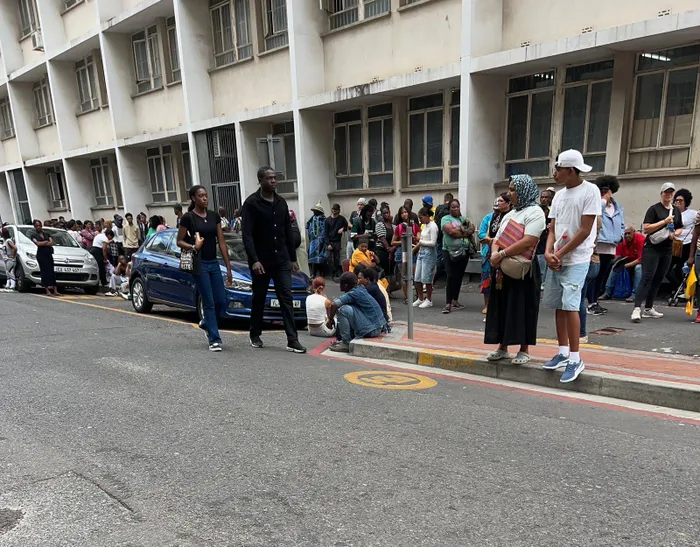
The Department of Home Affairs said it has not authorised any individual to sell or allocate queue spaces or booking slots on its behalf.
Image: WENDY DONDOLO/IOL
Some said they had been asked to pay to jump the line.
In some instances, applicants were happy as they had been helped quickly.
Thando Sikole, who visited the Cape Town CBD branch, said paying was sometimes the only option.
“I had to pay for a spot because I can’t afford to lose a whole day at work,” he said.
“If you come late, you will not be helped.”
At the Durban Ethekwini branch, a woman said she had stood in line all morning when someone approached her and offered to let her skip the queue — for a fee.
“I just had to get in,” the 32-year-old said. “For every hour I am not at work, I am not getting paid.”
A man who said he had extorted people standing in queues admitted it paid well while it lasted.
The man, who declined to be named, said he had pulled the stunt at the Govan Mbeki Home Affairs branch in Gqeberha.
“I told people I could help them skip the queue because I knew someone who worked inside,” he said.
“But when my friend moved away and I no longer had that access, I didn’t do it again.
"It just didn’t feel right without that protection.”
He said he had charged anything between R50 and R200 per person.
“It might not sound like a lot of money, but with four or five people a day, it was good,” he said.
He said he had used everything from rocks to discarded items to hold places in queues, which he then rented out.
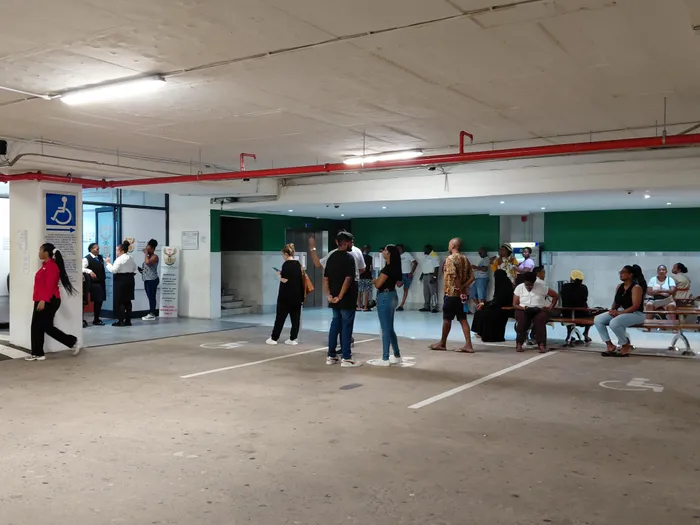
A man who said he had extorted people standing in queues admitted it paid well while it lasted.
Image: XOLILE MTEMBU/IOL
The SA National Civic Organisation (Sanco) chairperson, Abram Mashishi, said corruption in the country was deeply entrenched.
"If the government is not dealing with corrupt officials and the public is going to continue with these corrupt activities," he said.
"As Sanco, we always complain about these allegations ... they span from the public office to the highest levels of the government. For example, they are implicated in the Madlanga Commission. Our country is under siege as far as corruption is concerned.
Anti-crime activist Yusuf Abramjee echoed the sentiment and said the problem was nothing new.
He said in some cases the amount skyrocketed to R200 a head.
“Individuals hold and sell spots in queues outside Home Affairs offices for exorbitant fees, reportedly up to R200,” Abramjee explained.
He said the practice was unfair and turned access to basic documents into something people had to buy.
"This situation is not only a blatant exploitation of vulnerable citizens who are seeking essential services, but it also undermines the integrity and fairness of the public service provision," he said.
Abramjee said the alleged selling of queue spots had created an unfair system, where those with money moved ahead while the poor were pushed further back, sometimes for days.
He said the situation had raised serious questions about how queues were being managed and whether officials were turning a blind eye.
Abramjee also raised concerns about alleged document fraud, including claims by people who had discovered they were listed as “married” on the system without their knowledge or consent.
Sandra Dickson of Stop City of Cape Town said the shortage of Home Affairs offices meant people were forced to stand in dangerous, overcrowded queues for hours, often without knowing if they would be helped
"The very few Home Affairs offices make it extremely difficult to get any service from Home Affairs in any event," she said.
"The long queues make it a serious risk for anyone endeavouring to join these queues."
She said although new offices in shopping malls and at the Cape Town Civic Centre were being opened to ease the pressure, the rollout had been "painfully slow".
The offices are far too small to cope with demand, she said, and, as a result, desperate people are left with no choice but to take chances.
Dickson warned the situation encouraged wrongdoing.
"It is therefore inviting for employees or security staff to make a quick buck by selling appointments no matter how unacceptable it is," she said.
She added that poor service delivery has created an opportunity for criminals to take advantage of ordinary people.
"It is therefore very lucrative for a criminal mind to exploit this terribly inadequate service delivery from Home Affairs offices."
Mavuso said: "We urge the public not to pay anyone for queue spaces or booking slots and to report such actions to the department, by calling the Home Affairs Contact Centre on 0800-6011- 90 or sending an email to: [email protected]."
IOL News