

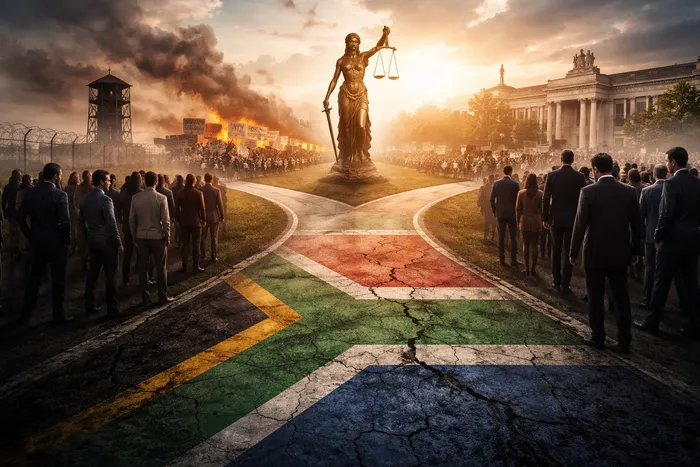
It is time for South Africans to move on to a brighter and bolder future, one free from the vestiges of the past.
Image: ChatGPT
Reading a recent article about Dr Wouter Basson – aka the architect of the apartheid government’s chemical warfare programme in the 1980s – left me reflecting on how we confront our past. Basson was acting under instructions from the apartheid state, while many of those who authorised or enabled those actions have since escaped accountability or passed away, leaving him to bear the burden of that legacy.None of this diminishes the seriousness or inhumanity of what took place. He could have chosen to walk away, and did not. That decision remains part of his moral responsibility. However, revisiting these matters in court decades later raises difficult questions about what justice and closure should look like so many years on.South Africa’s past is marked by violence on multiple fronts. Figures such as Robert McBride and Barend Strydom were also involved in deadly attacks during that turbulent period. The 1980s were a dark and painful chapter in our history, and the actions of many individuals – across divides – remain a stain and a lesson for the country.We have, in some instances, chosen a path of closure. The release and repatriation of Janusz Walus, for example, signalled a willingness to draw a line under part of that painful era. The question is whether we now find ourselves at a similar crossroads with Basson.Nearly five decades have passed, and he has lived with the weight of those actions ever since. At some point, a nation must decide whether continued legal pursuit serves justice, or whether it prevents us from fully moving forward. The democratic South Africa born in 1994 was meant to mark a new beginning – one rooted in reconciliation, accountability and the determination not to repeat the past.Vengeance rarely heals. A country’s future depends on learning from history while also finding ways to close its most painful chapters. | Colin Bosman Newlands
The Epstein files could prove a serious threat to Donald Trump’s presidency. His brand of politics – marked by aggressive rhetoric, disregard for legal norms and intense nationalism – is fuelling uncertainty and division. As the Epstein saga unfolds, high drama is likely, and brinkmanship in such a volatile climate is reckless.Trump appears willing to take significant risks in pursuit of political dominance. The missteps, defiance and confrontational tone of his leadership have deepened tensions within the US and beyond. His approach, built on intimidation and provocation, risks further destabilising an already polarised society.This style of politics exposes America’s fault lines and creates the possibility of consequences that could ripple across the world. Attempts to consolidate power through attacks on the media, critics and institutions erode trust and weaken democratic safeguards. Such rhetoric and policy direction point to a troubling future for governance and public discourse.If leadership is driven by power rather than principle, human rights, justice and liberty are placed in jeopardy. The stakes are high, and the world is watching closely as events unfold. | Farouk Araie Benoni
An open letter to President Cyril Ramaphosa and Health Minister Barbara Creecy.I write as a neurosurgeon representing about 70 medical professionals who have not been paid by the Road Accident Fund (RAF) for work completed as far back as 2015. Those affected include neurosurgeons, orthopaedic surgeons, physiotherapists, psychiatrists, industrial and clinical psychologists, occupational therapists and other specialists.We have waited years for payment for legitimate work requested by the RAF. Collectively, millions of rands are owed for thousands of cases. In many instances, our reports helped expose fraudulent or weak claims, saving the RAF substantial funds. Yet these same reports have been used in court proceedings despite the experts not being paid for producing them. In addition to unpaid fees, specialists have incurred significant costs for administration, typing, and other logistical expenses.Over the years, various explanations have been offered, including claims that reports were submitted late, that fees exceeded tariffs, or that experts were not authorised. These claims do not reflect the reality. Most reports were delivered on time, fees were in line with tariffs, and instructions were issued directly by the RAF or its attorneys. Documentation, instruction letters and reports are available to support this.Repeated attempts to resolve the matter have led nowhere. Experts have submitted invoices and supporting documents numerous times. Engagements with former RAF leadership produced no results. Some approached the Public Protector, but the matter was deemed outside its jurisdiction. Others pursued legal avenues, only for cases to stall for years. In 2025, the matter was escalated to the Minister of Transport and then to the Deputy Minister, leading to discussions and an interview process with an advocate. Since then, there has been no feedback. More recently, after changes within the RAF, a constructive meeting was held with new leadership and more documentation was requested. Months later, there has still been no response.This letter is written out of frustration and desperation. After more than a decade, many professionals fear they may never see payment for work honestly performed. | Dr P Miller Johannesburg
Now that John Steenhuisen has announced his withdrawal as DA leader, former colleagues and critics are clamouring to register their 10c worth of bile and disparagement.Politics is a snake pit for those who contest positions or who attain leadership. Winston Churchill judged it to be “even more difficult than war because in politics you die many times. In war you die only once.”Leaving aside his personal shortcomings and the criticisms of his role as minister of Agriculture, in the telescoped view of history, Steenhuisen will be noted for his unrivalled command of the rules of debate and mastery of issues in the cut and thrust of politics in the eThekwini Metro Council, the National Assembly and beyond in the general political arena.As leader of the DA eThekwini caucus he exhibited a feared and respected regard for his knowledge of the functioning of the different municipal units and the various statutes governing local government. Those skills saw him elevated to the provincial legislature and then to the National Assembly.They carried the DA during the lacklustre years of Maimane’s leadership. They gave Steenhuisen national exposure and paved the way for his election as DA leader. Heplayed a crucial role in enabling the DA to claw back support lost in the 2019 polls.Recognising that life is a series of seasons, Steenhuisen has decided that his season as DA leader should end. Nonetheless, it would be imprudent to discard his political worth. | DR DUNCAN DU BOIS Bluff
DAILY NEWS