

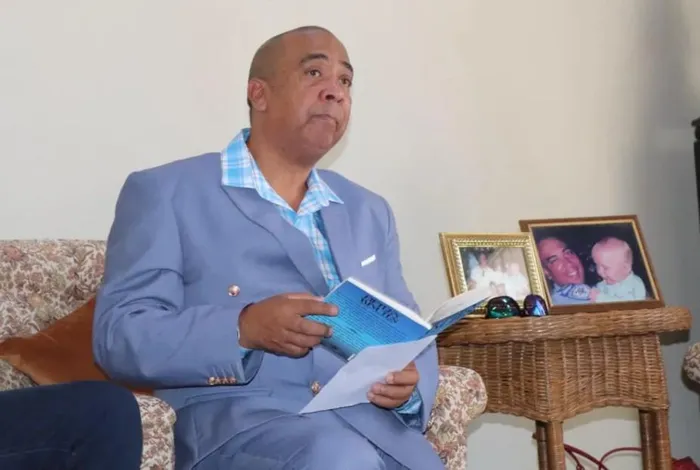
André Rautenbach, emotional, reading from his latest publication.
Image: Supplied
What began as a routine afternoon for retired Traffic Officer André Rautenbach became a moment that reshaped multiple lives.
On May 3, 2000, Rautenbach was washing his patrol car when a radio alert interrupted the calm. An eight-month-old baby, Brett, had been abducted from outside his Camps Bay home. The suspect vehicle was described as a white BMW 3-Series with no registration plates.
“I turned on my FM radio because it was fading,” Rautenbach recalls. “Something pushed me and said, ‘Pay attention’.”
He followed the BMW through Cape Town’s congested streets, initially without sirens to avoid alerting the driver. The pursuit lasted less than fifteen minutes, though Rautenbach says it felt far longer. At one point, he lost sight of the vehicle on a steep cobbled incline in Bo-Kaap. When he arrived moments later, the car had been abandoned and the suspect was walking away, attempting to blend into traffic.
Rautenbach apprehended the man. The vehicle appeared empty.
“I opened the car,” he says, “and I heard the cry.”
Baby Brett had been wedged beneath the passenger seat.
For Brett’s father, Sam, the day is remembered not in exact detail, but in sensation: waiting, fear, and adrenaline. He recalls running barefoot down the road in black shorts, heart monitor attached, before dropping to his knees in front of the suspect.
“I forgive you,” Sam told him. “Please, just give me back my son.”
The suspect remained calm and denied any involvement.
The motive for the kidnapping was never conclusively established. Sam believes it was likely ransom-related, while Rautenbach suspects the man was acting as a runner for a third party.
That moment soon became part of Cape Town folklore.
Amid a crowd of journalists, Sam declined requests to be photographed with his son, insisting instead that Rautenbach be in the frame.
“André found him,” Sam said. “It should be them.”
The image of Rautenbach in uniform, holding the rescued infant, appeared in newspapers nationwide and became a symbol of hope. It also brought unexpected scrutiny.
“I was called in under the red carpet,” Rautenbach recalls. “Management asked, ‘Why did you take the picture?’ I told them I didn’t. I just followed up.”
Following up, he says, was simply part of his job. Throughout his career, Rautenbach carried teddy bears in his patrol car, handing them to children at accident scenes — small gestures during moments of shock.
Years passed and the family moved away, but Sam never stopped trying to reconnect with the officer who recovered his son.
“I went into a police station years later asking, ‘Where’s André?’,” he says.
When they eventually reunited, the connection deepened into a lasting friendship. Rautenbach now refers to Sam’s children as his own.
“I always say Brett is my other son,” he says. “When I handed the baby back, they didn’t have to remember me. But they did.”
Recently, after revisiting the scene and hearing the story again from Sam’s wife’s perspective, Rautenbach decided to document the experience in his book, Fifteen Minutes That Changed Everything: Darkness Leads to Ultimate Glory.
“I couldn’t remember everything,” he says. “So I drove back to the location. I sat there for an hour or two. And then the memories just flooded back.”
For Sam, the experience remains deeply personal.
“Because we found him, I never went down,” he told IOL. “Every time I talk about it, it’s uplifting. It reminds us of the love we have for our family and for André.”
More than two decades later, the fifteen minutes that changed everything continue to echo — not only through an iconic photograph, but through a bond forged in crisis, now preserved in print and memory.
DAILY NEWS