

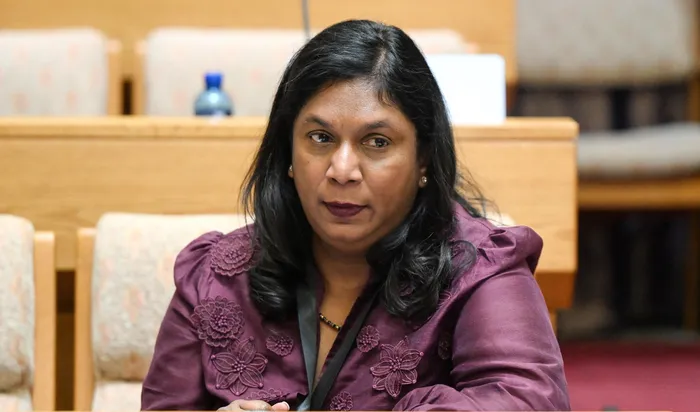
Serious allegations of misconduct within South Africa's Investigating Directorate Against Corruption raise questions about the integrity of ongoing high-profile investigations. In Picture: Advocate Andrea Johnson.
Image: Phando Jikelo / Parliament of RSA
Serious allegations of malfeasance and abuse of authority have emerged within the Investigating Directorate Against Corruption (IDAC) circles, which has the potential to damage the reputation of this key component for law enforcement in South Africa.
The IDAC's role is to take-down high level corruption.
Central to the claims was the unit's alleged bypassing of a crucial procedural requirement that is essential for the effective investigation of cases.
Section 27 of the National Prosecuting Authority (NPA) Act, which is the parent body of the IDAC, mandates that for any case to be investigated by unit, there must be a referral affidavit.
It is a document that outlines the nature of the suspicion, the grounds for such suspicion, and all relevant information known to the declarant.
Andrea Johnson, head of IDAC, previously asserted before Parliament that investigations must commence with a Section 27 referral; thus, the lack of such records raises alarming questions about oversight or even complicity.
There have been allegations that the IDAC failed to secure this necessary affidavit while investigating matters involving several high profile figures, including the Crime Intelligence boss, General Dumisane Khumalo, former Acting Police Commissioner General Kgomotso Phahlane, and businessman Kishene Chetty.
Both General Khumalo and Phahlane are currently challenging the procedural deficiencies in the handling of their respective cases.
When Umkhonto WeSizwe Member of Parliament Sibonelo Nomvalo asked Khumalo if Khumalo was aware that there were procedural discrepancies in his arrest, as there was no referral affidavit, he said he was aware of it.
Khumalo said that he learnt of it by going through the whole docket, and there were legal steps he was taking, but was unable to disclose them.
“The matter is in court, and I won't be able to talk that much on what did we did, and I can confirm that there is an ongoing process,” Khumalo said.
In stating the significance of Section 27, independent legal expert, attorney Mpumelelo Zikalala, who is in private practice, warned that the absence of a formal referral could jeopardise IDAC's credibility and the legitimacy of its investigations.
“A formal referral is legally necessary to properly activate and investigate a case; without it, investigations can be challenged or invalidated."
Zikalala said the apparent lack of a transparent process within the IDAC for determining which cases warranted investigation, raised fears that the unit could be manipulated for personal gain.
“The absence of clear criteria risks the unit being exploited or misused,” he cautioned.
At the centre of these allegations was senior investigator Suneel Bellochun, who apparently was responsible for all three current investigations.
Compounding the complexity of the situation, Bellochun also acts as both complainant and investigator in Chetty’s cases, including the controversial Silverton case (335/05/2020), which faced significant legal setbacks and was re enrolled under questionable circumstances.
Chetty, who previously had a contract with the South African Police Service (SAPS) for vehicle markings, has been embroiled in investigations initiated by Bellochun and another investigator for allegations of fraud, corruption, and forgery related to his work in 2018.
On the question of whether an investigator can be both a complainant and investigator legally, Zikalala insisted the that IDAC’s senior investigator should never act as both complainant and investigator in the same case, as it was fundamentally undermining the principles of independence and fairness.
“Such cases should ideally be handled by an independent investigator, preferably from a different province,” he asserted.
In response, the IDAC’s spokesperson Henry Mamothame acknowledged the clarity provided by Section 27, but contended that Section 28 allows the National Director of Public Prosecutions (NDPP) discretion to refer cases to IDAC without a referral affidavit.
This assertion has been met with skepticism; a former NDPP prosecutor, speaking anonymously, clarified that while Section 28 does grant referral authority, it does not absolve the NDPP from submitting a referral affidavit.
When questioned why Bellochun was permitted to serve in overlapping roles in Chetty's case, Mamothame declined to provide answers.
DAILY NEWS