

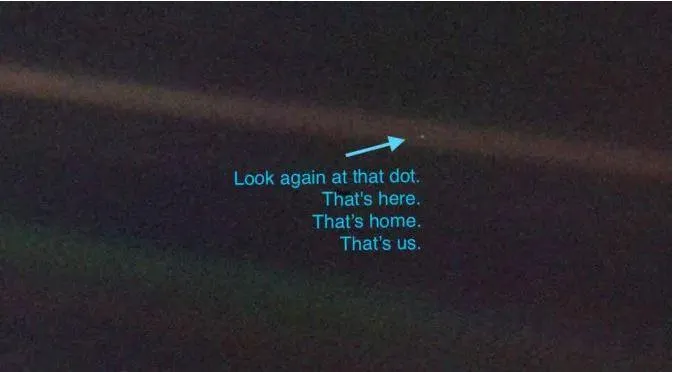
Earth as seen from the Voyager spacecraft from 6 billion kilometers.
Image: https://keithdb.medium.com/
Up to 75% of the letters in your paper and your Durban sister paper, The Mercury, refer to a non-South African problem, namely the Epstein Files.
I do not hold any brief for Epstein and find the whole issue horrid.
The anti-Semites will, of course, be gleeful as somehow, rightly or wrongly, Israel has been linked to the Epstein debacle, thus they now have another stick to beat Israel with.
Surely, though, South Africa has enough problems of its own to fill up a whole page of letters.
Let us consider the following: corruption in high places, the looting of State enterprises, councils failing national audits, inept councillors, weak leadership, deterioration of roads, pit toilets at schools, the unchecked growth of alien vegetation, unemployment, increasing crime and grime in cities, rural instability, unpunished statutory rape, teenage pregnancy, illegal immigration, the daily murder rate, lawlessness on our roads, suspect sewage treatment, interrupted fresh water supply, lack of vaccines, deterioration of South Africa’s aviation infrastructure, the rapidly rising cost of living etc.
Why are writers so parochial in their letter writing when all the above serious South African concerns, which burn and smoulder daily, are bypassed in favour of foreign predicaments? | Kevin Meineke Summerveld
Earth is immense. Even in one’s lifetime, it is not possible to visit every corner of the globe. There are so many countries, islands, cities and towns. In days gone by, travel was long and was often hazardous.
During the Voyagers of Discovery explorers and adventurers took months, even years, to travel to distant continent and countries across the oceans. Nowadays, travel is much faster. But even in this modern era, it would take more than a day to fly around the globe.
The space probe, Voyager 1, launched in 1977 to study the outer solar system and interstellar space., is still travelling at an astonishing speed of 61 000kph. It has now left our solar system and is in interstellar space.
The pioneering spacecraft is now an incredible 26 billion kilometres from Earth. Communication between the it and Earth takes a day! Surprisingly the instruments are still working even after 50 years, but scientists have had to shut down some of the instruments to conserve power. Voyager 1, and its sister, Voyager 2, has sent back a lot of data and images of our solar system and interstellar space, including pictures of Saturn and Jupiter as it flew by these two giant planets. For the first time we saw vivid pictures of Saturn’s rings and volcanic eruptions on Jupiter. One of the most iconic pictures it took was “Pale Blue Dot" – a picture of earth taken at the request of the late Carl Sagan n on February 14, 1990, at a distance of 6 billion kilometres.
It shows the earth as an insignificant tiny blue dot in the vastness of space .In our eyes the earth is immense, but in cosmological terms it is a mere speck. It can not even be seen from outer space.
This same pale blue dot is teeming with life. How can a tiny speck in the universe have so much life and the vast universe (supposedly) have none? A conundrum of cosmic proportions!
The earth is all we have. We cannot we even go to our nearest neighbour, Proxima B, for help even though, the believed habitable, exoplanet is only 4.25 light years away, it is virtually impossible} to get there!
A cosmic paradox. | Thyagaraj Markandan Kloof
FOR DECADES, South Africans from across the political spectrum paid lip-service to the so-called “two-state solution” in the Middle East, pandering to universal notions of human rights, racial equality, and justice for all.
Following the passing of Nelson Mandela, whose ideal was a nation in which no single group dominated another, the political expression of Palestinianism, at least within the country, took on an entirely different character. Gone were attempts at charting the moderate, progressive path Mandela outlined when he affirmed support for Yasser Arafat while also recognising Israel’s right to exist within secure borders.
At Mandela’s famous Pretoria speech on December 4, 1997, he stated: “But we know too well that our freedom is incomplete without the freedom of the Palestinians; without the resolution of conflicts in East Timor, the Sudan and other parts of the world.”
Unfortunately, his words have since been redacted into a justification by the left for unconditional support of Islamist organisations such as Hamas, whose aims directly oppose a two-state solution. The October 7, 2023, attack in Israel demonstrated that Hamas leader Khaled Mashaal seeks the complete removal of the secular Jewish state in favour of a theocracy under Sharia law, a system in which Jews are decidedly unwelcome.
This same rhetoric is evident in statements attributed to Naledi Pandor and others, when she called for the eradication of Christian Zionism and promised funds reminiscent of Fatah’s “Pay-for-Slay” programme.
Gone are any attempts by our government to disguise these terror objectives.
With Chief Rabbi Warren Goldstein sidelined by local media, and the Jewish community alarmed over a scandal involving the posh Anglican girls’ school Roedean, it is unsurprising that members of “Jews for a Free Palestine” have issued calumny reminiscent of rhetoric once reserved for Nazis.The German scholar Wilhelm Marr coined the term “Antisemitismus” in 1879 to give “Jew-hatred” a pseudo-scientific racial basis. The term later became associated with the hatred it sought to promote.
It is not, as SAJFP spokesperson Megan Choritz suggested, simply the antonym or corollary of the term “Semite.”
Mandela’s own words, from 1993, remain crucial: “I want to state in the most unequivocal terms that the African National Congress has stood firm against anti-semitism as it has stood firmly against all other forms of racism. It is our belief that all citizens should be protected against all forms of racism, including antisemitism.”In the end, Mandela’s balanced vision – a commitment to universal human rights, freedom, and peaceful coexistence – remains an essential benchmark against which South African political discourse on Israel, Palestine, and anti-semitism must be measured.
His legacy challenges present-day leaders to distinguish genuine advocacy for Palestinian rights from the promotion of extremism and to uphold the protections every community deserves. | David Robert Lewis Anti-apartheid activist and ex-member of South African Union of Jewish Students
Coming in the wake of wanting the name of the province to exclude reference to “Natal”, King Misuzulu Sinqobile kaZwelithini’s call for mining to be banned on land he owns, should raise concerns about royal overreach.
Although chapter 12 of the Constitution recognises the traditional authority of the King, it is clear that his role is no more than a moral, ceremonial and advisory one regarding his subjects.
Of course, as the owner of the 3 million acre Ingonyama Trust, which occupies 30% of the province, he is well within his right to decide how it is used or exploited.
However, besides the consequence of unemployment if he stopped mining, there is a question of the 1.5% which mining contributes to the GDP of the province and, indirectly, to the financial income the Royal Zulu Household Trust receives from the province – R86 141 million in 2025/26.
One would like to think that since the King is reliant on that amount, a degree of circumspection should be exercised in matters involving financial dependence.
After all, a considerable amount of that is derived from taxpayers who are not Zulus. | DUNCAN DU BOIS Bluff
The days of around 1000AD were called the Dark Ages, when religion locked all academic thought into dungeons, swept freedom of expression into the sewers of Europe, and did not hesitate to place any dissenters against authority, in full view of the public, in the stocks.
The period known as the “Renaissance” (about 1400AD), however, offered a glimmer of hope, with culture, arts, drama, music and academic education gradually catching on. Science, too, was permitted to believe – just a little at first – that the earth was not really the centre of the universe.
One of the greatest literary giants to appear in this period was William Shakespeare, with his unparalleled plays and dramas.
Presently, the world, most unfortunately, has reverted to that identical – probably worse – time zone of the very Dark Ages, with war, invasion, occupation, oppression, suppression, and racial and religious conflicts.
The movies of the day, alas, have also followed the mood of the times, and most of them use either hectic politics, violence or escapist scripts.
So I found watching Hamnet truly refreshing. I thought it was really brave and bold of the producers to excavate the idea of the imagined origin of the Bard, when not much is really documented, especially in these times when most people have completely drifted from arts, culture and classics.
It is also an eye-opener for those whose eyes are still half open that there’s hope for genuine cultural dramas again. Culture goes with peace. Wars have no space when people are watching truly meaningful and engrossing entertainment.
Presently, very little Shakespeare is truly exposed to high school learners. Many schools examine Shakespeare in just one term because the department prescribes too many other texts within the same year, so the Bard takes a back seat.
This movie, I feel, could inspire our teachers and our students to have a closer look at the incredible works of this genius. That can happen only if the education department reduces the number of set books in the same year. Here’s hoping. | Ebrahim Essa Durban
*Hamnet –a historical drama inspired by the life of William Shakespeare and the untold story of his son, Hamnet, who died at a young age – is currently showing at local Durban movie theatres.
DAILY NEWS