

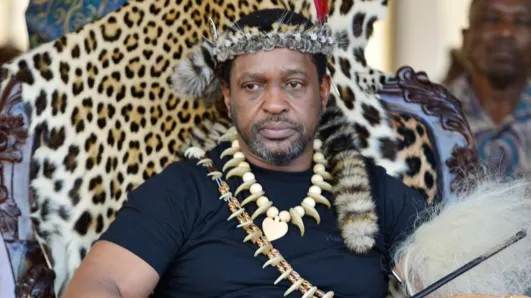
King Misuzulu kaZwelithini has called for the renaming of KwaZulu-Natal .
Image: Independent Newspapers Archives
King Misuzulu kaZwelithini's call to cull "Natal from the name KwaZulu-Natal has drawn pushback from many quarters because of the implications it carried.
Those who are opposed to King's name change proposal questioned the viability of such a move and argued that the province's history and identity would be affected, and it would carry astronomical cost implications.
Billions of rand would be sucked up by the financial, legal, and administrative implications that government departments, universities and businesses would be required to shoulder due to the renaming proces.
Motorists too are expected to feel the impact as they would require new registration plates for their vehicles.
King Misuzulu's made know his intention publicly, about three weeks ago, at the 147th commemoration of the Battle of Isandlwana event. He told his audience that “Natal” must be dropped from KZN's name.
His argument was that the region was historically known as KwaZulu under the Zulu kingdom before Natal was brought into the province's name during the colonial era.
Economists, governance specialists, legal experts, and brand strategists expressed their dissatisfaction and used previous renaming exercises to illustrate the cost implications.
When the Northern Province was renamed Limpopo in 2002, the estimated cost of the process was about R40 million, covering new signage, stationery, and promotional materials, a figure that sparked public debate at the time.
Professor Jannie Rossouw of Wits Business School said: “Renaming is always expensive. I have no doubt the full cost for KwaZulu-Natal will run into billions of rands.”
He questioned whether such expenditure should be a priority. “I feel that we have more important challenges than name changes in South Africa."
He added that institutions such as the University of KwaZulu-Natal (UKZN) would face significant expenses.
“The university will have to consider its own costs. I would be sad if the name changed, as I did my PhD at UKZN and am proud of my association with it.
''When politicians, and a king in this instance, cannot do what they should to improve lives, they start doing things they can, like changing names,'' he said.
Professor Purshottama Reddy, Senior Professor in Public Governance at UKZN, also opposed the change under current conditions.
“I am not in favour of changing the province’s name to just ‘KwaZulu’,” he said. While he might have supported it during the early transition to democracy, he argued that the country’s current challenges make it unwise to do so.
"Had this been done about 25–30 years ago, I would have certainly supported it, as it was still the transition period and we were all in quite a euphoric mood then,” he said.
He cited political instability within the Government of Provincial Unity, motions of no confidence brought by the MK Party, serious service delivery challenges, corruption, dysfunctional municipalities, low economic growth, and rising youth unemployment.
“We need to respond to these pressing challenges rather than focus on cosmetic name changes, which are not going to enhance the lives of the poor and indigent,” he said.
Reddy warned that renaming would incur high costs, including legislative and policy processes, as well as updating the names of public and private institutions, letterheads, and official documentation.
“Will all these cosmetic changes improve governance and quality of life for the masses? Most certainly not,” he said.
Brand strategist and founder of Circle Media, Arthur Vengai, described the proposal as a large-scale institutional rebrand.
“From a brand perspective, the highest costs are not logos or design. Major expenses lie in implementation, legislative amendments, updates across government databases, signage replacement, procurement cycles, compliance documentation, and digital migration.
Every statutory reference, database entry, procurement template, and public-facing asset must align. The ripple effect across institutions is significant.”
Vengai also noted potential impacts on international recognition: “KwaZulu-Natal carries decades of brand equity in tourism, port trade, and academia. Changing the name partially resets familiarity and requires careful communication to avoid confusion among investors and global partners.”
For institutions like UKZN, the costs could run tens or hundreds of millions of rand, affecting legal statutes, degree certificates, research indexing, global academic partnerships, alumni records, and digital systems, he said.
He added that a phased approach, legal recognition first, and infrastructure updates over time, would be the most practical way to manage costs.
Political analyst Siyabonga Ntombela said the proposal aligns with decolonisation.
“Removing Natal would symbolically sever the former province of the Union of South Africa, similar to the 1910 move when the four provinces replaced the British colonies. The King is not doing something new.”
However, he questioned its political traction: “Even the ANC dismissed it. Only the IFP supports the proposal. Costs could hit departmental logos, institutional branding, UKZN, and vehicle number plates, all in a province still recovering from flood damage and the 2021 July unrest.”
Meanwhile,Professor Sihawukele Ngubane, an academic at UKZN specialising in African languages and Zulu culture, said the authority to change a provincial name rests with Parliament.
“The change of provincial names is a jurisdiction of parliament. The process is debated in parliament and is subject to public participation,” Ngubane said. He added that the King, as custodian of culture, “has a right to initiate the discussion.”
Ngubane explained that the relevant portfolio committee would table a Bill in the National Assembly, after which it would follow parliamentary processes.
Ngubane said the name “Natal” was given by Portuguese explorer Vasco da Gama in 1497 and reflects European colonial and Christian heritage. In contrast, “KwaZulu” means “place of the Zulu” or land belonging to the Zulu people, he said.
From a corporate law perspective, Leisha Chiba of Spoor & Fisher said companies registered with “KwaZulu-Natal” would not be required to re-register.“
“No, these companies would not be compelled to re-register or change their company name. By way of example, the Companies Register still reflects registered company names which incorporate ‘Transvaal’,” she said.
Contracts referring to KwaZulu-Natal would remain valid, and businesses using “KZN” or “KwaZulu-Natal” in their branding would also remain free to do so, she said.
However, if proprietors chose to adopt “KwaZulu” in their trade marks, legal questions could arise depending on how prominently “Natal” features in the registered mark, she said.
DAILY NEWS